Description
Players own a share of an entity.
Discussion
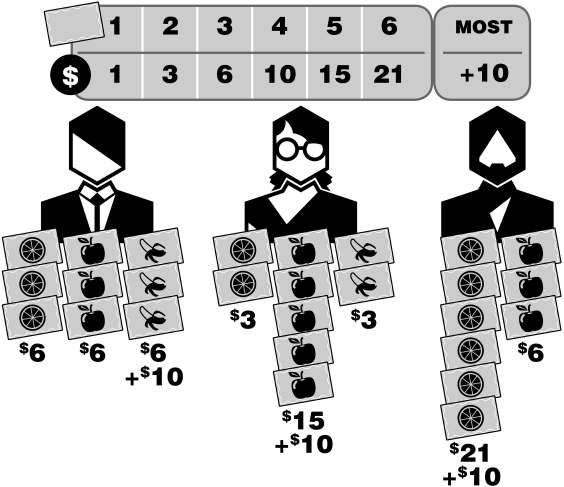
Typically, this Investment mechanism represents ownership in the form of stock. Players may buy shares of stock and accrue benefits based on the amount of stock owned. The benefits take two basic forms. In the simplest, players earn a dividend based on the number of shares owned. This may occur periodically, or at specific trigger points. Other systems give benefits to the player who owns the most shares, or to the top shareholders. This is very similar to an Area Majority system (ARC-02), so the considerations there apply. Often it is a combination of these two. In Acquire, for example, players buy shares in hotel chains, which grow during the game, and merge if they touch. When a chain merges, each share pays a set amount, with the top two shareholders earning special bonuses.
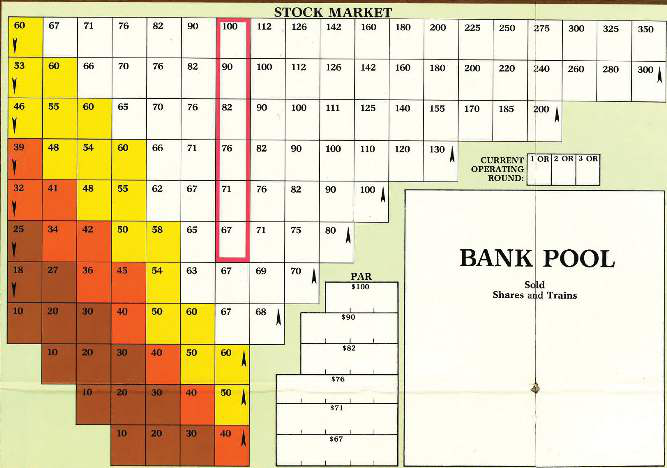
In Airlines, scoring happens at variable intervals based on Card Draw (CAR-04). Each airline awards points based on the number of flight paths it has claimed on the board. The player with the most gains one VP per flight path, and the player with the second-most gains half of that. The parallels with Area Majority are clear, as having one more share than your opponent is just as good as owning 100% of the shares. The number of shares that are available is usually limited. In Airlines, it varies by company, so players can lock in a guaranteed majority by having, for example, 4 shares in a 7-share company. This is distinct from the typical Area Majority game, where players can put as many resources as they like into a single entity. This distinctive mechanism is sometimes referred to as Area Control. Another instructive example in Airlines is the way values change for different airlines. Each has a different number of markers that can be placed on the map to claim more routes. Airlines with more shares have more markers. This makes them potentially more valuable, but players must do more to gain and have the most shares. See Connections (VIC-14) and Network Building (SET-04) for further discussion (Illustration 7.5). Illustration 7.5 The stock market track in 1830. A marker on this track indicates the current value of a stock share for each corporation. Buying stock moves the marker up and selling moves it down. Issuing dividends moves it to the right while withholding them shifts it to the left.
An analogous but different form of Investment is Contribution. Players who contribute to a particular effort are entitled to a share of the spoils. For example, in Tobago, players contribute clues to narrow down the location of a treasure. When it is located, players who contributed clues to the correct location earn a reward. In Dragon’s Gold, players cooperate to slay a dragon, and players who participate (no matter to what degree) are entitled to participate in the negotiations to divide the treasure.
Sample Games
Acquire (Sackson, 1964) Airlines (Moon, 1990) Chicago Express (Wu, 2007) Dragon’s Gold (Faidutti, 2001) Get the Goods (Ado and Moon, 1996) Shark (Vanaise, 1987) Tobago (Allen, 2009) Wheedle (Knizia, 2002)
描述
玩家拥有实体的一部分股份。
讨论
通常,这种投资(Investment)机制以股票的形式代表所有权。玩家可以购买股票并根据拥有的股票数量获得利益。利益采取两种基本形式。最简单的情况下,玩家根据拥有的股份数量获得股息。这可能定期发生,或在特定触发点发生。其他系统给予拥有最多股份的玩家或顶级股东利益。这与区域多数系统(ARC-02)非常相似,因此那里的考虑适用。通常它是这两种的结合。例如,在《Acquire》中,玩家购买连锁酒店的股票,这些连锁酒店在游戏过程中增长,如果接触则合并。当连锁店合并时,每股支付固定金额,前两名股东获得特别奖金。
在《Airlines》中,计分根据抽牌(CAR-04)以不定间隔发生。每家航空公司根据其在版图上声称的航线数量奖励积分。拥有最多的玩家每条航线获得1VP,第二多的获得一半。与区域多数的相似之处显而易见,因为拥有比对手多一股就像拥有100%的股票一样好。可用的股份数量通常是有限的。在《Airlines》中,它因公司而异,因此玩家可以通过拥有(例如)7股公司中的4股来锁定保证的多数。这与典型的区域多数游戏不同,在那个游戏中,玩家可以将任意数量的资源投入单个实体。这种独特的机制有时被称为区域控制(Area Control)。《Airlines》中的另一个有启发性的例子是不同航空公司的价值变化方式。每家都有不同数量的标记可用于在地图上声称更多航线。拥有更多股份的航空公司拥有更多标记。这使得它们可能更有价值,但玩家必须做更多工作才能获得并拥有最多的股份。有关进一步讨论,请参阅连接(Connections,VIC-14)和网络建设(Network Building,SET-04)(插图7.5)。插图 7.5 《1830》中的股票市场轨道。此轨道上的标记指示每家公司的股票当前价值。购买股票向上移动标记,出售则向下移动。发放股息将其向右移动,而扣留股息将其向左移动。
投资的一种类似但不同的形式是贡献(Contribution)。为特定工作做出贡献的玩家有权分享战利品。例如,在《Tobago》中,玩家提供线索以缩小宝藏的位置。当它被找到时,为正确位置提供线索的玩家获得奖励。在《Dragon’s Gold》中,玩家合作杀死一条龙,参与的玩家(无论程度如何)都有权参与瓜分宝藏的谈判。
游戏范例
Acquire (Sackson, 1964) - 《Acquire》 Airlines (Moon, 1990) - 《Airlines》 Chicago Express (Wu, 2007) - 《芝加哥快递》 Dragon’s Gold (Faidutti, 2001) - 《Dragon’s Gold》 Get the Goods (Ado and Moon, 1996) - 《Get the Goods》 Shark (Vanaise, 1987) - 《Shark》 Tobago (Allen, 2009) - 《Tobago》 Wheedle (Knizia, 2002) - 《Wheedle》