Description
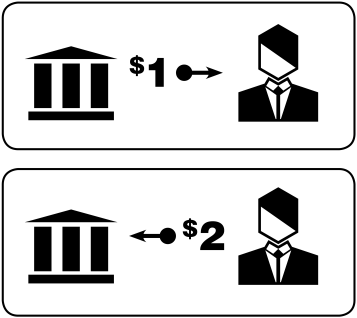
Players may take a Loan from the bank to get more money.
Discussion
Many games with money allow players to borrow. These can serve several purposes for the design. First, they can be punishments for players who do not manage their money properly and exist to keep those players in the game. But they can also provide a means to victory, giving players the resources required to jump-start their engine or complete a big project. In fact, some games, like Railroad Tycoon: The Board Game, essentially require taking Loans to be a part of a winning strategy. Designers need to be careful to frame the concept of Loans in their game to incentivize players in the appropriate way. There are several varieties of Loan mechanisms in games, around the way they are paid back, and other effects they have on the game. In some games, Loans are never paid back during the game. Tey simply count against a player’s final money totals or victory points. In other games, such as Railways of the World, players pay interest each turn based on bonds they have issued (another way of representing Loans). Whenever a player wishes, they may take a bond certificate and 1,000 per bond, and bonds may never be repaid. Players lose one victory point (VP) for each bond they have at the end of the game.
In Brass, players may use an action to take a loan of 20 for the first, 25. Any Loans held at the end of the game reduce the score by three VPs. In Monopoly, players may take Loans but need to disable one of their properties to do so. Flipping a property allows the player to take the mortgage value from the bank. While it is flipped, the player may not collect rent if someone lands on the property. To unmortgage a property, a player must pay the mortgage value plus 10% interest. Other than the loss of the use of the property, there is no penalty for having a property mortgaged through the entire game. By rule, players must mortgage properties when faced with a cost that they cannot pay. This mechanism takes choices away from players, while needlessly extending a trailing player’s long, slow, death spiral. Designers should avoid this type of mechanism.
Sample Games
Age of Steam (Wallace, 2002) Brass (Wallace, 2007) Container (Delonge and Ewert, 2007) Monopoly (Darrow and Magie, 1933) Railroad Tycoon: The Boardgame (Drover and Wallace, 2005) Railways of the World (Drover and Wallace, 2005) Wealth of Nations (Carroll, 2008)
描述
玩家可以向银行借贷(Loan)以获得更多资金。
讨论
许多有金钱的游戏允许玩家借贷。这对设计有几个目的。首先,它们可以是对没有妥善管理资金的玩家的惩罚,并且是为了让那些玩家继续留在游戏中。但它们也可以提供一种胜利手段,给玩家提供启动引擎或完成大项目所需的资源。事实上,有些游戏,如《铁路大亨》(Railroad Tycoon: The Board Game),本质上需要将借贷作为获胜策略的一部分。设计师需要小心在游戏中构建借贷的概念,以适当的方式激励玩家。游戏中有几种借贷机制,围绕它们的偿还方式以及它们对游戏的其他影响。在有些游戏中,贷款在游戏期间永远不会偿还。它们只是算在玩家的最终资金总额或胜利点数中。在其他游戏中,例如《Railways of the World》,玩家每回合根据他们发行的债券(代表贷款的另一种方式)支付利息。只要玩家愿意,他们可以拿走一张债券证书和1,000,债券不能偿还。在游戏结束时,玩家每拥有一张债券就会失去一分胜利点数(VP)。
在《Brass》中,玩家可以使用一个行动获得20,第二笔25。游戏结束时持有的任何贷款使分数减少降低三个VP。在《大富翁》(Monopoly)中,玩家可以贷款,但需要禁用他们的一处房产。翻转房产允许玩家从银行获取抵押价值。当它被翻转时,如果有人落在该房产上,玩家不能收取租金。要解除抵押房产,玩家必须支付抵押价值加上10%的利息。除了失去房产的使用权外,整个游戏中抵押房产没有任何惩罚。根据规则,当面临无法支付的费用时,玩家必须抵押房产。这种机制剥夺了玩家的选择权,同时不必要地延长了落后玩家漫长、缓慢的死亡螺旋。设计师应避免此类机制。
游戏范例
Age of Steam (Wallace, 2002) - 《蒸汽时代》 Brass (Wallace, 2007) - 《工业革命》 Container (Delonge and Ewert, 2007) - 《集装箱》 Monopoly (Darrow and Magie, 1933) - 《大富翁》 Railroad Tycoon: The Boardgame (Drover and Wallace, 2005) - 《铁路大亨》 Railways of the World (Drover and Wallace, 2005) - 《世界铁路》 Wealth of Nations (Carroll, 2008) - 《国富论》