Description
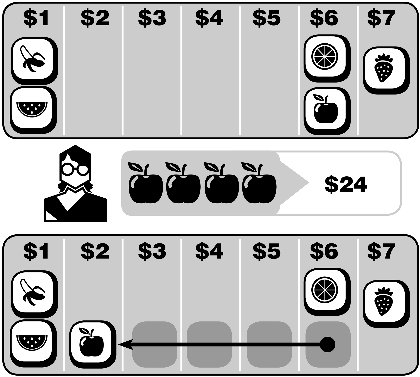
Players may buy from or sell resources to Markets, where prices and quantities can vary.
Discussion
Markets are a specialized form of Exchanging (ECO-01), as players are typically exchanging stocks or commodities for money, all of which are resources. However, there are some specific considerations for this implementation, particularly around changing prices. Note that we are defining a Market mechanism as one where prices change. Mechanisms like that, found in Concordia, where you can buy or sell for a fixed value throughout the game would fall under Exchange, even though it is called a Market. One mechanism for varying prices is using a track as in Supremacy, where there is a price track for each commodity, with a marker indicating the current buy/sell price. If a player sells that commodity the price is reduced, and if they buy it, the price increases. If a player buys or sells multiple units, all units can either be sold at the same price prior to adjustment (as in Supremacy) or can drop one space with each good sold (as in Crude). While the latter makes it more difficult for players to exploit the system, it makes the calculations a bit more complex.
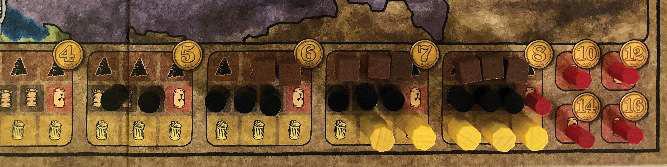
Price tracks can be 2-dimensional grids, as in the 18xx series. In those games, selling shares makes prices move down within a pricing column, while issuing dividends moves it to another column with a different price scale. This gives more fine-grained control to the design, and there can be special effects when the price hits the top or bottom of a row or column. Rather than have a marker record the current price, the actual commodity tokens can do so. This is done by placing one commodity per space on the pricing track. The price of the commodity is based on the farthest space up the track covered by the commodity, or sometimes the farthest visible space. As commodities are bought, higher price spaces are revealed, and as they are sold, the higher price spaces are covered so the price drops. Visually, the former method usually calls for numbers to be printed above or below the track spaces, which takes up more room, while the latter allows the numbers to be printed on the track spaces themselves. This elegant track system is used in Crude, Power Grid, and others. When players take a resource off the track, they simultaneously are adjusting the pricing for that resource, without having to remember to do anything else. Wealth of Nations adds a twist in that the buy and sell prices are not the same in each space. There is a delta that creates friction in the market system (Illustration 7.1). Markets can sometimes be one-way ratchets. In Acquire, players may only buy shares from the market, not sell them. And as the hotel chains they represent expand, the price of the shares goes up and can never go down. In other cases, like Rococo, prices for thread and fabric go down throughout the course of the turn, decreasing as each player makes purchases. This ostensibly models the decline of prices in a bazaar as closing time approaches and is also helpful for balancing first-player turn-order advantage. Market systems create a lot of player interaction, as players may attempt to manipulate the price to their advantage or deprive their opponent of the Illustration 7.1 The market in Power Grid. Coal (the brown cubes) cost 6, oil (black) 5, and trash (yellow) 7. If two coals are purchased, the next would cost 7.
ability to gain needed resources. Tey also help to self-balance resource pro-duction. If one resource is being over-produced or under-used by the players, the price will be driven downward, and players will adjust accordingly. In a system where the physical resource tokens are placed on the market track, they may even become completely unavailable if players are hoarding them.
Sample Games
1830 (Tresham, 1986) Acquire (Sackson, 1964) Chicago Express (Wu, 2007) Concordia (Gerdts, 2013) Crude: The Oil Game (St. Laurent, 1974) Greed Incorporated (Doumen and Wiersinga, 2009) Power Grid (Friese, 2004) Rococo (Cramer, Malz, and Malz, 2013) Shark (Vanaise, 1987) Stockpile (Sobol and Orden, 2015) Supremacy (Simpson, 1984) Wealth of Nations (Carroll, 2008)
描述
玩家可以向市场购买或出售资源,其中价格和数量可能会变化。
讨论
市场(Markets)是交换(ECO-01)的一种特殊形式,因为玩家通常是用股票或商品交换金钱,所有这些都是资源。然而,此实现有一些具体考虑因素,特别是围绕价格变化。请注意,我们将市场机制定义为价格变化的机制。像在《Concordia》中发现的那样,你可以以固定价值买卖整个游戏的机制将属于交换,即使它被称为市场。改变价格的一种机制是像在《Supremacy》中那样使用轨道,每种商品都有一条价格轨道,带有一个标记指示当前的买入/卖出价格。如果玩家出售该商品,价格会降低,如果通过购买,价格会增加。如果玩家购买或出售多个单位,所有单位可以在调整前以相同价格出售(如在《Supremacy》中),或者每售出一个商品价格就下降一格(如在《Crude》中)。虽然这一者使玩家更难利用系统,但它使计算稍微复杂一些。
价格轨道可以是二维网格,如在18xx系列中。在那些游戏中,出售股票使价格在定价列中向下移动,而发行股息将其移动到不同价格等级的另一列。这给设计提供了更细粒度的控制,并且当价格达到行或列的顶部或底部时可能会有特殊效果。实际的商品标记可以记录当前价格,而不是用标记记录。这是通过在定价轨道上的每个空间放置一个商品来完成的。商品的价格基于该商品覆盖的轨道上的最远空间,或者有时是最远可见空间。随着商品被购买,显示更高价格的空间,并且随着它们被出售,更高价格的空间被覆盖,因此价格下降。在视觉上,前一种方法通常要求将数字印在轨道空间的上方或下方,这占用更多空间,而后者允许将数字印在轨道空间本身上。这种优雅的轨道系统用于《Crude》、《电力公司》(Power Grid)等。当玩家从轨道上拿走资源时,他们同时也调整了该资源的定价,而不必记得做任何其他事情。《Wealth of Nations》增加了一个转折,即每个空间的买入和卖出价格并不相同。有一个差额在市场系统中产生摩擦(插图7.1)。市场有时可以是单向棘轮。在《Acquire》中,玩家只能从市场购买股票,而不能出售。随着他们代表的连锁酒店扩张,股票价格上涨,永远不会下跌。在其他情况下,如《洛可可》(Rococo),线和布的价格在整个回合中下降,随着每个玩家进行购买而减少。表面上这模仿了随着关门时间临近集市价格的下降,并且也有助于平衡首位玩家的回合顺序优势。市场系统创造了大量的玩家互动,因为玩家可能试图操纵价格以对自己有利或剥夺对手的能力(插图7.1 《电力公司》中的市场。煤(棕色方块)花费6,石油(黑色)5,垃圾(黄色)7。如果购买两块煤,下一块将花费7)。
获得所需资源的能力。它们也有助于自我平衡资源生产。如果一种资源被玩家过度生产或利用不足,价格将被压低,玩家将相应调整。在将物理资源标记放置在市场轨道上的系统中,如果玩家囤积它们,它们甚至可能变得完全不可用。
游戏范例
1830 (Tresham, 1986) - 《1830》 Acquire (Sackson, 1964) - 《Acquire》 Chicago Express (Wu, 2007) - 《芝加哥快递》 Concordia (Gerdts, 2013) - 《和谐罗马》 Crude: The Oil Game (St. Laurent, 1974) - 《原油:石油游戏》 Greed Incorporated (Doumen and Wiersinga, 2009) - 《贪婪公司》 Power Grid (Friese, 2004) - 《电力公司》 Rococo (Cramer, Malz, and Malz, 2013) - 《洛可可》 Shark (Vanaise, 1987) - 《Shark》 Stockpile (Sobol and Orden, 2015) - 《股市大亨》 Supremacy (Simpson, 1984) - 《Supremacy》 Wealth of Nations (Carroll, 2008) - 《国富论》