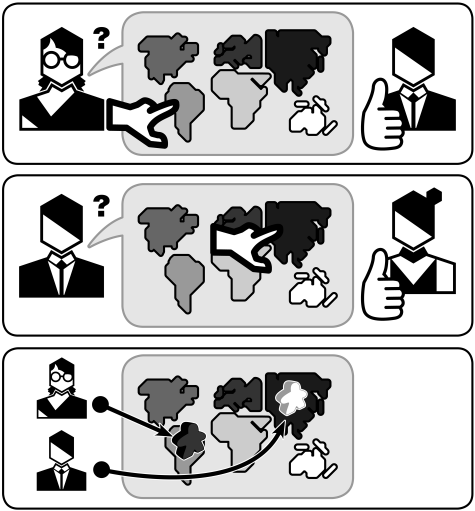
Description
Players make agreements about courses of action.
Discussion
Negotiation as a mechanism is very similar to Trading (ECO-02). We are drawing a distinction here between the exchange of resources, which defines Trading, and the influencing of actions that people take, usually in exchange for a promised action by the negotiating player. Bribery (ECO-16) combines these, exchanging resources for an action. The dividing line here is certainly fuzzy but useful. Negotiation games often include deals that are non-binding. Diplomacy is a classic example. Players can discuss and coordinate moves, but nothing in the game binds players to follow through when they secretly write their orders.
Designers may include rules that mandate binding Negotiations. Typically, these require that the terms of the deal be resolved immediately and not extend to future turns or actions. This is a practical matter, as it becomes difficult to remember what the negotiated deal terms were and eliminates the need to include rules for what happens if the agreed-upon action physically cannot be performed. Non-binding deals raise the emotional stakes for many players because they raise questions of honesty and loyalty, which are social rather than economic norms. Negotiations can also dramatically lengthen games, and so negotiation periods may need to be time-limited. While any game is potentially subject to players negotiating, there are a few techniques for designers to add it as a specific feature. One is to have a dedicated Negotiation or discussion phase, as is done in Diplomacy or The Resistance. The rules should contain some structure around the length of Negotiations and what is or is not binding. Negotiation can also be encouraged through Voting (RES-15), Hidden Roles (UNC-04), and Simultaneous Action Selection (TRN-09). These mechanisms introduce discussion and negotiation naturally, although it is recommended that the legality of negotiation (and again, the scope), be referenced in the rules. Finally, negotiation can be supported thematically. Games that are modeling deals or politics (like I’m the Boss or Republic of Rome) will naturally lead to player negotiation.
Sample Games
Cosmic Encounter (Eberle, Kittredge, Norton, and Olatka, 1977) Diplomacy (Calhamer, 1959) A Game of Trones (Petersen and Wilson, 2003) I’m the Boss (Sackson, 1994) Intrigue (Dorra, 1994) Republic of Rome (Berthold, Greenwood, and Haines, 1990) The Resistance (Eskrisge, 2009) Werewolf (Davidoff and Plotkin, 1986)
描述
玩家就行动方案达成协议。
讨论
谈判(Negotiation)作为一种机制与交易(ECO-02)非常相似。我们在这里区分了定义交易的资源交换,以及影响人们采取的行动,通常是为了换取谈判玩家承诺的行动。贿赂(ECO-16)结合了这些,用资源换取行动。这里的分界线肯定是模糊的,但是有用的。谈判游戏通常包括不具约束力的交易。《外交》(Diplomacy)是一个典型的例子。玩家可以讨论和协调行动,但是在他们秘密写下订单时,游戏没有任何东西约束玩家坚持到底。
设计师可能包括要求具有约束力的谈判的规则。通常,这些要求交易条款立即解决,并且不扩展到未来的回合或行动。这是一个实际问题,因为很难记住谈判的交易条款是什么,并且消除了如果商定的行动实际上无法执行会发生什么的规则的需要。不具约束力的交易增加了许多玩家的情感赌注,因为它们提出了诚实和忠诚的问题,这更多是社会规范而不是经济规范。谈判也可以大大延长游戏时间,因此谈判期可能需要时间限制。虽然任何游戏都可能受玩家谈判的影响,但设计师有一些技术可以将其添加为特定功能。一种是有专门的谈判或讨论阶段,如在《外交》或《抵抗组织》(The Resistance)中所做的那样。规则应该包含一些围绕谈判长度以及什么有约束力或无约束力的结构。还可以通过投票(RES-15)、隐藏角色(UNC-04)和同时行动选择(TRN-09)来鼓励谈判。这些机制自然地引入了讨论和谈判,尽管建议在规则中引用谈判的合法性(及范围)。最后,谈判可以在主题上得到支持。模拟交易或政治的游戏(如《I’m the Boss》或《Republic of Rome》)自然会导致玩家谈判。
游戏范例
Cosmic Encounter (Eberle, Kittredge, Norton, and Olatka, 1977) - 《银河遭遇战》 Diplomacy (Calhamer, 1959) - 《外交》 A Game of Thrones (Petersen and Wilson, 2003) - 《权力的游戏》 I’m the Boss (Sackson, 1994) - 《我是老板》 Intrigue (Dorra, 1994) - 《阴谋/篡位》 Republic of Rome (Berthold, Greenwood, and Haines, 1990) - 《罗马共和国》 The Resistance (Eskrisge, 2009) - 《抵抗组织》 Werewolf (Davidoff and Plotkin, 1986) - 《狼人杀》