Description
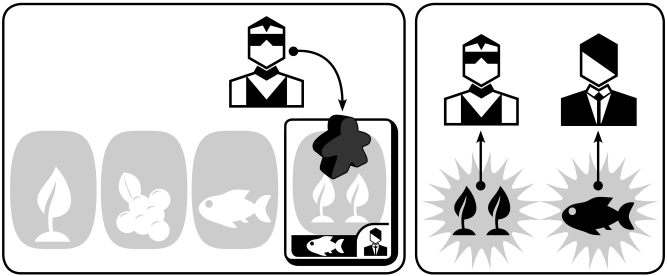
Players own entities and perform actions for those entities or collect benefits if others use them.
Discussion
In Le Havre and Caylus, players may build buildings, which become new action spaces that all workers can use (see “Worker Placement” in Chapter 9 for more details). Typically, the owner can use the space free of charge, but when other players use the space, they must pay a fee to the owner. This type of Ownership mechanism introduces a lot of different value calculations for the player. If I invest in this building, is it attractive enough that other players will use it and I will recoup my investment? If I take advantage of a building owned by another player, will it benefit my opponent more than me? As such, this mechanism can create a lot of player interaction. In many rail games, including Empire Builder, Railway Rivals, and Rail Baron, players may use tracks built by other players for a fixed cost. This leads to decisions about how often a player may need to take a certain route in the future and rent-vs.-buy calculations (Illustration 7.6). A more advanced form of Ownership is featured in 1830, 18xx games more generally, Imperial, and more. In these games, players purchase shares in companies (or countries in the case of Imperial), and the player with the most shares is the executive owner and has the ability to take actions on behalf of that entity. In 1830, players can build tracks and stations, buy
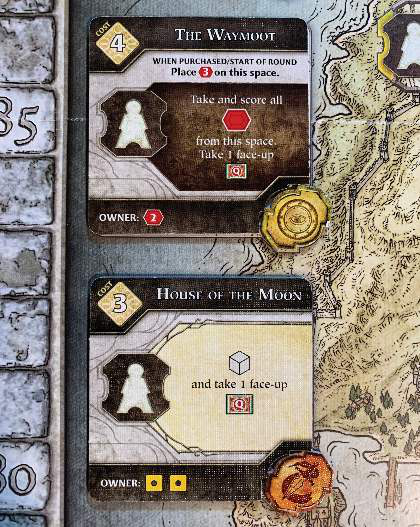
trains, and decide whether or not to issue dividends. In Imperial, players may build armies or navies, declare war on other countries, or build up their economy. Typically, the money and assets of the company belong to the company. Players have their own money and assets, and these are strictly separate. There are specific means by which players can profit from running the company, not all of which are to the benefit of the company or the other shareholders. Like in real-world business, there are many strategies for enrichment, and these games offer a high level of complexity and steeper learning curves. If a player obtains more shares than the current owner, they take over Ownership. This can lead to major shifts in board state. While owners usually don’t like to lose their position, it can sometimes be an important tactic, particularly in the 18xx series of games. In those, the corporations, which represent railroad companies, must have trains. When trains become obsolete, they are discarded, and new ones must be purchased. If the railroad does Illustration 7.6 In Lords of Waterdeep, players may construct buildings which they then own. This is indicated by the color chip placed in the lower right. They gain a benefit if other players visit them, as shown in the bottom “OWNER” section of the building.
not have enough money, the owner must pay for new trains out of pocket. An important tactic is for the owner to drain money out of the company treasury and then dump their shares to stick the almost-bankrupt company with another player. Greed Incorporated is also based around this idea, as the key strategy in this game is getting Ownership of a company, getting it pay you bonuses, and bailing out before it goes under. Ownership of this type makes a game multilevel. Players need to consider the individual player positions within companies, the companies’ positions on the board, and the relative strengths and cash positions of all.
Sample Games
1830 (Tresham, 1986) Acquire (Sackson, 1964) Belfort (Cormier and Lim, 2011) Caylus (Attia, 2005) Empire Builder (Bromley and Fawcett, 1982) Greed Incorporated (Doumen and Wiersinga, 2009) Imperial (Gerdts, 2006) Le Havre (Rosenberg, 2008) Lords of Waterdeep (Lee and Tompson, 2012) Rail Baron (Erickson and Erickson, 1977) Railway Rivals (Watts, 1984)
描述
玩家拥有实体并为这些实体执行行动,或者在其他人使用它们时收集利益。
讨论
在《勒阿弗尔》(Le Havre)和《凯吕斯》(Caylus)中,玩家可以建造建筑物,这些建筑物成为所有工人都可以使用的新行动空间(有关详细信息,请参阅第9章中的“工人放置”)。通常,所有者可以免费使用该空间,但当其他玩家使用该空间时,他们必须向所有者支付费用。这种类型的所有权(Ownership)机制为玩家引入了许多不同的价值计算。如果我投资这座建筑,它是否有足够的吸引力让其他玩家使用它并且我将收回投资?如果我利用另一位玩家拥有的建筑物,它对我对手的利处会多于我吗?因此,这种机制可以创造大量的玩家互动。在许多铁路游戏中,包括《Empire Builder》、《Railway Rivals》和《Rail Baron》,玩家可以使用其他玩家建造的轨道,费用固定。这导致了关于玩家将来可能需要采取某条路线的频率以及租与买的计算(插图7.6)。《1830》(以及更普遍的18xx游戏)、《Imperial》等游戏中具有更高级形式的所有权。在这些游戏中,玩家购买公司的股份(或在《Imperial》中是国家),拥有最多股份的玩家是执行所有者,并有能力代表该实体采取行动。在《1830》中,玩家可以建造轨道和车站,购买
火车,并决定是否发放股息。在《Imperial》中,玩家可以建立军队或海军,向其他国家宣战,或建立其经济。通常,公司的金钱和资产属于公司。玩家拥有自己的金钱和资产,这些是严格分开的。有具体的手段让玩家可以从经营公司中获利,并非所有手段都对公司或其他股东有利。就像在现实世界的商业中一样,致富的策略有很多,这些游戏提供了高水平的复杂性和更陡峭的学习曲线。如果一名玩家获得的股份目前的拥有者多,他们就会接管所有权。这可能导致版图状态的重大转变。虽然所有者通常不喜欢失去他们的地位,但这有时可能是一个重要的战术,特别是在18xx系列游戏中。在那些游戏中,代表铁路公司的公司必须拥有火车。当火车过时时,它们被丢弃,必须购买新的。如果铁路
插图7.6 在《深水城领主》(Lords of Waterdeep)中,玩家可以建造他们随后拥有的建筑物。这由放置在右下角的颜色筹码指示。如果其他玩家访问它们,他们会获得好处,如建筑物底部“OWNER”(所有者)部分所示。
没有足够的钱,所有者必须自掏腰包购买新火车。一个重要的战术是所有者耗尽公司金库的钱,然后抛售他们的股份,将几乎破产的公司留给另一位玩家。《Greed Incorporated》也是基于这个想法,因为这个游戏的关键策略是获得公司的所有权,让它付给你奖金,并在它破产之前逃离。这种类型的所有权使游戏变得多层次。玩家需要考虑公司内部的个人玩家地位,公司在版图上的位置,以及所有人的相对实力和现金状况。
游戏范例
1830 (Tresham, 1986) - 《1830》 Acquire (Sackson, 1964) - 《Acquire》 Belfort (Cormier and Lim, 2011) - 《Belfort》 Caylus (Attia, 2005) - 《凯吕斯》 Empire Builder (Bromley and Fawcett, 1982) - 《Empire Builder》 Greed Incorporated (Doumen and Wiersinga, 2009) - 《贪婪公司》 Imperial (Gerdts, 2006) - 《Imperial》 Le Havre (Rosenberg, 2008) - 《勒阿弗尔》 Lords of Waterdeep (Lee and Tompson, 2012) - 《深水城领主》 Rail Baron (Erickson and Erickson, 1977) - 《Rail Baron》 Railway Rivals (Watts, 1984) - 《Railway Rivals》