Description
Resources are generated from a random process and distributed to qualifying players.
Discussion
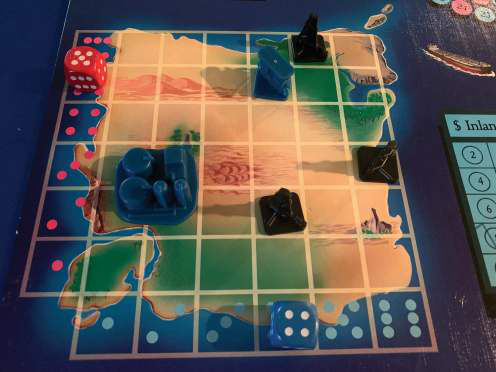
The Random Production mechanism was introduced in Crude but was popularized in Catan. In both of these games, players begin their turn by rolling two dice. In Catan, the die result determines which tiles activate, and any players with settlements or cities touching that tile receive resources. In Crude, the dice activate both the related row and column for the active players, and either the related column or row for their neighbor (Illustration 7.4). This mechanism keeps all players involved in other players’ turns, by offering the possibility of gaining resources. Players must remain flexible in their planning since they can’t guarantee resource production or the specific mix of resources they’ll get. There’s also a slot machine effect, as players may hit a small “jackpot” if they hit a needed number. This system was extended by Machi Koro by defining special abilities that only trigger on a player’s turn or that only trigger on other players’ turns. This was further refined in Space Base, where each ability card has two sides. The blue side has an ability that triggers on your turn. If the card is
replaced, it rotates to its red side and now triggers when an opponent rolls that number. Since, in games with more than two players, there are more opponent turns than your turns, getting cards to their red side is an important strategy. A weakness of these systems is that they can be susceptible to player perception of streaky dice rolls. In actuality, given the number of dice rolls in a typical game of Catan, it is inevitable that some numbers will be rolled more than average, which means that some will be rolled less. This introduces a level of randomness that may or may not match the design intent and player expectation. Designers also need to realize that players are poor judges of what is a normal “streak” in a game like this and will perceive their frequency as worse than average even when they are exactly as expected. The Catan Event Cards expansion introduces a deck of 36 cards featuring each of the different possible outcomes of a roll of 2d6. A reshuffle card sits five cards from the bottom, indicating when the deck is to be reshuffled. Whether this is an improvement or not is largely in the eyes of the beholder and the designer. Illustration 7.4 Each turn in Crude the active player rolls two dice, which activates a row and column in their grid of facilities, allowing production or transformation of resources. In addition, the blue die also triggers the matching column in the player to the left, while the red die triggers the row of the player to the right.
Sample Games
Catan (Teuber, 1995) Crude: The Oil Game (St. Laurent, 1974) Machi Koro (Suganuma, 2012) Space Base (Clair, 2018)
描述
资源由随机过程生成并分发给符合条件的玩家。
讨论
随机生产(Random Production)机制在《Crude》中引入,但在《卡坦岛》中普及。在这两个游戏中,玩家都以掷两个骰子开始他们的回合。在《卡坦岛》中,骰子结果决定哪些板块激活,任何拥有接触该板块的定居点或城市的玩家都会获得资源。在《Crude》中,骰子激活活跃玩家的相关行和列,以及其邻居的相关列或行(插图7.4)。此机制通过提供获得资源的可能性,让所有玩家参与其他玩家的回合。玩家必须在计划中保持灵活,因为他们无法保证资源生产或他们将获得的特定资源组合。还有一个老虎机效应,因为如果玩家击中所需的数字,他们可能会中一个小“头奖”。《Machi Koro》通过定义仅在玩家回合触发或仅在其他玩家回合触发的特殊能力扩展了该系统。这在《Space Base》中得到了进一步完善,其中每张能力卡都有两面。蓝色面具有在你回合触发的能力。如果卡牌被
替换,它旋转到红色面,现在当对手掷出该数字时触发。因为在拥有两个以上玩家的游戏中,对手的回合比你的回合多,所以将卡牌变为红色面是一个重要的策略。这些系统的弱点是它们可能容易受到玩家对连续骰子掷出的感知的影响。实际上,考虑到典型《卡坦岛》游戏中的骰子掷出次数,不可避免地会有一些数字掷出的次数超过平均水平,这意味着有些数字掷出的次数会更少。这引入了一定程度的随机性,可能符合也可能不符合设计意图和玩家期望。设计师还需要意识到,玩家在这样的游戏中对什么是正常的“连胜/连败”判断力很差,即使它们完全符合预期,也会认为它们的频率比平均水平更差。《卡坦岛事件卡》扩展包引入了一副36张牌,每张牌都具有2d6掷出的不同可能结果。一张重洗牌位于底部第五张牌,指示何时重洗牌堆。这是否是改进主要取决于旁观者和设计师的看法。插图7.4 在《Crude》的每一回合中,活跃玩家掷两个骰子,这激活了他们设施网格中的行和列,允许生产或转换资源。此外,蓝色骰子还触发左侧玩家的匹配列,而红色骰子触发右侧玩家的行。
游戏范例
Catan (Teuber, 1995) - 《卡坦岛》 Crude: The Oil Game (St. Laurent, 1974) - 《原油:石油游戏》 Machi Koro (Suganuma, 2012) - 《骰子街》 Space Base (Clair, 2018) - 《太空基地》