Description
Resources are in an ordered queue and can only be pulled from one end or, rarely, both ends but not the middle.
Discussion
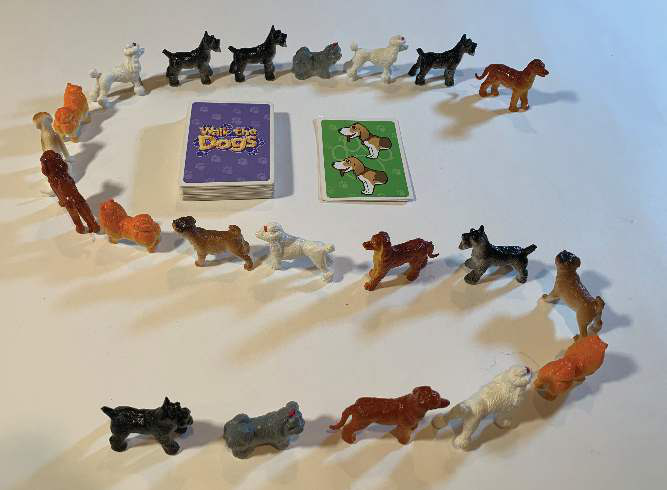
A pure expression of this mechanism can be found in Walk the Dogs. During the setup, players lay out a long line of dog figures of different breeds. Players play cards that allow them to pull a certain number of dogs from the head or tail of the line, with the objective of forming sets (SET-01 Set Valuation) (Illustration 7.9). Marracash uses multiple resource queues. Players are merchants inside the city and can purchase stalls of different colors. Customer pawns with these same colors are randomly placed in a line outside the city gates (one line per gate), and players may bring a few into the city each turn but must bring the pawns at the head of the line.
This mechanism restricts player’s abilities to act while giving them great visibility into future possibilities. All of the customer pawns are placed at the start of the game, so players have complete knowledge of the sequence at the start of the game and can plan accordingly. This is a great example of Input Randomness, where players must react to initial randomization rather than have randomness result from dice or some other randomizer to determine the outcome of an action. This mechanism is distinguished from Action Queue (ACT-06), Shared Action Queue (ACT-07), and Programmed Movement (MOV-10) in a variety of ways. First, in Resource Queue you typically only deal with the head or tail, while in the action queues you execute the entire queue each turn. Also, action queues are most often laid out, resolved, and pulled back in full each turn, rather than being laid out at the start of the game. Patchwork has a circular Resource Queue with a pawn defining the “head” of the queue. Players may take one of the next three pieces ahead of the pawn. Again, the entire circle is randomly laid out at the start of the game, so players have full visibility over everything from the start. Illustration 7.9 The line of dogs in Walk the Dogs is a Resource Queue. If the card shown is played, the player will take the two dogs at the head of the line.
In some games, the resource queue is constructed or manipulated by the players. In the darkly satirical Guillotine, at the start of each round nobles are laid out in a line. On their turn, each player will chop the head off the noble at the start of the line and earn their points. Players have cards that allow them to manipulate the line to try to arrange for the least popular (and most valuable) nobles to be at the head of the line on their turn. Similarly, in Retreat to Darkmoor, players try to maneuver their minions so that they are not last in the queue, where they may be slain by the marauding hero. Minions at the head of the line will escape to the havens in Darkmoor, where they will score for their owners. In another example, Kolejka is set in Communist-era Poland, and you send family members to different stores to wait in line to purchase goods. Players both construct the queues by sending pawns to different queues, as well as have action cards that allow them to manipulate those queues. The game Bohnanza is built around this concept of queues. Each player has a hand of bean cards and must play the leftmost card each round into their gardens. Since you are trying to plant sets of the same bean, you may not want to play the leftmost card. Trading (ECO-02) with other players allows you to pull cards from the normal queue and keep your sets intact. A card-based queue system can also be found in Aeon’s End. In this deckbuilding game (CAR-05), at the end of the turn players place all their discarded cards on top of their discard pile in any order. When the draw deck is exhausted, instead of reshuffling the discard pile, it is simply flipped over to form the new draw deck. Players have complete knowledge of the state of their deck (although admittedly with a memory element). In a looser interpretation of Resource Queue, players are not just restricted to certain elements at the head or tail but may dig deeper by paying more of a resource. This mechanism becomes a Dutch Auction (AUC-08) under these conditions and is discussed more fully in that section.
Sample Games
Aeon’s End (Riley, 2016) Bohnanza (Rosenberg, 1997) Guillotine (Peterson, 1998) Kolejka (Madaj, 2011) Marracash (Dorra, 1996) Patchwork (Rosenberg, 2014) Retreat to Darkmoor (Loomis and Shalev, 2016) Walk the Dogs (Moon, Weissblum 2005)
描述
资源处于有序队列中,只能从一端提取,或者偶尔从两端提取,但不能从中间提取。
讨论
这种机制的纯粹表达可以在《Walk the Dogs》中找到。在设置期间,玩家摆出一长排不同品种的狗模型。玩家打出的卡牌允许他们从队伍的头部或尾部拉出一定数量的狗,目的是形成套牌(SET-01集合估值)(插图7.9)。《Marracash》使用多个资源队列。玩家是城市内的商人,可以购买不同颜色的摊位。具有这些相同颜色的顾客棋子被随机放置在城门外的一条线上(每个门一条线),玩家每回合可以将一些带入城内,但必须带走队伍头部的棋子。
这种机制限制了玩家的行动能力,同时让他们对未来的可能性有极大的可见性。所有顾客棋子都在游戏开始时放置,因此玩家在游戏开始时完全了解顺序,并可以相应地进行计划。这是输入随机性的绝佳示例,玩家必须对初始随机化做出反应,而不是让随机性来自骰子或其他随机发生器来确定行动的结果。该机制在很多方面不同于行动队列(ACT-06)、共享行动队列(ACT-07)和程序化移动(MOV-10)。首先,在资源队列(Resource Queue)中,通常只处理头部或尾部,而在行动队列中,每回合执行整个队列。此外,行动队列通常每回合全部列出、解决和收回,而不是在游戏开始时列出。《拼布艺术》(Patchwork)有一个圆形的资源队列,有一个棋子定义队列的“头”。玩家可以拿走棋子前方接下来的三个板块之一。再次强调,整个圆圈是在游戏开始时随机布置的,因此玩家从一开始就对一切都有完全的可见性。插图7.9 《Walk the Dogs》中的狗阵列是一个资源队列。如果打出所示的牌,玩家将带走队伍头部的两只狗。
在某些游戏中,资源队列由玩家构建或操纵。在具有黑色讽刺意味的《Guillotine》中,每轮开始时,贵族排成一行。在他们的回合,每位玩家将砍掉排在队伍首位的贵族的头,并赚取他们的分数。玩家拥有允许他们操纵队伍的卡牌,试图安排最不受欢迎(也是最有价值)的贵族在他们的回合处于队伍首位。同样,在《Retreat to Darkmoor》中,玩家试图操纵他们的随从,使他们不处于队列的最后,在那里他们可能会被掠夺的英雄杀死。队伍首位的随从将逃到Darkmoor的避难所,在那里他们将为所有者得分。在另一个例子中,《排队》(Kolejka)设定在共产主义时代的波兰,你派家庭成员去不同的商店排队购买商品。玩家既通过将棋子发送到不同的队列来构建队列,又拥有允许他们操纵这些队列的行动卡。《种豆》(Bohnanza)也是围绕队列概念构建的。每个玩家都有一手豆子牌,每轮必须将最左边的牌打入他们的田地。由于你试图种植同种豆子的套牌,你可能不想打出最左边的牌。与其他玩家交易(ECO-02)允许你从正常队列中取出卡牌并保持你的套牌完整。在《Aeon’s End》中也可以找到基于卡牌的队列系统。在这个牌库构筑游戏(CAR-05)中,在回合结束时,玩家将所有弃牌以任意顺序放在弃牌堆顶部。当抽牌堆耗尽时,不是重新洗牌弃牌堆,而是简单地将其翻转以形成新的抽牌堆。玩家完全了解其牌组的状态(虽然公认带有记忆元素)。在资源队列的更宽松解释中,玩家不仅限于头部或尾部的某些元素,还可以通过支付更多资源来挖掘更深。这种机制在这些条件下变成荷兰式拍卖(AUC-08),并在该部分中进行了更充分的讨论。
游戏范例
Aeon’s End (Riley, 2016) - 《末日决战》 Bohnanza (Rosenberg, 1997) - 《种豆》 Guillotine (Peterson, 1998) - 《Guillotine》 Kolejka (Madaj, 2011) - 《排队》 Marracash (Dorra, 1996) - 《Marracash》 Patchwork (Rosenberg, 2014) - 《拼布艺术》 Retreat to Darkmoor (Loomis and Shalev, 2016) - 《Retreat to Darkmoor》 Walk the Dogs (Moon, Weissblum 2005) - 《Walk the Dogs》
Auctions
A common concern in game design is how to allocate resources fairly among players. One of the most versatile solutions is an auction. Auctions pro-vide for player agency, drama, interaction, strategy, and calculation. Tey are engaging and skill-testing, while providing players the opportunity to acquire whatever they wish, as long as they are able to pay. The branch of mathematics called Game Teory studies auctions extensively, and game designers can draw on a rich trove of auction types with widely varying dynamics. Auctions can help keep a game in balance because players can dynamically adjust their pricing in response to fluctuations in the value of goods in a game. For a time, auction mechanisms were wildly popular, and Reiner Knizia, the master of the auction, dominated the tabletop industry and the awards circuit with a dizzying array of clever and innovative auction games. Other genres, like 18xx, also incorporated auctions, especially on setup. Yet, over time, the auction has waned in popularity, as Worker Placement (Chapter 9) and Drafting Mechanisms (CAR-06) presented alternative methods for allocating actions and resources in games. Why did this shift occur? To some extent, gamer tastes change, like fashion, but designers should be aware of some of the drawbacks of the auction mechanism that contributed to its decline. Auctions depend on players being able to make accurate valuations of the lots up for auction. As players gain experience with a game, these assessments are easier to make, but for many players, the first few plays can be very frustrating. Auctions are also fragile to players who make bidding mistakes, like over-spending early. In many auction games, one bad judgment can cripple a player for the rest of the game. A challenging counterpoint to players being able to accurately judge value is that they should not be able to judge it too accurately. As an example, consider DOI: 10.1201/9781003179184-8
how much you would bid for a 10 doesn’t make sense: bid more and you’ll overpay. Bid less, and you’ll be. There needs to be some obscuring of the precise value of the lot up for bid. Some ways to do that include hidden goals, having the values depend on what lots may be available in the future, or a mechanism like set collection (Chapter 12), which makes the same good have different values to different players. Auctions can also slow a game down quite a bit. While this isn’t a problem when auctions are the central mechanism of the game, it can present problems for pacing and playtime when they are a subsystem in a bigger game. Fortunately, there are many auction mechanics that are specifically designed to address this challenge, and we discuss them in this chapter. Multiple-lot auctions, simultaneous or single-bid auctions, and auctions with substantial constraints on bidding amounts all help make auctions work better in the context of tabletop games. As you read this section, you may find that many other mechanisms can be described as a kind of auction or are isomorphic to an auction. We’ll point to examples throughout this section that may be surprising or eye-opening. Keep in mind, however, that the math underlying an auction, or any mechanism, is only one piece of the puzzle. How players experience a mechanism, how it’s presented, and the way it supports the game’s theme and setting are as much a part of the mechanism as the underlying math. Nonetheless, auctions are like the skeletal system of games, even games with no explicitly named auction mechanisms. In many cases, it is their mathematical dynamics and structure that support the rest of the game.
拍卖 (Auctions)
游戏设计中的一个普遍关注点是如何在玩家之间公平分配资源。最通用的解决方案之一是拍卖。拍卖提供了玩家代理、戏剧性、互动、策略和计算。它们既引人入胜又考验技巧,同时为玩家提供了获得他们想要的任何东西的机会,只要他们能够支付。被称为博弈论的数学分支广泛研究拍卖,游戏设计师可以利用具有广泛不同动态的丰富拍卖类型宝库。拍卖有助于保持游戏平衡,因为玩家可以根据游戏中货物价值的波动动态调整定价。有一段时间,拍卖机制非常流行,拍卖大师Reiner Knizia凭借一系列令人眼花缭乱的巧妙创新的拍卖游戏主导了桌面行业和奖项巡回赛。其他类型,如18xx,也包含了拍卖,特别是在设置时。然而,随着时间的推移,拍卖的受欢迎程度有所下降,因为工人放置(第9章)和轮抽机制(CAR-06)提供了游戏中分配行动和资源的替代方法。为什么会发生这种转变?在某种程度上,玩家的口味像时尚一样变化,但设计师应该意识到拍卖机制的一些缺点导致了它的衰落。拍卖取决于玩家能够通过拍卖对拍品进行准确的估值。随着玩家获得游戏经验,这些评估更容易做出,但对于许多玩家来说,前几次游玩可能会非常令人沮丧。拍卖对于犯下出价错误的玩家也很脆弱,比如早期超支。在许多拍卖游戏中,一个糟糕的判断可能会使玩家在剩下的游戏中陷入瘫痪。玩家能够准确判断价值的一个具有挑战性的对立面是,他们不应该能够太准确地判断它。作为一个例子,考虑
你会为一张10美元的钞票出价多少。除10美元以外的任何出价都没有意义:出价更多,你会多付。出价更少,你会(即刻获利?原文似乎中断)。需要对拍卖品的精确价值进行一些模糊处理。做到这一点的一些方法包括隐藏目标,让价值取决于未来可能可用的拍品,或者像集合收集(第12章)这样的机制,这使得同一商品对不同玩家具有不同的价值。拍卖也会使游戏速度变慢很多。虽然当拍卖是游戏的核心机制时这不是问题,但当它们是更大游戏中的子系统时,它可能会给节奏和游戏时间带来问题。幸运的是,有许多拍卖机制专门设计用于应对这一挑战,我们将在本章中讨论它们。多拍品拍卖、同时或单次出价拍卖以及对出价金额有实质性限制的拍卖都有助于使拍卖在桌面游戏的背景下更好地运作。在阅读本节时,你可能会发现许多其他机制可以被描述为一种拍卖或与拍卖同构。我们将在本节中指出可能令人惊讶或大开眼界的例子。然而,请记住,拍卖或任何机制背后的数学只是拼图的一部分。玩家如何体验机制,它如何呈现,以及它如何支持游戏的主题和背景,与底层数学一样是机制的一部分。尽管如此,拍卖就像游戏的骨架系统,即使是没有明确命名的拍卖机制的游戏也是如此。在许多情况下,是它们的数学动态和结构支持了游戏的其余部分。