Description
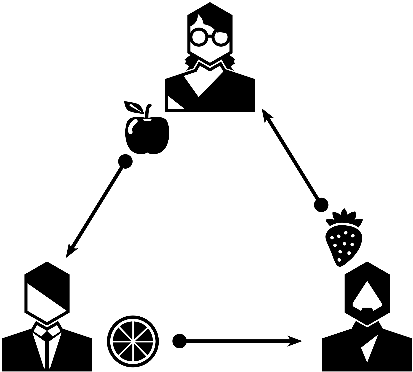
Players may Trade assets with each other.
Discussion
This is a form of Exchanging (ECO-01), except that players determine the terms of the exchange. In order for Trading to work, the resources being traded need to have different values to different players. This is often accomplished through the use of Sets. See Chapter 12 for full details on the supporting mechanisms. The value also needs to be difficult to precisely determine. Again, sets are often used to accomplish this, as players may not know exactly which cards their opponent has. Future value can also be obfuscated, usually based on random future events. Games typically limit what can be traded. For example, Civilization gives players commodity cards, and only those may be traded. In Sidereal Confluence, on the other hand, where a variety of types of resources may be combined in different deals. Sometimes games will strictly require like-forlike trades (e.g., two cards for two cards). The actual mechanism of Trading can be conducted in several ways. Most common is a defined open Trading session, where players shout out deals and proposals, as in Civilization, Trade on the Tigris, Sidereal Confluence,
and many other games. Open Trading is fun and chaotic but has several downsides. First, trade phases tend to be time-consuming, as players haggle. It can also leave out players who don’t have many things to trade or are otherwise uninvolved. Also, players who are less assertive may suffer a handicap. For these reasons, Trade Phases often are timed, and players may only make deals within those windows. If players can make a trade at any point during the game, it may lengthen the game noticeably and also lead to odd timing effects—what if the players can trade between a combat resolution and removal of casualties? Questions that are not covered by the rules are likely to arise and outright exploits may lurk beneath the surface. However, there are games that allow Trading at any time. Monopoly is a good example. Another consideration in trades is the truthfulness factor. Most games require some level of truth on the part of the players. In Civilization, players must tell the truth about two cards out of the minimum of three they are required to include in a trade. Tey may say whatever they would like about the others. In Trade on the Tigris, each trade card has a top and bottom half with different resources. Players must tell the truth about the top but may say anything about the bottom. Introducing deception elements into the trade mechanism can add some spice and excitement, but some players will feel uncomfortable about it, and others will simply not have a poker face. Regardless, however, when Trading resources, the deal typically must be performed as defined. Because of this, most games ban future promises as part of a trade, as it is difficult to police and requires rules for what happens if an agreement cannot be fulfilled. This is in contrast with Negotiations, where players often do not do what they promise (ECO-18). It is also worth mentioning that introducing Trading gives players a tool to self-balance a game. If one player is in the lead, others may refuse to trade with them, or force them to accept less favorable trade. This is a soft Catch-the-Leader mechanism (VIC-18).
Sample Games
Catan (Teuber, 1995) Chinatown (Hartwig, 1999) Civilization (Tresham, 1980) Monopoly (Darrow and Magie, 1933) Pit (Cayce, Gavitt, and Parker, 1903) Sidereal Confluence (Deichmann, 2017) Trade on the Tigris (Engelstein and Sturm, 2018)
描述
玩家可以互相交易(Trade)资产。
讨论
这是交换(ECO-01)的一种形式,只是玩家决定交换的条款。为了使交易有效,交易的资源需要对不同玩家具有不同的价值。这通常通过使用集合(Sets)来实现。有关支持机制的完整详细信息,请参阅第12章。价值也需要难以精确确定。再次强调,集合通常用于实现这一点,因为玩家可能不完全知道对手有哪些牌。未来价值也可以被混淆,通常基于随机的未来事件。游戏通常限制可以交易的内容。例如,《Civilization》给玩家商品卡,只有那些可以交易。另一方面,在《Sidereal Confluence》中,各种类型的资源可以在不同的交易中组合。有时游戏会严格要求同类交易(例如,两张卡换两张卡)。交易的实际机制可以通过几种方式进行。最常见的是定义的公开交易时段,玩家大声喊出交易和提议,如在《Civilization》、《Trade on the Tigris》、《Sidereal Confluence》、
和许多其他游戏中。公开交易既有趣又混乱,但有几个缺点。首先,交易阶段往往很耗时,因为玩家在讨价还价。它也可能把没有多少东西可交易或以其他方式不参与的玩家排除在外。此外,不太自信的玩家可能会吃亏。由于这些原因,交易阶段通常是定时的,玩家只能在这些窗口内进行交易。如果玩家可以在游戏期间的任何时候进行交易,这可能会显着延长游戏时间,并导致奇怪的时间安排效果——如果玩家可以在战斗解决和移除伤亡之间进行交易怎么办?规则未涵盖的问题可能会出现,并且彻底的漏洞可能潜伏在表面之下。然而,有些游戏允许随时交易。《大富翁》(Monopoly)就是一个很好的例子。交易中的另一个考虑因素是真实性因素。大多数游戏要求玩家具有某种程度的真实性。在《Civilization》中,玩家必须对交易中要求包含的至少三张卡片中的两张说实话。他们可以对其他的随心所欲。在《Trade on the Tigris》中,每张交易卡都有不同资源的上半部分和下半部分。玩家必须对上半部分说实话,但可以对下半部分说任何话。在交易机制中引入欺骗元素可以增添一些趣味和兴奋,但有些玩家会对此感到不舒服,而另一些人则根本没有扑克脸。无论如何,在交易资源时,通常必须按定义执行交易。因此,大多数游戏禁止将未来承诺作为交易的一部分,因为它很难监管,并且需要针对如果协议无法履行会发生什么制定规则。这与谈判形成鲜明对比,在谈判中,玩家经常不做他们承诺的事情(ECO-18)。值得一提的是,引入交易为玩家提供了自我平衡游戏的工具。如果一名玩家领先,其他人可能会拒绝与他们交易,或强迫他们接受不太有利的交易。这是一种软性的追赶领先者机制(VIC-18)。
游戏范例
Catan (Teuber, 1995) - 《卡坦岛》 Chinatown (Hartwig, 1999) - 《唐人街》 Civilization (Tresham, 1980) - 《Civilization》 Monopoly (Darrow and Magie, 1933) - 《大富翁》 Pit (Cayce, Gavitt, and Parker, 1903) - 《Pit》 Sidereal Confluence (Deichmann, 2017) - 《Sidereal Confluence》 Trade on the Tigris (Engelstein and Sturm, 2018) - 《Trade on the Tigris》