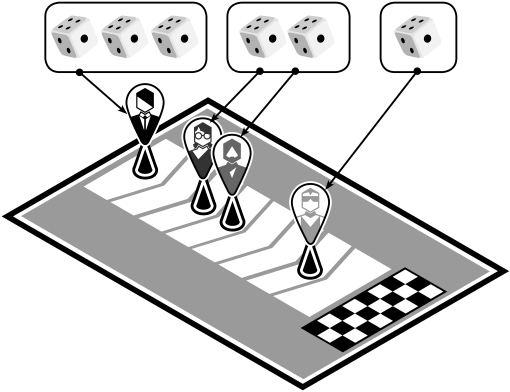
Description
The game systems advantage players that are behind or disadvantage players that are ahead.
Discussion
This is a meta-mechanism that can be implemented in a variety of ways. For example, Power Grid changes turn order based on who is leading. The player in last always takes the most advantageous position. Age of Steam forces players to reduce their Victory Points (VPs) based on how many they have. Players who have more points must lose more. Other games may give special tokens or abilities to players that are lagging. While these are all overt, some Catch the Leader mechanisms are more subtle. A King of the Hill mechanism (VIC-17) typically exposes the leader to attack, and not other players—or players that are further behind are less attractive targets. This will naturally incentivize players to try to pull back the leader. The designer should consider the severity of the Catch the Leader mechanism. If it is too strong, it can be advantageous for players to sandbag and try to stay back to make a strong late move rather than be penalized earlier.
Depending on the theme and nature of the game, this may or may not be desirable. Designers should also look out for the opposite of a Catch the Leader mechanism (“snowballs”), where the game mechanisms make it easier for players in the lead to get further ahead. Economic games are susceptible to this, as the measure of victory (money) is also the resource that helps growth and power. Monopoly is an example. Splitting the victory currency from cash can alleviate this issue. For example, players may need to use cash to buy antiques, which actually give VPs. This forces players to decide when to turn their working resource into a victory resource. See Victory Points as a Resource for more details (VIC-04).
Sample Games
Age of Steam (Wallace, 2002) The Expanse Board Game (Engelstein, 2017) Monopoly (Darrow and Magie, 1933) Power Grid (Friese, 2004)
描述
游戏系统使落后的玩家受益或使领先的玩家处于劣势。
讨论
这是一个元机制,可以通过多种方式实现。例如,《电力公司》(Power Grid)根据谁领先来改变回合顺序。最后一名的玩家总是占据最有利的位置。《蒸汽时代》(Age of Steam)强迫玩家根据他们拥有的分数来减少胜利点数(VP)。拥有更多分数的玩家必须失去更多。其他游戏可能会给落后的玩家特殊的代币或能力。虽然这些都是公开的,但有些追赶领先者(Catch the Leader)机制更为微妙。山丘之王(King of the Hill)机制(VIC-17)通常将领导者暴露在攻击之下,而不是其他玩家——或者落后的玩家是不太有吸引力的目标。这自然会激励玩家试图拉回领导者。设计师应该考虑追赶领先者机制的严重性。如果它太强,玩家可能会为了以后做出强有力的举动而故意落后,而不是更早受到惩罚,这对玩家来说是有利的。
根据游戏的主题和性质,这可能是可取的,也可能不是。设计师还应该注意追赶领先者机制的反面(“滚雪球”),即游戏机制使领先的玩家更容易进一步领先。经济游戏容易受到这种情况的影响,因为胜利的衡量标准(金钱)也是帮助增长和权力的资源。《大富翁》(Monopoly)就是一个例子。将胜利货币与现金分开可以缓解这个问题。例如,玩家可能需要使用现金购买古董,这实际上给予VP。这迫使玩家决定何时将他们的工作资源转化为胜利资源。有关详细信息(VIC-04),请参阅作为资源的胜利点数(Victory Points as a Resource)。
游戏范例
Age of Steam (Wallace, 2002) - 《蒸汽时代》 The Expanse Board Game (Engelstein, 2017) - 《苍穹浩瀚》 Monopoly (Darrow and Magie, 1933) - 《大富翁》 Power Grid (Friese, 2004) - 《电力公司》