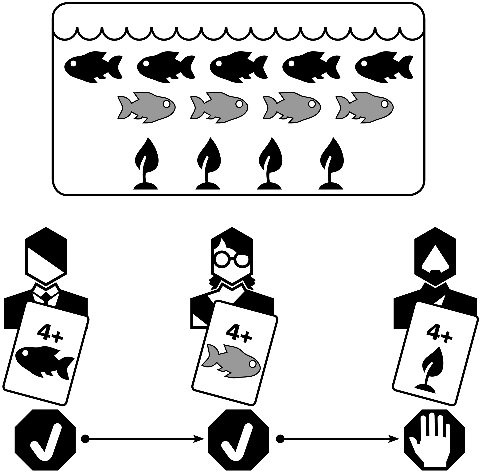
Description
The game ends after a set number of targets or goals are completed.
Discussion
In one sense, the Completing Target mechanism is related to Exhausting Resources (VIC-10), as meeting X targets could be represented by removing “mission accomplished” markers from a pool and having the game end when those markers are exhausted. The difference in player experience is substantial, though, and gaining accomplishments is thematically more coherent in most cases than exhausting “mission accomplished” tokens. Completing Targets is also similar to Race end-game conditions, where the game ends when players hit (typically) a victory point goal. However, the goals can be more than just the accumulation of points, such as curing all diseases in Pandemic, taking enough keeps in Dune, or destroying the One Ring in War of the Ring.
In all of these examples, the game is won by the player(s) triggering the event that ends the game. However, this is not necessarily the case. For example, in Race for the Galaxy, the game can end several ways, one of which is by a player getting seven cards into their tableau. But the player who does this does not necessarily win. Winning is determined by other means than the game ending. As there is no reason to end the game if you’re not going to win, this type of trigger can lead to over-analysis. For this reason, designs that can be triggered by a player’s action often include hidden points or bonuses that can make it difficult to judge who is leading. Another design technique that can be considered is giving a bonus for triggering the end of the game, to incentivize players to take that action. This mechanism can be found in Concordia and Azul and is often a factor used to balance issues like players getting an equal number of turns, but some players knowing that the game will end when they take their final turn and others now knowing it. See our discussion of End-Game Bonuses (VIC-06).
Sample Games
Azul (Kiesling, 2017) Concordia (Gerdts, 2013) Dune (Eberle, Kittredge, and Olatka, 1979) Pandemic (Leacock, 2008) Race for the Galaxy (Lehmann, 2007) War of the Ring (Di Meglio, Maggi, and Nepitello, 2004)
描述
在完成一定数量的目标或目的后,游戏结束。
讨论
从某种意义上说,完成目标(Completing Target)机制与耗尽资源(VIC-10)有关,因为满足X个目标可以通过从池中移除“任务完成”标记并在这些标记耗尽时结束游戏来表示。不过,玩家体验的差异是巨大的,在大多数情况下,获得成就比耗尽“任务完成”代币在主题上更连贯。完成目标也类似于竞速终局条件,当玩家达到(通常)胜利点数目标时,游戏结束。然而,目标不仅仅是积分的积累,例如在《瘟疫危机》(Pandemic)中治愈所有疾病,在《沙丘》(Dune)中占领足够的据点,或者在《魔戒圣战》(War of the Ring)中摧毁至尊魔戒。
在所有这些例子中,游戏由触发结束游戏的事件的玩家获胜。然而,情况并非总是如此。例如,在《银河竞逐》(Race for the Galaxy)中,游戏可以通过几种方式结束,其中之一是玩家将七张牌放入他们的画面中。但这样做的玩家不一定获胜。获胜是由游戏结束以外的其他方式决定的。因为如果你不打算赢就没有理由结束游戏,这种类型的触发器会导致过度分析。出于这个原因,可以由玩家行动触发的设计通常包括隐藏点数或奖金,这使得很难判断谁领先。可以考虑的另一种设计技术是给予触发游戏结束的奖励,以激励玩家采取该行动。这种机制可以在《Concordia》和《Azul》中找到,并且通常是用于平衡诸如玩家获得相同回合数等问题的因素,但一些玩家知道当他们进行最后一轮时游戏将结束,而其他玩家现在知道了。请参阅我们对游戏结束奖励(End-Game Bonuses,VIC-06)的讨论。
游戏范例
Azul (Kiesling, 2017) - 《花砖物语》 Concordia (Gerdts, 2013) - 《和谐罗马》 Dune (Eberle, Kittredge, and Olatka, 1979) - 《沙丘》 Pandemic (Leacock, 2008) - 《瘟疫危机》 Race for the Galaxy (Lehmann, 2007) - 《银河竞逐》 War of the Ring (Di Meglio, Maggi, and Nepitello, 2004) - 《魔戒圣战》