Description
The game ends when a specified number of connections are made on the board.
Discussion
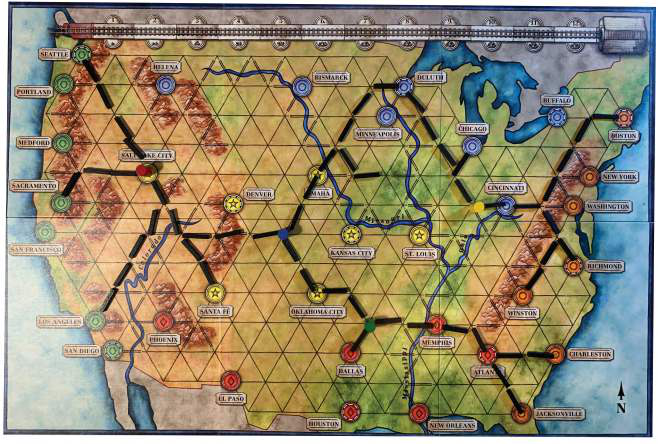
The Connections mechanism can be both an end-game trigger and a means of victory. It is related to the Race mechanism (VIC-07). In basic Connection games, like Twixt, it serves as the measure of victory. The first player to connect opposite sides of the board ends the game and determines the victor. In TransAmerica, the round is won by the first player to connect all of their cities into a single network (Illustration 5.2). There are many games, however, that end based on connections but in which connections don’t ensure victory. The most prominent example is the Crayon Rails series, which started with Empire Builder. In Empire Builder, players build rail networks. The game ends when a single player connects a certain number of major cities together in their network, as well as passes a certain threshold of cash. Both conditions are required for game end and victory. Connection can also be used as a sub-game. In Android, players try to create connections between different groups, which gives in-game benefits. In the 18xx and Age of Steam series, players place hexagonal tiles that have tracks printed on them onto the board in different configurations. Cable Car does the same with square tiles. Placing those tiles enables players to create routes between stations allowing for delivery of goods and earning money. Typically, these routes are shared by all players. Connection games need to deal with several topology issues. Can players cross the paths of other players? Games that do not permit it, like
Twixt, often become static and have an optimal strategy. It is more typical to allow players to cross or even parallel other players’ connections by paying a penalty or increasing resource cost to do so, and/or by requiring a special tile.
Sample Games
18xx (Tresham, 1974) Age of Steam (Wallace, 2002) Android (Clark and Wilson, 2008) Cable Car (Henn, 2009) Empire Builder (Bromley and Fawcett, 1982) Santa Fe (Moon, 1992) TransAmerica (Delonge, 2001) Twixt (Randolph, 1962) Illustration 5.2 Nearing the end of a game of TransAmerica. The first player to connect all five of their cities (one of each color) wins the round.
描述
当版图上建立指定数量的连接时,游戏结束。
讨论
连接(Connections)机制既可以是游戏结束触发器,也可以是胜利手段。它与竞速机制(VIC-07)有关。在基本的连接游戏中,如《Twixt》,它作为胜利的衡量标准。第一个连接版图相对两侧的玩家结束游戏并确定胜者。在《TransAmerica》中,第一位将所有城市连接成单个网络的玩家赢得这一轮(插图5.2)。然而,有许多游戏虽然基于连接结束,但连接并不保证胜利。最著名的例子是从《Empire Builder》开始的Crayon Rails系列。在《Empire Builder》中,玩家建立铁路网络。当一名玩家在其网络中连接一定数量的主要城市并通过一定的现金门槛时,游戏结束。游戏结束和胜利都需要这两个条件。连接也可以用作子游戏。在《Android》中,玩家试图在不同组之间建立连接,从而获得游戏内利益。在18xx和《Age of Steam》系列中,玩家将印有轨道的六角形板块以不同的配置放置在版图上。《Cable Car》用方形板块做同样的事情。放置这些板块使玩家能够在车站之间创建路线,从而运送货物并赚取金钱。通常,这些路线由所有玩家共享。连接游戏需要处理几个拓扑问题。玩家可以穿越其他玩家的路径吗?不允许这样做的游戏,如
《Twixt》,通常变得静态并具有最优策略。更典型的是允许玩家通过支付罚款或增加资源成本,和/或通过要求特殊板块来穿越甚至平行其他玩家的连接。
游戏范例
18xx (Tresham, 1974) - 《18xx》系列 Age of Steam (Wallace, 2002) - 《蒸汽时代》 Android (Clark and Wilson, 2008) - 《Android》 Cable Car (Henn, 2009) - 《Cable Car》 Empire Builder (Bromley and Fawcett, 1982) - 《Empire Builder》 Santa Fe (Moon, 1992) - 《Santa Fe》 TransAmerica (Delonge, 2001) - 《TransAmerica》 Twixt (Randolph, 1962) - 《Twixt》 插图5.2 接近《TransAmerica》游戏的一局结束。第一个连接所有五个城市(每个颜色一个)的玩家赢得这一轮。