Description
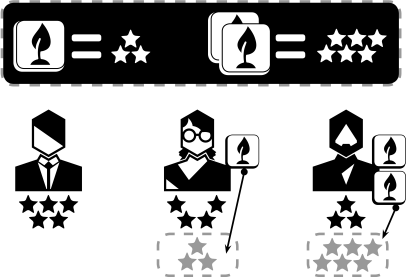
Players earn bonus VPs at the end of the game.
Discussion
This is a popular technique for giving players strategic direction. Giving players a specific goal to earn points early in the game gives new players an idea of what they should be doing. End-Game Bonuses can be either Personal or Public. Points from Personal goals can only be earned by the owner, while Public goals may be pursued by multiple players. In some games, goals are non-exclusive and can be scored by multiple players, while in others, only the player who achieves the goal “the best” receives the points. Public goals provide a natural interaction point for players and can be used where there is not as much player interaction through the other mechanisms. In their simplest form, public goals are a method for turning any puzzle into a competitive game. In Dimension, for example, players use the same set of spheres to build a pyramid that satisfies as many of the six public goals as possible. Private goals help differentiate players and can give a strong direction to their play. For example, in Ticket to Ride, the tickets tell players which cities to connect to, but points are awarded (or lost) only at the end of the game. This gives players a literal roadmap of their goals.
There are a number of benefits of keeping personal goals hidden, like making it impossible to precisely determine who is winning and adding an element of deduction as players attempt to block each other. Ticket to Ride with exposed goals would be a very different, and more frustrating, experience. Another design consideration is when and how goals are assigned. Sometimes they are random, and sometimes players must construct or choose their goals. A concern for designers is that if goals are assigned randomly, later in the game, players may luck into points by being randomly dealt a goal that they have already achieved. This is one reason that earlier assignment of bonuses is generally preferred unless countered by a penalty for not achieving them (as in Ticket to Ride). Games such as Race for the Galaxy may give players access to a random selection of possible End-Game Bonuses, but players may choose to build them or not. Concordia allows players to draft cards which will give bonus points in specific categories. Having more cards in a given category increases the point value. Terraforming Mars has an interesting approach to assigning end-game goals. Players may use an action and spend money to unlock specific public End-Game Bonuses. The amount of money required increases each time a new goal is unlocked, so waiting until you are certain about what you want to unlock means spending more resources. Only three goals at most can be unlocked, putting more pressure on players to decide which goals they think they can win at. Designers should also consider the ratio between points earned during the game and points earned at the end. If the ratio is very large and bonuses are complex or hidden, it can be very difficult for players to know where they stand. This increases the skill and experience required to play the game well. For example, in Concordia, all points are earned from End-Game Bonuses. To offset that issue, the game includes an optional intermediate scoring step which is basically a practice scoring so that players can make sure they under-stand the available bonuses, as well as get a better feel for their relative position.
Sample Games
Concordia (Gerdts, 2013) Dimension (Luchau, 2014) Race for the Galaxy (Lehmann, 2007) Suburbia (Alspach, 2012) Terraforming Mars (Fryxelius, 2016) Ticket to Ride (Moon, 2004)
描述
玩家在游戏结束时获得额外VP。
讨论
这是一种为玩家提供战略方向的流行技术。在游戏早期为玩家提供一个能获得积分的特定目标,让新玩家知道他们应该做什么。游戏结束奖励(End-Game Bonuses)可以是个人或公共的。个人目标的积分只能由拥有者获得,而公共目标可以由多名玩家追求。在某些游戏中,目标是非排他性的,多名玩家可以得分,而在其他游戏中,只有“最好”地实现目标的玩家才能获得积分。公共目标为玩家提供了一个自然的互动点,并且可以在通过其他机制没有太多玩家互动的地方使用。这也是将任何谜题变成竞争性游戏的一种方法。例如,在《Dimension》中,玩家使用相同的一组球体来构建一个金字塔,以尽可能满足六个公共目标。私人目标有助于区分玩家,并为他们的游戏提供明确的方向。例如,在《车票之旅》(Ticket to Ride)中,车票告诉玩家要连接哪些城市,但只有在游戏结束时才会奖励(或扣除)积分。这给了玩家一个字面上的目标路线图。
保持个人目标隐藏有很多好处,比如让人无法准确判断谁在获胜,并在玩家试图互相阻止时增加推理元素。如果公开目标,《车票之旅》将是一种非常不同且令人沮丧的体验。另一个设计考虑是目标分配的时间和方式。有时它们是随机的,有时玩家必须构建或选择他们的目标。设计师关心的一个问题是,如果目标是随机分配的,在游戏后期,玩家可能会因随机分到一个他们已经实现的目标而侥幸获得积分。这就是为什么通常首选早期分配奖金的一个原因,除非因未实现目标而受到惩罚(如在《车票之旅》中)。像《银河竞逐》(Race for the Galaxy)这样的游戏可能会让玩家获得随机选择的可能的结束游戏奖励,但玩家可以选择是否构建它们。《Concordia》允许玩家轮抽卡牌,这些卡牌将在特定类别中给予加分。在给定类别中拥有更多卡牌会增加分值。《殖民火星》(Terraforming Mars)有一种有趣的分配结束游戏目标的方法。玩家可以使用行动并花钱解锁特定的公共结束游戏奖励。每次解锁新目标所需的金额都会增加,因此等到你确定想要解锁什么意味着花费更多资源。最多只能解锁三个目标,给玩家施加更大压力来决定他们认为自己能在哪些目标上获胜。设计师还应考虑游戏期间获得的积分与结束时获得的积分之间的比例。如果比例很大且奖励复杂或隐藏,玩家很难知道自己的立场。这增加了玩好游戏所需的技巧和经验。例如,在《Concordia》中,所有积分都来自结束游戏奖励。为了抵消这个问题,游戏包括一个可选的中间计分步骤,这基本上是一个练习计分,以便玩家可以确保他们理解可用的奖励,并更好地了解他们的相对位置。
游戏范例
Concordia (Gerdts, 2013) - 《和谐罗马》 Dimension (Luchau, 2014) - 《Dimension》 Race for the Galaxy (Lehmann, 2007) - 《银河竞逐》 Suburbia (Alspach, 2012) - 《Suburbia》 Terraforming Mars (Fryxelius, 2016) - 《殖民火星》 Ticket to Ride (Moon, 2004) - 《车票之旅》