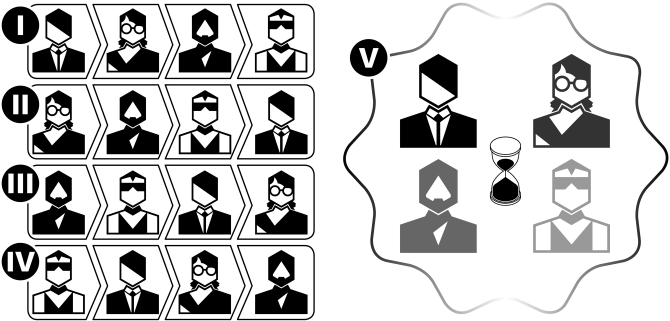
Description
When the main game ends, a special mini-game is played to determine the victor.
Discussion
This Finale mechanism adds a coda to a game, as it transitions to an alternate play mode at the end. In Monsters Menace America, players spend the bulk of the game moving their monsters around the US, stomping on cities, battling the military, gaining upgrades, and becoming more powerful. When the endgame is triggered, the players begin a monster demolition derby of sorts. The board is ignored, and the monsters simply battle against each other to determine the final victor. While the player that did the best during the first part of the game has the best chance to win, it could still be anyone. Cable Car is a connection game. But when players complete their connections they do not simply win. Instead, they need to begin running their cable car from one end of their track to the other, moving a few spaces per turn. The remaining players continue taking their turns, and anyone who completes their track can start moving their car. The player who gets their car to the end of their track first is the winner.
This final contest rewards efficiency in both building the track as well as maximizing the speed of the car. If you complete a very circuitous route first, you may still lose to a player who was better able to manage their tiles better and build an efficient route. Killer Bunnies and the Quest for the Magic Carrot is another example. Players can earn a numbered Magic Carrot during the course of the game. When they are all claimed, the game ends, and the winner is determined via lottery. The players draw one carrot at a time from a second carrot deck. The carrots drawn are losing carrots. Whoever has the final carrot remaining in the deck is the winner. This mechanism makes it clear to players what they need to do during the game to win and adds an exciting end-game element. However, it can also cheapen the meaning of the first part of the game, as a player may dominate the main game, earning ten tickets while the other players each get only one and still lose. As such, this is best suited for quicker and lighter games. The Finale mechanism is infrequently used as it often requires players to learn a whole different set of mechanisms to be used for the ending.
Sample Games
Cable Car (Henn, 2009) Killer Bunnies and the Quest for the Magic Carrot (Bellinger, 2002) Monsters Menace America (Connors and Knight, 2005)
描述
当主游戏结束时,玩一个特殊的迷你游戏来确定胜者。
讨论
这种终局(Finale)机制为游戏增加了一个尾声,因为它在最后过渡到另一种游戏模式。在《Monsters Menace America》中,玩家花费大部分时间在美国各地移动他们的怪物,踩踏城市,与军队作战,获得升级,并变得更加强大。当终局被触发时,玩家开始某种怪物拆除德比。版图被忽略,怪物只是互相战斗以确定最终胜者。虽然在游戏第一部分表现最好的玩家最有机会获胜,但这仍然可能是任何人。《Cable Car》是一个连接游戏。但当玩家完成连接时,他们并不仅仅是获胜。相反,他们需要开始让他们的缆车从轨道的一端运行到另一端,每回合移动几个空格。剩下的玩家继续轮流,任何完成轨道的人都可以开始移动他们的车。第一个把车开到轨道终点的玩家获胜。
这场最后的比赛奖励构建轨道的效率以及最大化车速。如果你先完成一条非常迂回的路线,你可能仍然会输给一个能更好地管理板块并构建高效路线的玩家。《Killer Bunnies and the Quest for the Magic Carrot》是另一个例子。玩家可以在游戏过程中获得编号的魔法胡萝卜。当它们都被认领后,游戏结束,胜者通过抽奖确定。玩家从第二个胡萝卜牌堆中一次抽一个胡萝卜。抽出的胡萝卜是失败的胡萝卜。谁拥有牌堆中剩下的最后一个胡萝卜,谁就是赢家。这种机制让玩家清楚地知道他们在游戏中需要做什么才能获胜,并增加了一个令人兴奋的终局元素。然而,这也可能贬低游戏第一部分的意义,因为一名玩家可能主导主游戏,获得十张票,而其他玩家每人只获得一张,但仍然失败。因此,这最适合更快更轻松的游戏。终局机制很少使用,因为它通常要求玩家学习一套完全不同的机制用于结局。
游戏范例
Cable Car (Henn, 2009) - 《Cable Car》 Killer Bunnies and the Quest for the Magic Carrot (Bellinger, 2002) - 《Killer Bunnies and the Quest for the Magic Carrot》 Monsters Menace America (Connors and Knight, 2005) - 《Monsters Menace America》