Description
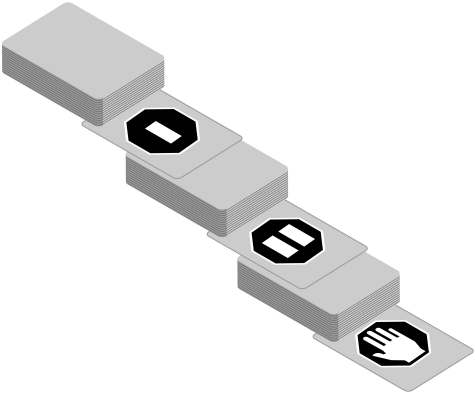
The game ends after an event occurs a specified number of times.
Discussion
The Fixed Number of Events mechanism is most closely associated with card decks. A number of special trigger cards are shuffled into the deck. When the last of these is turned up, the game will end. Airlines implements this system by mixing five into the stock deck. Each time a Scorecard is turned up, an intermediate scoring will occur. The last Scorecard initiates Final Scoring and the end of the game. A similar system is used in High Society but is not directly tied to scoring. Instead, four special Red cards are inserted into the Auction deck, along with 11 Yellow cards. When the fourth Red card is turned up, the game ends. This system can add a lot of variability and tension to a game, as players know approximately when it will end, but not exactly. A possible downside of this system is that the special cards may all happen very early in the game or very late, which creates long stretches with no scoring. It is possible in High Society for the four Red cards to be the first four cards turned over!
To combat this, many games that incorporate this mechanism use an initial deck construction method to ensure that the special cards are reasonably well distributed. The Expanse, for example, has the players divide the deck up into three piles, and shuffle two Scoring cards into each section. This ensures somewhat even distribution, without the players knowing exactly when Scoring cards will be turned up. Get the Goods controls the distribution by shuffling ten Scoring cards into the deck, with scoring happening when the 4th, 7th, and 10th cards are turned up. This allows tension to build as Scoring cards are turned up, while still giving a high probability of a reasonable spread of Scoring cards throughout the deck. This mechanism does not require card decks. In Pandemic, players lose if there are a certain number of Outbreaks. Players track these on a chart on the board.
Sample Games
Airlines (Moon, 1990) The Expanse Board Game (Engelstein, 2017) Get the Goods (Ado and Moon, 1996) High Society (Knizia, 1995) Pandemic (Leacock, 2008)
描述
游戏在事件发生指定次数后结束。
讨论
固定事件数(Fixed Number of Events)机制与卡牌组关系最密切。一些特殊的触发卡被洗入牌堆。当最后一张被翻开时,游戏将结束。《Airlines》通过混合五张到股票牌堆中来实现这个系统。每次翻开计分卡,都会进行一次中间计分。最后一张计分卡启动最终计分和游戏结束。《High Society》中使用类似的系统,但不直接与计分挂钩。相反,四张特殊的红牌被插入拍卖牌堆,连同11张黄牌。当第四张红牌被翻开时,游戏结束。这个系统可以给游戏增加很多可变性和紧张感,因为玩家大约知道什么时候会结束,但不确切。该系统的一个可能的缺点是特殊卡牌可能都在游戏早期或很晚出现,这会导致长时间没有计分。在《High Society》中,甚至可能四张红牌是前四张翻开的牌!
为了对此进行反击,许多采用这种机制的游戏使用初始牌堆构建方法,以确保特殊卡牌得到相当好的分布。例如,《The Expanse》让玩家将牌堆分成三堆,并将两张计分卡洗入每部分。这确保了某种程度的均匀分布,而玩家不知道计分卡何时会被翻开。《Get the Goods》通过将十张计分卡洗入牌堆来控制分布,并在翻开第4、第7和第10张卡时进行计分。这允许随着计分卡被翻开而建立紧张感,同时仍然给出整个牌堆中计分卡合理分布的高概率。这种机制不需要卡牌堆。在《瘟疫危机》(Pandemic)中,如果有一定数量的爆发,玩家就会输。玩家在版图上的图表中跟踪这些。
游戏范例
Airlines (Moon, 1990) - 《Airlines》 The Expanse Board Game (Engelstein, 2017) - 《苍穹浩瀚》 Get the Goods (Ado and Moon, 1996) - 《Get the Goods》 High Society (Knizia, 1995) - 《上流社会》 Pandemic (Leacock, 2008) - 《瘟疫危机》