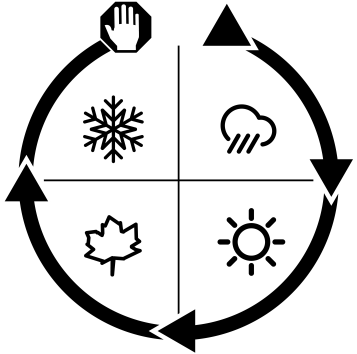
Description
The game ends after a set number of rounds.
Discussion
This is a basic approach to determine when the game will end. However, there are still some considerations for the designer. First, players must track the current round, often with a marker on a track. It’s not a big burden on the players, but it does require them to remember to advance the token at the end of each round. If possible, a more natural way of tracking the current round is advised. An elegant approach is to have items used in the game come off of the round tracker, instead of pushing a maker along it. In Castles of Burgundy, the new building tiles that populate the board each round are divided into stacks and placed on the round tracker. Tose tiles are placed on the board each turn, which is a step that players are unlikely to forget, and players can glance at the round tracker and see, based on how many stacks remain, how many rounds are left in the game. Similar techniques can be used for an end-game trigger. The Speicherstadt has a deck with a fixed number of cards. When the cards run out, the game is over. This eliminates the need for players to act to advance a marker. The depletion of the cards happens naturally over the course of the game. The number of turns and rounds is the same every game—but the players do not directly track them. For example, in Modern Art, the end of each round features the valuation of paintings, with players placing markers for the most valuable paintings for that round. However, there are only three slots for these markers, corresponding to the rounds in the game. The valuation step will not be missed by players, so this does not increase the rules’ burden on the players. The other consideration is end-game edge effects. If the players know that this is the final round, it may change their behavior, which may be undesirable. One aspect of this is discussed in Hidden and Exposed Victory Points (VIC-05).
Sample Games
Castles of Burgundy (Feld, 2011) Die Macher (Schmiel, 1986) Guilds of London (Boydell, 2016) Modern Art (Knizia, 1992) Small World (Keyaerts, 2009) The Speicherstadt (Feld, 2010) Twilight Struggle (Gupta and Matthews, 2005)
描述
游戏在设定的轮数后结束。
讨论
这是确定游戏何时结束的基本方法。然而,对于设计师来说,仍有一些考虑因素。首先,玩家必须跟踪当前回合,通常是在轨道上使用标记。这对玩家来说不是很大的负担,但确实需要他们记得在每一轮结束时推进标记。如果可能,建议使用更自然的方式来跟踪当前回合。一种优雅的方法是将游戏中使用的物品从回合跟踪器上取下,而不是推动标记。在《Castles of Burgundy》中,每轮填充版图的新建筑板块被分成几堆并放置在回合跟踪器上。这些板块每回合被放置在版图上,这是一个玩家不太可能忘记的步骤,玩家可以看一眼回合跟踪器,根据剩下的堆数,就能看到游戏中还剩多少轮。类似的技术可用于结束游戏触发器。《The Speicherstadt》有一副固定数量的卡牌。当卡牌用完时,游戏结束。这消除了玩家采取行动推进标记的需要。
卡牌的耗尽在游戏过程中自然发生。每场游戏的回合数和轮数都是相同的——但玩家并不直接跟踪它们。例如,在《Modern Art》中,每一轮结束都有画作估值,玩家为该轮最有价值的画作放置标记。然而,这些标记只有三个插槽,对应于游戏中的轮次。玩家不会错过估值步骤,因此这不会增加玩家的规则负担。另一个考虑因素是结束游戏边缘效应。如果玩家知道这是最后一轮,这可能会改变他们的行为,这可能是不可取的。隐藏和公开胜利点数(VIC-05)中讨论了这方面的一个方面。
游戏范例
Castles of Burgundy (Feld, 2011) - 《勃艮第城堡》 Die Macher (Schmiel, 1986) - 《Die Macher》 Guilds of London (Boydell, 2016) - 《伦敦公会》 Modern Art (Knizia, 1992) - 《现代艺术》 Small World (Keyaerts, 2009) - 《小世界》 The Speicherstadt (Feld, 2010) - 《汉堡仓库城》 Twilight Struggle (Gupta and Matthews, 2005) - 《冷战热斗》