Description
Each player’s score is equal to the lowest value of several categories. Whoever has the highest lowest value is the winner.
Discussion
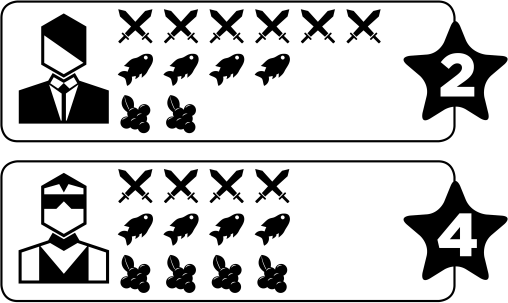
As the title of this Highest Lowest mechanism may be a bit unclear, here is a more lengthy explanation using the diagram above. Let’s say players are collecting the four icons in the image above—swords, fish, leaves, and grapes. Player A has 10 swords, 5 fish, 7 leaves, and 2 grapes. Teir final score will be the lowest of those four—in this case, the 2 grapes, so 2 points. First used in Knizia’s Tigris & Euphrates, this scoring mechanism forces players to pursue multiple paths equally. Specializing in gaining red, for example, will not be a winning strategy. This forces players to generalize and typically encourages player interaction as they compete in the same areas. Tigris & Euphrates has players collecting cubes of different colors to determine the final score. When using cubes, this system is the same as collecting sets of one of each color. Later implementations like Ingenious and Wendake use tracks, which can make it easier to visualize the current score, as it is just the lowest track marker. Ingenious adds an additional twist, as while final scoring is based on the lowest color value, during the game, bonuses are awarded for getting a high
value of a particular color. So, tension is introduced between staying balanced and specializing. Wendake has two separate pairs of tracks, and the value of each pair is equal to the lowest of the two. Ten, the scores for each pair are added together to determine the final score. Adding this additional level of detail groups certain aspects together and opens up more strategic design space.
Sample Games
Between Two Cities (O’Malley, Pedersen, and Rosset, 2015) Ingenious (Knizia, 2004) Tigris & Euphrates (Knizia, 1997) Welcome to Centerville (Jensen, 2017) Wendake (Sabia, 2017)
描述
每个玩家的分数等于几个类别中的最低值。谁拥有最高的最低值(Highest Lowest),谁就是赢家。
讨论
由于这个最高中的最低(Highest Lowest)机制的标题可能有点不清楚,这里使用上面的图表进行更详细的解释。假设玩家正在收集上图中的四个图标——剑、鱼、叶子和葡萄。玩家A有10把剑、5条鱼、7片叶子和2串葡萄。他们的最终分数将是这四个中最低的——在这种情况下,是2串葡萄,所以是2分。这种计分机制首先在Knizia的《底格里斯河与幼发拉底河》(Tigris & Euphrates)中使用,迫使玩家平等地追求多条路径。例如,专注于获得红色将不会是获胜策略。这迫使玩家全面发展,并通常鼓励玩家互动,因为他们在相同领域竞争。《底格里斯河与幼发拉底河》让玩家收集不同颜色的方块来确定最终分数。当使用方块时,此系统与收集每种颜色一个的集合相同。像《Ingenious》和《Wendake》这样的后期实现使用轨道,这可以更容易地可视化当前分数,因为它只是最低的轨道标记。《Ingenious》增加了一个额外的转折,因为虽然最终计分基于最低颜色值,但在游戏过程中,如果获得特定颜色的高
值,则会奖励奖金。因此,在保持平衡和专业化之间引入了紧张感。《Wendake》有两对独立的轨道,每对的值等于两者中的最低值。然后,将每一对的分数相加以确定最终分数。添加这种额外的细节水平将某些方面组合在一起,并开辟了更多的战略设计空间。
游戏范例
Between Two Cities (O’Malley, Pedersen, and Rosset, 2015) - 《双城之间》 Ingenious (Knizia, 2004) - 《智谋棋/天才》 Tigris & Euphrates (Knizia, 1997) - 《底格里斯河与幼发拉底河》 Welcome to Centerville (Jensen, 2017) - 《Welcome to Centerville》 Wendake (Sabia, 2017) - 《Wendake》