Description
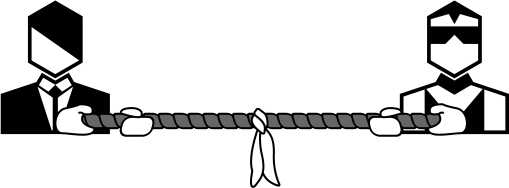
A marker is moved up and back on a track toward or away from a neutral position.
Discussion
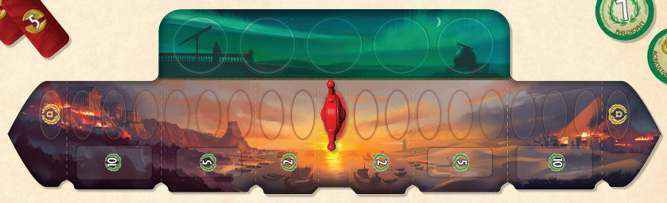
Tug of War can be both a scoring mechanism and an end-game trigger. In its simplest form, two players will move a marker back and forth along a track, with each of them owning one end of the track. If the marker reaches the end of a track it typically triggers an event, such as ending the game, as in Twilight Struggle. In this case, it also triggers victory for the player who moves the marker to their end (Illustration 5.4). It may also trigger a scoring event, as in Guardians, where each location has a short tug-of-war track. If the marker reaches the end of a track, the Illustration 5.4 The Military track in 7 Wonders Duel. If either player reaches their end, they score a military victory. In addition, they gain bonus tokens the first time they reach certain spaces on their side.
player owning that end scores points for the location, and it is removed from the game and replaced. Tug of War is not limited to two players. When there are three or more sides represented, each has a branch leading from a central neutral point. Churchill is a three-player game, with players debating over issues around World War II. Each issue starts in the center of the track. When a player influences an issue, it moves toward their track, or, if it is on another player’s track, first toward the neutral point and then up their track. Churchill also has a special trigger if an issue reaches the end of one of the tracks. In that case, the issue is locked for that player, and it can no longer be influenced up and down the tracks. The game also features multiple issues on the tugof-war track at the same time, allowing the designer to introduce more complexity and player options by allowing multiple issues to be influenced with one action or special bonuses for certain types of issues. Another example of multiple players influencing multiple items is Starship Samurai, where players are trying to sway factions to their side. Each player has a track on the alliance board, and if a faction is on another player’s track, in order to sway them to your side, you first move the faction token down toward a neutral zone off of that player’s track and then up your track. The location of the marker can also award points or abilities at certain times. In Twilight Struggle, for example, if no Sudden Death conditions are triggered (VIC-15) and the game ends by concluding the final turn, the winner is decided by the location of the marker on the track. The location of the markers at Conference end in Churchill at the end of the debate phase determines who gets to decide on the outcome of the issue. Starship Samurai awards Victory Points or resources based on the location of each faction at the end of the round. This mechanism is very clean and easy for players to understand, particularly in the two-player version. It is easy for players to see where they stand and what actions influence the track. When used for an end-game condition, it is typically used as a Sudden Death condition, as requiring that the marker reach the end means that there need to be some means to drive the game toward a conclusion. It also means that as one player moves closer to victory, the other moves further away. This can reduce tension as compared to a Completing Targets system (VIC-11), where all players may be close to victory at the same time.
Sample Games
7 Wonders Duel (Bauza and Cathala, 2015) Churchill (Herman, 2015) Guardians (Flores, 2018) Starship Samurai (Vega, 2018) Twilight Struggle (Gupta and Matthews, 2005)
描述
标记在轨道上向中立位置移动或远离中立位置。
讨论
拔河(Tug of War)既可以是计分机制,也可以是游戏结束触发器。在最简单的形式中,两名玩家在轨道上来回移动标记,每人拥有轨道的一端。如果标记到达轨道尽头,通常会触发事件,例如结束游戏,如在《冷战热斗》(Twilight Struggle)中。在这种情况下,它也触发将标记移动到其一端的玩家获胜(插图5.4)。它也可以触发计分事件,如在《Guardians》中,每个地点都有一个短的拔河轨道。如果标记到达轨道尽头,拥有那一端的玩家获得该地点的分数,并且该地点从游戏中移除并被替换。拔河不限于两名玩家。当代表三方或更多方时,每一方都有一个从中立点引出的分支。《Churchill》是一个三人游戏,玩家就二战周围的问题进行辩论。每个问题都从轨道中心开始。当玩家影响一个问题时,它向他们的轨道移动,或者如果它在另一个玩家的轨道上,首先向中立点移动,然后向他们的轨道移动。《Churchill》还有一个特殊触发器,如果问题到达其中一个轨道的尽头。在这种情况下,该问题被锁定给该玩家,并且不能再在轨道上下被影响。游戏还同时在拔河轨道上具有多个问题,允许设计师通过允许通过一个动作影响多个问题或为某些类型的问题提供特殊奖励来引入更多的复杂性和玩家选项。多名玩家影响多个项目的另一个例子是《Starship Samurai》,玩家试图将派系拉向自己这边。每个玩家在联盟板上都有一条轨道,如果一个派系在另一个玩家的轨道上,为了
插图5.4 《七大奇迹:对决》中的军事轨道。如果任一玩家到达他们的一端,他们获得军事胜利。此外,他们第一次到达其一侧的某些空间时会获得奖励代币。
将他们拉向你这边,你首先将派系标记向下移动到该玩家轨道之外的中立区,然后再向你的轨道移动。标记的位置也可以在特定时间奖励积分或能力。例如,在《冷战热斗》中,如果未触发猝死条件(VIC-15)且游戏通过结束最后一回合而结束,则胜者由轨道上的标记位置决定。《Churchill》中辩论阶段结束时会议结束时的标记位置决定了谁可以决定该问题的结果。《Starship Samurai》根据回合结束时每个派系的位置奖励胜利点数或资源。这种机制非常干净,易于玩家理解,特别是在双人版本中。玩家很容易看到自己的立场以及哪些行动会影响轨道。当用于结束游戏条件时,它通常用作猝死条件,因为要求标记到达尽头意味着需要某种手段来推动游戏走向结局。这也意味着随着一名玩家接近胜利,另一名玩家离胜利越来越远。这就比完成目标系统(VIC-11)减少了紧张感,在那个系统中,所有玩家可能同时又接近胜利。
游戏范例
7 Wonders Duel (Bauza and Cathala, 2015) - 《七大奇迹:对决》 Churchill (Herman, 2015) - 《丘吉尔》 Guardians (Flores, 2018) - 《Guardians》 Starship Samurai (Vega, 2018) - 《Starship Samurai》 Twilight Struggle (Gupta and Matthews, 2005) - 《冷战热斗》