Description
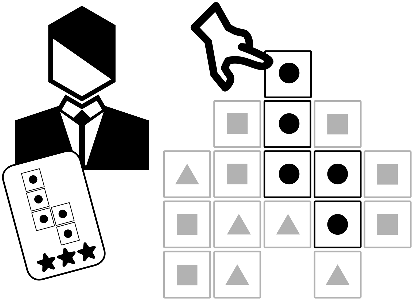
An event causes the Game State to be evaluated relative to some scoring condition. Players earn points based on how that state matches the condition.
Discussion
In most points-based games, players manipulate the Game State and then gain points based on that State. In some games, such as 7 Wonders or Agricola, points are only tallied at the end of the game. However, there are a variety of ways with which scoring can be triggered, which can be grouped broadly into three categories: Scheduled, Player Action, and Random systems. In Scheduled systems, there are predefined intervals for when scoring will happen, and players know when they are approaching. For example, in El Grande, scoring happens three times during the game, after a set number of rounds. Regardless of which actions the players take, scoring will happen at exactly those intervals. In Galaxy Trucker, players score at the end of each run, when a fixed number of hazards are encountered. In a Player Action system, players are the ones who trigger scoring. Sometimes this is completely at the discretion of the players, and sometimes the precise timing falls within a band of possible values. For example, in Twilight Struggle, players who have dealt a Region Scoring card must play it sometime during that hand. However, the exact timing is dependent on a Player Action. The Expanse Board Game is more open-ended, as players
can draft a Scoring card any time one is available. Tey do not have to do it within a certain time frame. In a Random system, there are Scoring cards or tokens that are mixed in with other items. When these are drawn, scoring occurs. In Airlines, Scoring cards are shuffled into the deck. As each is drawn, scoring happens. The drawing of the last card also ends the game (VIC-12). In practice, truly random scoring systems are rare. Frequently, Scoring cards are shuffled into the bottom third of the deck or some similar range. Other random triggers involve seeing two or even three more of the same type of card, as in Incan Gold, where the second hazard of the same type drawn ends the round, or Ethnos, where the third dragon drawn ends the age. These systems are random, but their likely outcomes fall within a predictable range. Games that score just one time, at game end, can fall into any of these categories depending on how the end of the game is triggered. Many systems are a blend between these categories. Twilight Struggle has elements of all three, as Scoring is under player control (somewhat), must occur by a definite point in the game (Scheduled), but it is also Random in that it is not known in which round the Region Scoring cards will be in play. Rather than seeing these differences as categorical, we can say that scoring systems have some or all of these characteristics. Area Majority (ARC-02) and Economic games (Chapter 7) in particular tend to use the VP from the Game State mechanism. Area Majority games are very concerned about board state, and their core concept is maneuvering your resources to be able to obtain the most majorities when scoring is triggered. Similarly, in Economic Games, where money is often a proxy for VPs, businesses can pay out based on the state of the boards and markets. Power Grid, for example, pays out money based on connected cities at the end of each turn. A Scheduled trigger is best suited for more strategic games, as it allows for long-term planning. Random triggers are excellent at creating tension but can reward players who simply happened to be in a superior position when scoring occurs. Player Action triggers can be highly strategic or quite tactical, depending on implementation. Players can plan and trigger scoring when it is most beneficial to them, leading to interesting choices. It can also add tension as other players try to take advantage of another player triggering scoring, particularly in games where the possibility of a scoring option is hidden (as in Twilight Struggle).
While Scheduled trigger systems are more strategic, they can also lead to bad edge effects. An “edge effect” is a distortion of gameplay when it approaches a boundary. If players know exactly when scoring will occur, the final actions leading up to scoring can be subject to over-analysis and gamelengthening delays as players attempt to optimize their scores, particularly if there are no hidden elements. Depending on the nature of the game, this can impact players’ enjoyment. Some Schedule-based systems put scoring at the end of each player’s turn, like Small World and Trough the Ages: A Story of Civilization. Because of the proximity of the player’s actions to when scoring occurs, this blurs with Victory Points from Player Actions (VIC-02). It is worth noting that sometimes these systems award points at the start of a player’s turn, not the end; King of Tokyo is an example. This means that players need to maintain their state as the other players take their turns and can lead to interesting interactions.
Sample Games
7 Wonders (Bauza, 2010) Agricola (Rosenberg, 2007) Airlines (Moon, 1990) Azul (Kiesling, 2017) El Grande (Kramer and Ulrich, 1995) Ethnos (Mori, 2017) The Expanse Board Game (Engelstein, 2017) Galaxy Trucker (Chvátil, 2007) Go (Unknown, 2200 bce) Incan Gold (Faidutti and Moon, 2005) King of Tokyo (Garfield, 2011) Power Grid (Friese, 2004) Primordial Soup (Matthäus and Nestel, 1997) Small World (Keyaerts, 2009) Trough the Ages: A Story of Civilization (Chvátil, 2006) Twilight Struggle (Gupta and Matthews, 2005)
描述
事件导致游戏状态相对于某些计分条件进行评估。玩家根据该状态与条件的匹配程度获得积分。
讨论
在大多数基于积分的游戏中,玩家操纵游戏状态(Game State),然后基于该状态获得积分。在某些游戏中,例如《七大奇迹》(7 Wonders)或《农场主》(Agricola),积分仅在游戏结束时计算。然而,触发计分的方式多种多样,可以大致分为三类:预定系统(Scheduled)、玩家行动系统(Player Action)和随机系统(Random)。在预定系统中,计分的时间间隔是预定义的,玩家知道它们何时临近。例如,在《大王》(El Grande)中,计分在游戏中进行三次,在设定的轮数之后。无论玩家采取什么行动,计分都将准确地在此间隔发生。在《银河卡车司机》(Galaxy Trucker)中,玩家在每次运行结束时计分,即遇到固定数量的危险时。在玩家行动系统中,触发计分的玩家。有时甚至完全由玩家在决定,有时精确的时间落在可能的值带内。例如,在《冷战热斗》(Twilight Struggle)中,发到区域计分卡的玩家必须在该手牌期间的某个时间打出它。然而,确切的时间取决于玩家行动。《The Expanse》更开放,因为玩家
可以在有计分卡时随时轮抽计分卡。他们不必在特定的时间范围内这样做。在随机系统中,计分卡或代币与其他物品混合在一起。当这些被抽出时,就会发生计分。在《Airlines》中,计分卡被洗入牌堆。每抽出一张,就会发生计分。抽出最后一张牌也结束游戏(VIC-12)。在实践中,真正的随机计分系统很少见。通常,计分卡被洗入牌堆的底部三分之一或类似的范围内。其他随机触发包括看到两张甚至三张相同类型的卡牌,如在《印加宝藏》(Incan Gold)中,抽出的第二张相同类型的危险结束该轮,或者在《Ethnos》中,抽出的第三条龙结束该时代。这些系统是随机的,但它们的可能结果落在可预测的范围内。仅计分一次的游戏,在游戏结束时,根据触发游戏结束的方式,可以归入这些类别中的任何一个。许多系统是这些类别之间的混合。《冷战热斗》具有这三者的元素,因为计分受玩家控制(某种程度上),必须在游戏中的明确点发生(预定),但它也是随机的,因为不知道区域计分卡将在哪一轮中发挥作用。与其将这些差异视为分类,不如说计分系统具有其中一些或全部特征。区域多数(Area Majority,ARC-02)和经济游戏(第7章)尤其倾向于使用基于游戏状态的VP机制。区域多数游戏非常关注版图状态,其核心概念是操纵你的资源,以便在触发计分时能够获得大多数多数。同样,在经济游戏中,金钱通常是VP的代理,企业可以根据版图和市场的状态进行支付。例如,《电力公司》(Power Grid)在每回合结束时根据连接的城市支付金钱。预定触发器最适合更具战略性的游戏,因为它允许长期规划。随机触发器非常适合制造紧张局势,但可能会奖励那些在计分发生时恰好处于优势地位的玩家。玩家行动触发器可以是高度战略性的或相当战术性的,具体取决于实施。玩家可以在对他们最有利的时候计划和触发计分,从而导致有趣的选择。它还可以增加紧张感,因为其他玩家试图利用另一名玩家触发计分的机会,特别是在计分选项的可能性被隐藏的游戏中(如在《冷战热斗》中)。
虽然预定触发系统更具战略性,但它们也会导致糟糕的边缘效应。“边缘效应”是游戏玩法在接近边界时的扭曲。如果玩家确切知道何时会发生计分,那么导致计分的最后行动可能会受到过度分析和游戏延长的影响,因为玩家试图优化他们的分数,特别是如果没有隐藏元素的话。根据游戏的性质,这可能会影响玩家的享受。一些基于预定的系统将计分放在每个玩家回合的结束,如《小世界》(Small World)和《历史巨轮》(Through the Ages)。由于玩家行动与计分发生时间的接近,这与基于玩家行动的胜利点数(VIC-02)混淆。值得注意的是,有时这些系统在玩家回合开始时奖励积分,而不是结束时;《东京之王》(King of Tokyo)就是一个例子。这意味着玩家需要在其他玩家轮流时保持他们的状态,这可能会导致有趣的互动。
游戏范例
7 Wonders (Bauza, 2010) - 《七大奇迹》 Agricola (Rosenberg, 2007) - 《农场主》 Airlines (Moon, 1990) - 《Airlines》 Azul (Kiesling, 2017) - 《花砖物语》 El Grande (Kramer and Ulrich, 1995) - 《大王》 Ethnos (Mori, 2017) - 《Ethnos》 The Expanse Board Game (Engelstein, 2017) - 《苍穹浩瀚》 Galaxy Trucker (Chvátil, 2007) - 《银河卡车司机》 Go (Unknown, 2200 bce) - 《围棋》 Incan Gold (Faidutti and Moon, 2005) - 《印加宝藏》 King of Tokyo (Garfield, 2011) - 《东京之王》 Power Grid (Friese, 2004) - 《电力公司》 Primordial Soup (Matthäus and Nestel, 1997) - 《原始汤》 Small World (Keyaerts, 2009) - 《小世界》 Trough the Ages: A Story of Civilization (Chvátil, 2006) - 《历史巨轮》 Twilight Struggle (Gupta and Matthews, 2005) - 《冷战热斗》