Description
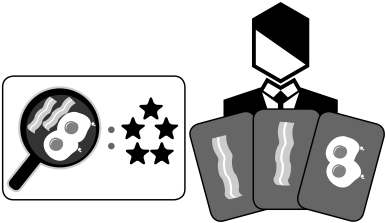
Players earn points by performing actions.
Discussion
In contrast with Victory Points from Game State, this mechanism gives players points based on discrete actions which may be very local. An example would be capturing stones in Go, where each stone is worth one point. Surrounding territory in Go, the other way of scoring points, is only evaluated at the end of the game and until that point can be invaded, shrunk, or expanded. Eclipse and Kemet offer VPs for winning battles. Many games, like Lords of Waterdeep, Nexus Ops, or Splendor, have players take actions to complete or claim private or public goal cards (VIC-11), which are worth points. The relationship between the Action that you perform to gain VPs and how that affects your position and the game state has an important impact on the flow of the game. In some, like Lords of Waterdeep, completing quest cards is the main point of the game and doesn’t aid or hinder your ability to perform other actions in the future. However, in games like Dominion and Splendor, taking Victory cards can hinder your ability to gain more Victory cards. In Dominion, the point cards become part of your deck, but they have no purpose if drawn. Tey simply clog things up. In Splendor, purchasing high-value cards does not give you as much of a “bang for your buck” for getting gem bonuses as purchasing lower-cost cards. In these games, the players need to choose between building up their engine or economy and cashing in on it. It creates what we call a
“pivot,” where players need to transition between building and scoring. This can be an interesting puzzle for players to work through.
Sample Games
Carcassonne (Wrede, 2000) Codenames (Chvátil, 2015) Dominion (Vaccarino, 2008) Eclipse (Tahkokallio, 2011) Go (Unknown, 2200 bce) Kemet (Bariot and Montiage, 2012) Lords of Waterdeep (Lee and Tompson, 2012) Nexus Ops (Cantino and Kimball, 2005) Splendor (André, 2014)
描述
玩家通过执行动作获得积分。
讨论
与基于游戏状态的胜利点数相比,此机制(Victory Points from Player Actions)根据离散的动作给玩家积分,这些动作可能是非常局部的。一个例子是《围棋》(Go)中的提子,每颗棋子值一分。在《围棋》中,另一种得分方式——围地,仅在游戏结束时进行评估,在此之前可能会被入侵、缩小或扩大。《Eclipse》和《Kemet》为赢得战斗提供VP。许多游戏,如《深水城领主》(Lords of Waterdeep)、《Nexus Ops》或《璀璨宝石》(Splendor),让玩家采取行动完成或认领私人或公共目标卡(VIC-11),这些卡值分。你为获得VP而执行的行动与它如何影响你的位置和游戏状态之间的关系对游戏流程有重要影响。在某些游戏中,如《深水城领主》,完成任务卡是游戏的主要点,并不会帮助或阻碍你将来执行其他行动的能力。然而,在像《皇舆争霸》(Dominion)和《璀璨宝石》这样的游戏中,拿走胜利卡可能会阻碍你获得更多胜利卡的能力。在《皇舆争霸》中,点数卡成为你牌组的一部分,但如果抽到它们就没有用处。它们只是堵塞了东西。在《璀璨宝石》中,购买高价值卡牌在获得宝石奖励方面并不像购买低成本卡牌那样“物有所值”。在这些游戏中,玩家需要在建立引擎或经济与从中获利之间做出选择。它创造了我们所谓的
“支点”(pivot),玩家需要在建设和得分之间进行转换。这对玩家来说可能是一个需要解决的有趣难题。
游戏范例
Carcassonne (Wrede, 2000) - 《卡卡颂》 Codenames (Chvátil, 2015) - 《行动代号》 Dominion (Vaccarino, 2008) - 《皇舆争霸》 Eclipse (Tahkokallio, 2011) - 《星蚀》 Go (Unknown, 2200 bce) - 《围棋》 Kemet (Bariot and Montiage, 2012) - 《Kemet》 Lords of Waterdeep (Lee and Tompson, 2012) - 《深水城领主》 Nexus Ops (Cantino and Kimball, 2005) - 《异星来客》 Splendor (André, 2014) - 《璀璨宝石》