
Description
A game with two or more players and a single winner.
Discussion
This is the most familiar game structure, the one we encounter as children in games like Candyland and Snakes & Ladders. Competitive games still make up the large majority of the market for tabletop games. Tey typically offer a symmetry of expectations: putting aside the impacts of unusual luck and skill, each player begins the game with a roughly equivalent chance of victory. When this promise is broken, the game is considered imbalanced and may even be tagged with the label “broken.” As we’ll discuss later (see “Variable Player Powers” in this chapter and “Variable Setup” in Chapter 6), players may have perfectly symmetric factions and starting conditions or highly asymmetric ones. But, in both cases, it’s important that the game offers roughly even chances of victory to each player (Illustration 1.1). In many games, there is an asymmetry that in-game balancing alone can’t solve, like the first-mover advantage in chess or the service advantage in tennis. Competitive games often balance these advantages through meta-structures, like tournaments, that offer each player an equal number of chances to play from the advantaged position. In multiplayer games, this may be less practical. Instead, players may be offered other opportunities to balance any perceived or actual inequities, like the bidding in Bridge, betting in Poker, or the early alliances in Diplomacy.
The promise of balance in a competitive game gives rise to several related issues, like methods for determining victory and breaking ties. Tie-breaking (RES-18), in particular, is interesting because crowning a winner in a competitive game depends upon the game storing information that allows players to determine who played the better game. For many games, this information may not be available. Once we have to look beyond who scored the most victory points or who crossed some finish line first, there may not be relevant game-state information that could allow us to reasonably determine which of the tied players played best. And yet, in competitive games, many players disdain a game that ends in shared victory. Experience-oriented designers should consider that players tend to recall how a game ended more than the rest of the play experience, and hence the designers should seek to avoid an indecisive conclusion.
Sample Games
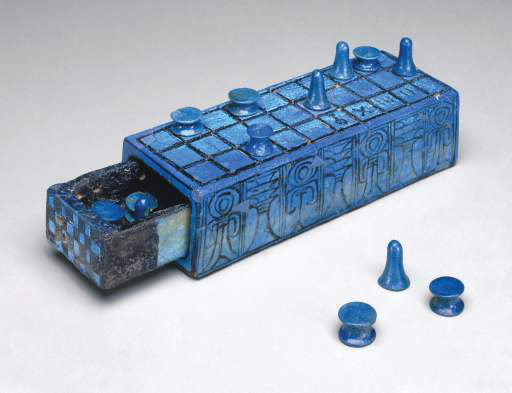
Acquire (Sackson, 1964) Candyland (Abbot, 1949) Chess (Unknown, ∼1200) Diplomacy (Calhamer, 1959) Senet (Unknown, ∼2600 bce) Snakes & Ladders (Unknown, ∼200 bce) Illustration 1.1 The Egyptian game Senet is one of the oldest board games known, going back to 2600 BCE. This set dates around 1350 BCE.
描述
有两个或更多玩家且只有一个赢家的游戏。
讨论
这是最熟悉的游戏结构,我们在童年时期的游戏中,如《糖果乐园》(Candyland)和《蛇梯棋》(Snakes & Ladders)中遇到过。竞争性游戏(Competitive Games)仍然构成了桌面游戏市场的绝大多数。它们通常提供期望的对称性:抛开非凡运气和技能的影响,每位玩家开始游戏时获胜的机会大致相当。当这一承诺被打破时,游戏被认为是不平衡的,甚至可能被贴上“坏了”的标签。正如我们稍后将讨论的那样(参见本章中的“可变玩家能力”和第6章中的“可变设置”),玩家可能拥有完全对称的派系和起始条件,或者高度不对称的。但是,在这两种情况下,重要的是游戏为每位玩家提供大致均等的获胜机会(插图1.1)。在许多游戏中,存在一种单纯靠游戏内平衡无法解决的不对称性,例如国际象棋中的先行优势或网球中的发球优势。竞争性游戏通常通过元结构来平衡这些优势,如锦标赛,为每位玩家提供同等数量的从优势位置进行比赛的机会。在多人游戏中,这可能不太切合实际。取而代之的是,可能会为玩家提供其他机会来平衡任何感知到的或实际的不平等,如《桥牌》中的叫牌,《扑克》中的下注,或《外交》(Diplomacy)中的早期联盟。
竞争性游戏中的平衡承诺引发了几个相关问题,如确定胜利和打破平局的方法。打破平局(Tie-breaking,RES-18)特别有趣,因为在竞争性游戏中加冕赢家取决于游戏存储允许玩家确定谁玩得更好的信息。对于许多游戏,这些信息可能不可用。一旦我们必须超越谁得分最多或谁先越过终点线,可能就没有相关的游戏状态信息可以让我们合理地确定哪位平局玩家玩得最好。然而,在竞争性游戏中,许多玩家鄙视以共同胜利结束的游戏。面向体验的设计师应该考虑到,玩家往往比起其他的游戏体验更记得游戏是如何结束的,因此设计师应该寻求避免不具决定性的结论。
游戏范例
Acquire (Sackson, 1964) - 《Acquire》 Candyland (Abbot, 1949) - 《糖果乐园》 Chess (Unknown, ∼1200) - 《国际象棋》 Diplomacy (Calhamer, 1959) - 《外交》 Senet (Unknown, ∼2600 bce) - 《塞尼特》 Snakes & Ladders (Unknown, ∼200 bce) - 《蛇梯棋》 插图1.1 埃及游戏《塞尼特》是已知最古老的棋盘游戏之一,可追溯到公元前2600年。这一套大约在公元前1350年。