Description
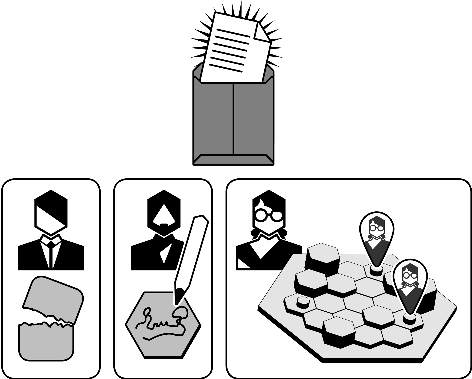
A legacy game is a multisession game in which permanent and irreversible changes to the game state carry over from session to session.
Discussion
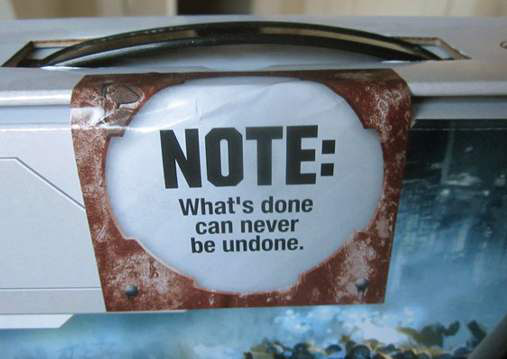
The first legacy game, Rob Daviau’s Risk Legacy, came from the unlikeliest of places: Hasbro. Daviau, by his telling, half-shepherded, half-snuck the audacious design past the gatekeepers at the company and emerged with a genre-defining hit. Famously, the game was sealed with a sticker that had to be broken to open the box, and which warned ominously, “What Is Done Cannot Be Undone.” This irreversible permanent change is what legacy games are all about (Illustration 1.2). Legacy games are difficult to playtest, require generating quite a lot of content, and are tricky to produce and price properly. Curmudgeons will rightly point out that RPGs and campaign games are essentially legacy games, except that you don’t have to destroy your game as you play. Yet that permanent destruction, the tearing of a card or writing on a board, generates a visceral response that those other games don’t. Breaking this taboo and permanently altering a game can be a stressful and cathartic experience at the same time.
Legacy games aren’t simply about destroying components and defacing boards. Another element common to these games is unlocks: gated content that can only be opened and accessed after some condition is met. We’ll refrain from specific examples so as not to spoil these experiences for the uninitiated! Unlocks differ fundamentally from gated content in non-legacy games (see “Gating and Unlocking,” ACT-15) in that unlocks usually occur at game-end, their impacts will only be felt in the next session, and these unlocks are typically not simply buffs and de-buffs to existing statistics, but rather, entire new mechanisms, characters, factions, maps, etc. These unlocks can also radically change the narrative or move the camera and offer players new perspectives and surprises. Like campaign games, legacy games require a substantial commitment to complete, and they typically call for the same group to come together ten or more times. Pandemic Legacy can theoretically take 24 sessions to complete! Publishers, and thus designers, can feel trapped between offering a novel and essentially unrepeatable experience, on the one hand, while still providing sufficient re-playability to players, despite the consumable nature of the game. Most legacy games do allow players to keep playing the game even after the campaign is concluded, but anecdotally, it seems that few players do so. It appears that the market is expanding to allow for a broader range of possible games such that at the right price point, even a single-play game like the Exit series can be a hit. Games like the Harry Potter: Hogwarts Battle Illustration 1.2 The exterior seal in Risk Legacy. This helps place the player in the proper headspace for the game.
deck-building game have used unlocks, but not destructibility, and are fully resettable. Gloomhaven takes a similar approach with reusable stickers to pro-vide changes that are campaign-permanent but otherwise reversible. Fabled Fruit is even more easily reset, requiring nothing more than reordering a deck of cards. However, it is difficult to distinguish it structurally from, say, a deck-building game in which any given play session may include a completely different subset of cards. Legacy games are a still-emerging category and definition. Elements we’ve identified may not exist in every game, and new elements may yet emerge, especially as legacy games and digital apps converge. Concerns about reusability and the environment do appear to have shifted designers away from requiring the destruction of components. In Zombie Teenz Evolution, a 2021 nominee for the prestigious Spiel des Jahres award, gameplay elements are mostly resettable, but a comic strip included in the rules is composed of sticker panels that are unlocked during gameplay. From a product design perspective, the game can be given to another group to play after one group completes it, but some aspects of the experience are only available to the purchaser of a new copy.
Sample Games
Betrayal Legacy (Daviau, Cohen, Honeycutt, Miller, Neff, and Veen, 2018) Charterstone (Stegmaier, 2017) Fabled Fruit (Friese, 2016) Gloomhaven (Childres, 2017) Harry Potter: Hogwarts Battle (Forrest-Pruzan Creative, Mandell and Wolf, 2016) Legacy of Dragonholt (Valens, Clark, Flanders, and Mitsoda, 2017) Pandemic Legacy: Season 1 (Daviau and Leacock, 2015) Risk Legacy (Daviau and Dupuis, 2011) Zombie Teenz Evolution (Lobet, 2020)
描述
遗产游戏(Legacy Game)是一种多会话游戏,其中对游戏状态的永久和不可逆的改变会从一个会话延续到下一个会话。
讨论
第一款遗产游戏,Rob Daviau的《Risk Legacy》,来自最不可能的地方:孩之宝(Hasbro)。根据Daviau的说法,他半是引导、半是偷偷摸摸地将这个大胆的设计带过了公司的把关人,并产生了一款定义流派的热门作品。众所周知,这款游戏是用一张贴纸密封的,必须打破贴纸才能打开盒子,上面不祥地警告说:“做过的事无法撤销。”这种不可逆转的永久性改变正是遗产游戏的全部内容(插图1.2)。遗产游戏很难进行游戏测试,需要生成大量内容,并且很难生产和正确定价。爱发牢骚的人会正确地指出,RPG和战役游戏基本上是遗产游戏,除了你不必在玩的时候破坏你的游戏。然而,那种永久性的破坏,撕毁卡牌或在版图上书写,会产生其他游戏所没有的内心反应。打破这一禁忌并永久改变游戏可能是一种既有压力又能宣泄情绪的体验。
遗产游戏不仅仅是破坏组件和污损版图。这些游戏的另一个共同元素是解锁:只有在满足某些条件后才能打开和访问的门禁内容。我们将避免具体的例子,以免破坏未涉足者的体验!解锁与非遗产游戏中的门禁内容(见“门禁和解锁”,ACT-15)有根本不同,因为解锁通常发生在游戏结束时,它们的影响只能在下一次会话中感受到,而且这些解锁通常不仅是对现有统计数据的增益和减益,而是全新的机制、角色、派系、地图等。这些解锁还可以彻底改变叙事或移动视角,并为玩家提供新的视角和惊喜。像战役游戏一样,遗产游戏需要大量的承诺才能完成,并且通常要求同一组人聚在一起十次或更多次。《瘟疫危机:承传》(Pandemic Legacy)理论上可能需要24次会话才能完成!出版商,进而设计师,可能会感到被困在提供新颖且本质上不可重复的体验与仍然为玩家提供足够的可重玩性之间,尽管游戏具有消耗性。大多数遗产游戏确实允许玩家在战役结束后继续玩游戏,但据传闻,似乎很少有玩家这样做。市场似乎正在扩大,以允许更广泛的可能游戏,以便在适当的价格点上,即使是像《Exit》系列这样的一次性游戏也能大受欢迎。像《哈利·波特:霍格沃茨之战》(Harry Potter: Hogwarts Battle)这样的
插图1.2 《Risk Legacy》的外部密封。这有助于将玩家置于游戏的适当顶层空间中。
牌库构建游戏使用了解锁,但没有破坏性,并且完全可以重置。《Gloomhaven》采取了类似的方法,使用可重复使用的贴纸来提供战役永久但可逆的改变。《Fabled Fruit》甚至更容易重置,只需要重新排序一副牌。然而,从结构上很难将其与比如说每一次游戏会话可能包含完全不同的卡牌子集的牌库构建游戏区分开来。遗产游戏仍然是一个新兴的类别和定义。我们确定的元素可能并不存在于每个游戏中,并且可能会出现新元素,特别是随着遗产游戏和数字应用程序的融合。对可重用性和环境的担忧似乎确实使设计师不再要求破坏组件。在2021年著名的Spiel des Jahres奖提名游戏《Zombie Teenz Evolution》中,游戏元素大多是可重置的,但规则中包含的漫画条由在游戏过程中解锁的贴纸面板组成。从产品设计的角度来看,游戏可以在一组完成后交给另一组玩,但体验的某些方面仅对新副本的购买者可用。
游戏范例
Betrayal Legacy (Daviau, Cohen, Honeycutt, Miller, Neff, and Veen, 2018) - 《背叛:遗产》 Charterstone (Stegmaier, 2017) - 《Charterstone》 Fabled Fruit (Friese, 2016) - 《Fabled Fruit》 Gloomhaven (Childres, 2017) - 《幽港迷城》 Harry Potter: Hogwarts Battle (Forrest-Pruzan Creative, Mandell and Wolf, 2016) - 《哈利·波特:霍格沃茨之战》 Legacy of Dragonholt (Valens, Clark, Flanders, and Mitsoda, 2017) - 《Legacy of Dragonholt》 Pandemic Legacy: Season 1 (Daviau and Leacock, 2015) - 《瘟疫危机:承传 第1季》 Risk Legacy (Daviau and Dupuis, 2011) - 《Risk Legacy》 Zombie Teenz Evolution (Lobet, 2020) - 《Zombie Teenz Evolution》