Description
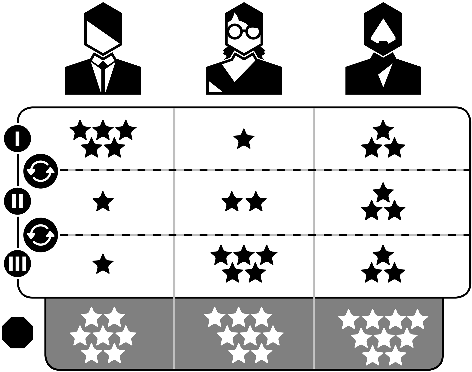
This is a game in which players play until reaching a stopping condition, then record scores, reset the game, and play one or more additional rounds. The game concludes after some number of rounds, and the cumulative score is calculated to determine a winner.
Discussion
Score-and-reset is a very common game structure that is well represented among classic games from Bridge to Backgammon, and in modern games like Red7, Ravenous River, and Incan Gold. Card games are especially amenable to this structure, which matches well with playing out a hand of cards, shuffling and redealing. Games with a strong turn-order advantage can take advantage of the score-and-reset structure by having players take turns in the lead position and using cumulative scoring to measure who played best over a series of rounds. Stacking games like Rhino Hero use score-and-reset because once the shared structure is toppled, there’s a need to collect up the cards and pieces anyway, and this represents a natural end point. Whether players do in fact record wins and losses or points is to some extent a matter of the dynamics of
the game group itself. By contrast, dexterity games like KLASK and BONK reset after each goal, but scoring is rigorously tracked. Score-and-reset structures can be somewhat informal. Players might play a series of games of Hive and declare a victor after one player reaches some total number of victories. There’s not a sharp line between score-and-reset and round structure in general. Amun-Re features two ages, in which gameplay is identical, but the board itself does not fully reset. Pyramids built in the first age persist in the second age and influence the valuation of territories. In Blue Lagoon, the board is reset between the first and second half of the game, with the exception of the huts players lay out in the first half. However, the rules of placement change profoundly—where players were free to lay explorers on any sea space in the first half; in the second half, they must begin laying explorers adjacent to their huts.
Sample Games
Amun-Re (Knizia, 2003) Blue Lagoon (Knizia, 2018) BONK (Harvey, 2017) Hive (Yianni, 2001) Incan Gold (Faidutti and Moon, 2005) KLASK (Bertelsen, 2014) Ravenous River (Shalev, 2016) Red7 (Chudyk and Cieslik, 2014) Rhino Hero (Frisco and Strumph, 2011)
描述
这是一种游戏,玩家玩到达到停止条件,然后记录分数,重置游戏,再玩一轮或多轮。游戏在若干轮后结束,计算累计得分以确定获胜者(Score-and-Reset Games)。
讨论
计分并重置(Score-and-Reset)是一种非常常见的游戏结构,在从《桥牌》(Bridge)到《双陆棋》(Backgammon)的经典游戏,以及像《Red7》、《Ravenous River》和《印加宝藏》(Incan Gold)这样的现代游戏中都有很好的体现。纸牌游戏特别适合这种结构,这与打出一手牌、洗牌和重新发牌非常吻合。具有强烈回合顺序优势的游戏可以利用计分并重置结构,让玩家轮流处于领先位置,并使用累计计分来衡量谁在一系列回合中表现最好。像《Rhino Hero》这样的堆叠游戏使用计分并重置,因为一旦共享结构倒塌,无论如何都需要收集卡牌和碎片,这就代表了一个自然的终点。玩家实际上是否记录输赢或分数,在某种程度上取决于
游戏小组本身的动态。相比之下,像《KLASK》和《BONK》这样的敏捷游戏在每个进球后都会重置,但计分会被严格跟踪。计分并重置结构可能有些非正式。玩家可能会玩一系列《Hive》游戏,并在一名玩家达到一定数量的胜利后宣布获胜者。计分并重置与一般的回合结构之间并没有明确的界限。《Amun-Re》具有两个时代,其中的游戏玩法相同,但版图本身并没有完全重置。第一时代建造的金字塔延续到第二时代,并影响领土的估值。在《Blue Lagoon》中,版图在游戏的上半场和下半场之间被重置,除了玩家在上半场布置的小屋。然而,放置规则发生了深刻的变化——在上半场,玩家可以自由地将探险家放在任何海洋空间上;在下半场,他们必须开始将探险家放在与他们的小屋相邻的地方。
游戏范例
Amun-Re (Knizia, 2003) - 《阿蒙拉/Amun-Re》 Blue Lagoon (Knizia, 2018) - 《Blue Lagoon》 BONK (Harvey, 2017) - 《BONK》 Hive (Yianni, 2001) - 《昆虫棋/Hive》 Incan Gold (Faidutti and Moon, 2005) - 《印加宝藏》 KLASK (Bertelsen, 2014) - 《KLASK》 Ravenous River (Shalev, 2016) - 《Ravenous River》 Red7 (Chudyk and Cieslik, 2014) - 《Red7》 Rhino Hero (Frisco and Strumph, 2011) - 《犀牛英雄/Rhino Hero》