Description
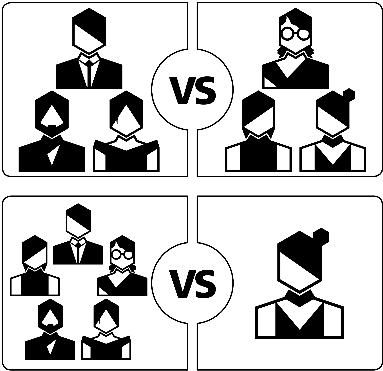
In team-based games, teams of players compete with one another to obtain victory. There are a variety of possible team structures, including symmetrical teams like 2v2 and 3v3, multiple sides like 2v2v2, and even One vs. All.
Discussion
Team-based play is an ancient human pastime and is prevalent in sports, classic card games, and war games. Tematic board games that model some conflict often have to deal with a bilateral narrative, whether in the conflict of good vs. evil like in War of the Ring, the eponymous conflict of Axis & Allies, or the entirely fabricated battle between villagers and their lycanthropic tormentors in Werewolf. Team games allow designers to faithfully recreate these two-sided conflicts while making space for more players at the table. Most team games assign players to one team or another at the outset and allow collaboration and communication among partners. In some cases, partners may share territory and resources or even move each other’s pieces around the board. Early editions of Axis & Allies, for example, featured Commander-in-Chief rules to model the historical reality of coordinating attacks by multinational armies.
Assigning players to teams in secret is a common trope in social deduction and betrayal-style games. In Werewolf, the werewolves know one another, but the villagers are left to deduce who is a fellow human and who might devour them in the night. In Battlestar Galactica, neither humans nor Cylons are revealed to one another, leading to intense suspicion and paranoia. Battlestar Galactica features a further twist: team assignments are not static, and a player might start the game as a human, only to become a Cylon in a mid-game loyalty phase that can potentially reassign players from the human to the Cylon side. Some games support partnering at the meta-game level. In Risk, Diplomacy, and many other games, the rules specify that alliances can be formed and broken freely. There are even games that further encode these alliances into the rules. Dune provides for different end-game conditions for alliances with different numbers of factions, includes a specific phase when alliances may be formed, and has rules governing the conduct of allies (e.g., they may not attack each other). Eclipse establishes economic advantages for allying with other players, while limiting the number of these allegiances and enforcing in-game penalties on betrayers. There is a great deal of fluidity between games that allow for coordination in play and those that have explicit mechanisms to support that coordination. Another common approach to team-based games is to assign players different roles in the game. This goes well beyond the distinct player abilities common to many co-op games. Party games from Celebrity to Taboo to Codenames feature one player in a clue-giving role, with one or more teammates in a guessing role. This structure is especially suitable for party games because of the concurrent play of the guessers and the ability for the game structure to support large numbers of players at any one time. It also allows players to easily enter and exit from a game without negatively impacting the overall play experience for other players. It is not just party games that embrace role separation, though. Space Cadets: Dice Duel and Captain Sonar both have players crewing a ship as engineers, radar operators, captains, and weapons specialists. Each player plays a mini-game to model their function within the ship, and the broader game is the sum of these coordinated parts. Sometimes, these roles can be fixed for the whole game, sometimes, players will rotate through the roles every round, and sometimes, the game itself will force players to change roles. This last approach can be thematically interesting and appealing to experienced players but can be especially challenging for new players, who can easily be disoriented when forced to change roles. It also makes teaching
these games much more difficult, since, in theory, every player needs to know every mini-game before the play can begin. Designers need to take this into account, perhaps by reserving role-changing cards and other triggers for advanced play only. Somewhat less common are team games with more than two teams competing at once. Skirmish games like Star Wars: X-Wing can allow for these types of modes, but there are even more unusual examples. Cyclades with the Titans expansion enables a 2v2v2 mode, and Ticket to Ride: Asia also supports 2v2v2 play. Team modes are fairly common in otherwise non-team games, and some team modes are attempts to enable a 1v1 game to scale to a higher player count. The aforementioned Axis & Allies and War of the Ring have team modes, but players may simply choose to play using the 1v1 rules and have teammates collaborate in decision-making instead of using the formal rules for team play. Two other game genres feature partnerships. Card games, especially those in the trick-taking family, are one. The other partnership genre is dexterity games. Flick ’em Up has explicit partnership rules, and many flicking games like PitchCar and Caveman Curling are amenable to alternating play. Another very popular game structure is One vs. All. This structure is especially suitable for hidden-movement hunting games, in which one player attempts to escape from a group of hunters, like Scotland Yard, Specter Ops, and Hunt for the Ring. It’s also common in overlord-style games where one player controls the “bad guys” and the other players each control an individual hero. Conan, Star Wars: Imperial Assault, and Level 7 [Omega Protocol] all feature this style of play. Fantasy Flight Games has converted many of its overlord games into cooperative games by introducing an app to control the overlord player. What distinguishes One vs. All most sharply from other team games is the asymmetric nature of the factions. In hunting games, each player typically controls only one character, but the characters tend to have very distinct abilities, and the victory conditions for the two sides are different too. In overlord games, the overlord usually controls a whole host of minions that they can deploy, whereas the other players control only one
character. These games can be difficult to teach and learn because players need to learn how both factions work in order to play the game effectively. While the genre remains very popular, that challenge continues to bedevil designers and players.
Sample Games
Axis & Allies (Harris, Jr., 1981) Battlestar Galactica: The Board Game (Konieczka, 2008) Captain Sonar (Fraga and Lemonier, 2016) Caveman Curling (Quodbach, 2010) Celebrity (Unknown) Codenames (Chvátil, 2015) Conan (Henry, Bauza, Bernard, Cathala, Croc, Maublanc, and Pouchain, 2016) Descent: Journeys in the Dark (Second Edition) (Clark, Konieczka, Sadler, and Wilson, 2012) Diplomacy (Calhamer, 1959) Dune (Eberle, Kittredge, and Olatka, 1979) Eclipse (Tahkokallio, 2011) Flick ’em Up (Beaujannot and Monpertuis, 2015) Hunt for the Ring (Maggi, Mari, and Nepitello, 2017) Level 7 [Omega Protocol] (Schoonover, 2013) Mansions of Madness: Second Edition (Valens, 2016) PitchCar (du Poël, 1995) Risk (Lamorisse and Levin, 1959) Scotland Yard (Burggraf, Garrels, Hoermann, Ifland, Scheerer, and Schlegel, 1983) Space Cadets: Dice Duel (Engelstein and Engelstein, 2013) Specter Ops (Matsuuchi, 2015) Star Wars: Imperial Assault (Kemppainen, Konieczka, and Ying, 2014) Taboo (Hersch, 1989) War of the Ring (Second Edition) (Di Meglio, Maggi, and Nepitello, 2012)
描述
在基于团队的游戏(Team-Based Games)中,玩家团队相互竞争以获得胜利。有各种可能的团队结构,包括对称团队如2v2和3v3,多方如2v2v2,甚至一对多。
讨论
基于团队的游戏是人类古老的消遣方式,在体育运动、经典纸牌游戏和战争游戏中都很流行。模拟某种冲突的主题棋盘游戏通常必须处理双边叙事,无论是在《魔戒圣战》(War of the Ring)中的善恶冲突,同名的《轴心国与同盟国》(Axis & Allies)冲突,还是《狼人杀》(Werewolf)中村名与其狼人折磨者之间完全捏造的战斗。团队游戏允许设计师忠实地重现这些双边冲突,同时为桌面上更多的玩家腾出空间。大多数团队游戏一开始就分配玩家到一个团队或另一个团队,并允许合作伙伴之间进行协作和交流。在某些情况下,合作伙伴可以共享领土和资源,甚至可以在版图上移动彼此的棋子。例如,《轴心国与同盟国》的早期版本具有总司令规则,以模拟多国军队协调攻击的历史现实。
秘密分配玩家到团队是社交推理和背叛风格游戏中的常见比喻。在《狼人杀》中,狼人彼此认识,但村民们只能推断谁是人类同胞,谁可能在夜间吞噬他们。在《太空堡垒卡拉狄加》(Battlestar Galactica)中,人类和赛昂人都不会向对方透露,导致强烈的怀疑和偏执。《太空堡垒卡拉狄加》还有一个转折:团队分配不是静态的,玩家可能以人类身份开始游戏,但在游戏中期的忠诚阶段变成赛昂人,这可能会将玩家从人类方重新分配到赛昂人方。一些游戏支持元游戏层面的合作。在《Risk》、《外交》和许多其他游戏中,规则规定可以自由结盟和解盟。甚至有些游戏将这些联盟进一步编码到规则中。《沙丘》(Dune)为具有不同派系数量的联盟提供了不同的终局条件,包括可以结盟的特定阶段,并有管理盟友行为的规则(例如,他们可能不会互相攻击)。《Eclipse》确立了与其他玩家结盟的经济优势,同时限制这些效忠的数量并对背叛者实施游戏内惩罚。在允许游戏内协调的游戏和具有支持该协调的明确机制的游戏之间存在很大的流动性。基于团队的游戏的另一种常见方法是为游戏中的玩家分配不同的角色。这远远超出了许多合作游戏中常见的不同玩家能力。从《Celebrity》到《Taboo》再到《Codenames》的聚会游戏都有一名玩家扮演提供线索的角色,一名或多名队友扮演猜测角色。这种结构特别适合聚会游戏,因为猜测者同时进行游戏,并且游戏结构能够在任何时间支持大量玩家。它还允许玩家轻松进入和退出游戏,而不会对其他玩家的整体游戏体验产生负面影响。不仅仅是聚会游戏拥抱角色分离。《Space Cadets: Dice Duel》和《Captain Sonar》都让玩家作为工程师、雷达操作员、船长和武器专家组成船员。每位玩家玩一个小游戏来模拟他们在船内的功能,而更广泛的游戏是这些协调部分的总和。有时,这些角色可以在整个游戏中固定,有时,玩家每轮轮换角色,有时,游戏本身会迫使玩家改变角色。最后一种方法在主题上可能很有趣,对有经验的玩家很有吸引力,但对新玩家来说尤其具有挑战性,当被迫改变角色时,他们很容易迷失方向。这也使得教学
这些游戏要困难得多,因为理论上,每个玩家都需要在游戏开始前了解每个小游戏。设计师需要考虑到这一点,也许通过仅为高级游戏保留角色变更卡和其他触发器。不太常见的是两个以上团队同时竞争的团队游戏。像《Star Wars: X-Wing》这样的小规模冲突游戏可以允许这些类型的模式,但还有更不寻常的例子。《Cyclades》及其《Titans》扩展包支持2v2v2模式,《Ticket to Ride: Asia》也支持2v2v2游戏。团队模式在其他非团队游戏中相当常见,一些团队模式试图使1v1游戏扩展到更高的玩家数量。上述《轴心国与同盟国》和《魔戒圣战》有团队模式,但玩家可能只是选择使用1v1规则进行游戏,并让队友在决策中协作,而不是使用正式的团队游戏规则。另外两种游戏类型具有伙伴关系。纸牌游戏,尤其是吃墩家族中的游戏,就是其中之一。另一种伙伴关系类型是敏捷游戏。《Flick ’em Up》有明确的伙伴关系规则,许多像《PitchCar》和《Caveman Curling》这样的弹指游戏都适合交替游戏。另一种非常流行的游戏结构是一对多(One vs. All)。这种结构特别适合隐藏移动狩猎游戏,其中一名玩家试图从一群猎人中逃脱,如《Scotland Yard》、《Specter Ops》和《Hunt for the Ring》。这也常见于领主风格游戏,其中一名玩家控制“坏人”,其他玩家每人控制一个英雄。《Conan》、《Star Wars: Imperial Assault》和《Level 7 [Omega Protocol]》都具有这种游戏风格。Fantasy Flight Games通过引入控制领主玩家的应用程序,将其许多领主游戏转化为合作游戏。一对多与其他团队游戏最明显的区别在于派系的不对称性质。在狩猎游戏中,每个玩家通常只控制一个角色,但角色往往具有非常不同的能力,双方的胜利条件也不同。在领主游戏中,领主通常控制一大群他可以部署的小兵,而其他玩家只控制一个
角色。这些游戏可能很难教和学,因为玩家需要了解两个派系如何运作才能有效地玩游戏。虽然这一流派仍然非常受欢迎,但这一挑战继续困扰着设计师和玩家。
游戏范例
Axis & Allies (Harris, Jr., 1981) - 《轴心国与同盟国》 Battlestar Galactica: The Board Game (Konieczka, 2008) - 《太空堡垒卡拉狄加》 Captain Sonar (Fraga and Lemonier, 2016) - 《索纳尔船长/Captain Sonar》 Caveman Curling (Quodbach, 2010) - 《Caveman Curling》 Celebrity (Unknown) - 《Celebrity》 Codenames (Chvátil, 2015) - 《行动代号》 Conan (Henry, Bauza, Bernard, Cathala, Croc, Maublanc, and Pouchain, 2016) - 《柯南》 Descent: Journeys in the Dark (Second Edition) (Clark, Konieczka, Sadler, and Wilson, 2012) - 《深入绝地:黑暗之旅》 Diplomacy (Calhamer, 1959) - 《外交》 Dune (Eberle, Kittredge, and Olatka, 1979) - 《沙丘》 Eclipse (Tahkokallio, 2011) - 《星蚀》 Flick ’em Up (Beaujannot and Monpertuis, 2015) - 《Flick ’em Up》 Hunt for the Ring (Maggi, Mari, and Nepitello, 2017) - 《Hunt for the Ring》 Level 7 [Omega Protocol] (Schoonover, 2013) - 《Level 7 [Omega Protocol]》 Mansions of Madness: Second Edition (Valens, 2016) - 《疯狂诡宅》 PitchCar (du Poël, 1995) - 《PitchCar》 Risk (Lamorisse and Levin, 1959) - 《Risk》 Scotland Yard (Burggraf, Garrels, Hoermann, Ifland, Scheerer, and Schlegel, 1983) - 《苏格兰场/Scotland Yard》 Space Cadets: Dice Duel (Engelstein and Engelstein, 2013) - 《太空学员:骰子对决》 Specter Ops (Matsuuchi, 2015) - 《Specter Ops》 Star Wars: Imperial Assault (Kemppainen, Konieczka, and Ying, 2014) - 《星球大战:帝国突击》 Taboo (Hersch, 1989) - 《Taboo》 War of the Ring (Second Edition) (Di Meglio, Maggi, and Nepitello, 2012) - 《魔戒圣战》