Description
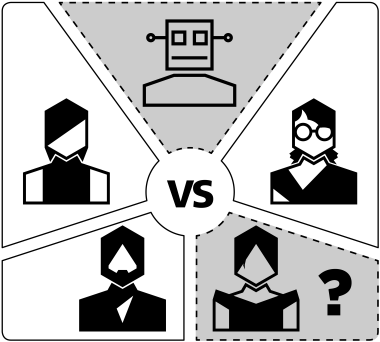
A traitor game can be seen as a kind of team game or as a cooperative game with a betrayal mechanism. The traitors typically win by triggering a failure condition for the players, though an affirmative win condition can also exist. For our purposes, a traitor game is characterized by traitors that begin the game with hidden identities.
Discussion
Traitor games sit at the overlap in the Venn diagram of social deduction games, team games, and cooperative games. The cooperative game engine sets the overall parameters for how players interact in the game, and those choices provide information that players can use and manipulate to deduce, accuse, and mislead. The team element provides coordination options for both sides, both out loud and in secret. These designs must add a layer of obfuscation to preserve uncertainty and mystery. Tus, in Dead of Winter, the cards contributed by players to meet the current crisis are shuffled prior to being revealed to hide which player contributed which card. In designing traitor games, it’s important to consider how the game plays at different stages of knowing the traitor’s identity. The tension and suspense of not knowing who is on which side is great fuel for the beginning of the game, but once the traitor has been sussed out, is the game still fun? Does the traitor still
have meaningful and interesting choices? Is catching the traitor a victory condition itself? Betrayal at House on the Hill is a traitor game with many story modules, each with its own mechanisms, that designers can treat it as a case study on this exact issue. Betrayal does not quite fit our definition of traitor game, in that the traitor is not determined at the start of the game. The initial part of the game, prior to the haunt that assigns the traitor role to one player, could perhaps be seen as an extensive gamified setup phase. In any case, the lessons from Betrayal’s story modes apply to games that fall more firmly within our definition. Another challenge facing traitor games is learnability. Like in team or One vs. All games, players have to learn how all the sides work to play properly. In traitor games with hidden identities, players can’t readily ask questions or consult the rules without giving away their loyalties. Good player-aids and reference material need to be the areas of focus. These games also usually require that the traitor player knows the game well, to maximize the potential of their position. This emphasizes the need for an easily learned game. Good player-aids can go a long way too, especially when the player-aids for both factions help explain how the opposite faction plays too.
Sample Games
Battlestar Galactica: The Board Game (Konieczka, 2008) Betrayal at House on the Hill (Daviau, Glassco, McQuilian, Selinker, and Woodruff, 2004) Dead of Winter: A Crossroads Game (Gilmour and Vega, 2014) Saboteur (Moyersoen, 2004) Shadows over Camelot (Cathala and Laget, 2005) Werewolf (Davidoff and Plotkin, 1986)
描述
叛徒游戏(Traitor Games)可以被看作是一种团队游戏,或者是带有背叛机制的合作游戏。叛徒通常通过触发玩家的失败条件来获胜,尽管也可以存在肯定的胜利条件。为了我们的目的,叛徒游戏的特征是叛徒在游戏开始时具有隐藏身份。
讨论
叛徒游戏位于社交推理游戏、团队游戏和合作游戏维恩图的重叠部分。合作游戏引擎设定了玩家在游戏中如何互动的总体参数,这些选择提供了玩家可以用来推断、指控和误导的信息。团队元素为双方提供了大声和秘密的协调选项。这些设计必须增加一层混淆以保持不确定性和神秘感。因此,在《死亡寒冬》(Dead of Winter)中,玩家为应对当前危机贡献的卡牌在揭示之前被洗牌,以隐藏哪个玩家贡献了哪张卡牌。在设计叛徒游戏时,重要的是要考虑游戏在知道叛徒身份的不同阶段是如何进行的。不知道谁在哪一边的紧张和悬疑是游戏开始时的巨大燃料,但一旦叛徒被发现,游戏还有趣吗?叛徒是否还
有有意义和有趣的选择?抓住叛徒本身就是一种胜利条件吗?《山屋惊魂》(Betrayal at House on the Hill)是一款拥有许多故事模块的叛徒游戏,每个模块都有自己的机制,设计师可以将其作为这方面问题的案例研究。《山屋惊魂》不太符合我们对叛徒游戏的定义,因为叛徒不是在游戏开始时确定的。游戏的最初部分,在分配叛徒角色给一名玩家的预兆之前,或许可以被视为一个广泛的游戏化设置阶段。无论如何,来自《山屋惊魂》故事模式的教训适用于更坚定地符合我们定义的游戏。叛徒游戏面临的另一个挑战是可学习性。就像在团队或一对多游戏中一样,玩家必须了解各方如何运作才能正确玩游戏。在具有隐藏身份的叛徒游戏中,玩家不能轻易提问或查阅规则而不泄露他们的忠诚。优秀的玩家辅助工具和参考资料需要成为重点领域。这些游戏通常还要求叛徒玩家非常了解游戏,以最大化他们位置的潜力。这强调了对易于学习的游戏的需求。优秀的玩家辅助工具也可以发挥很大作用,尤其是当两个派系的玩家辅助工具也有助于解释对方派系如何运作时。
游戏范例
Battlestar Galactica: The Board Game (Konieczka, 2008) - 《太空堡垒卡拉狄加》 Betrayal at House on the Hill (Daviau, Glassco, McQuilian, Selinker, and Woodruff, 2004) - 《山屋惊魂》 Dead of Winter: A Crossroads Game (Gilmour and Vega, 2014) - 《死亡寒冬》 Saboteur (Moyersoen, 2004) - 《矮人矿坑/Saboteur》 Shadows over Camelot (Cathala and Laget, 2005) - 《圆桌骑士/Shadows over Camelot》 Werewolf (Davidoff and Plotkin, 1986) - 《狼人杀》