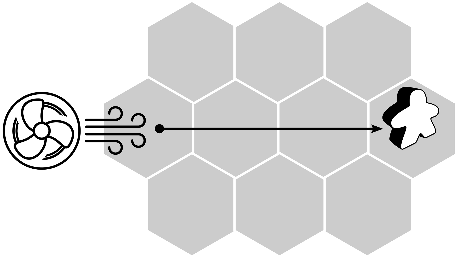
Description
Pieces automatically move in a certain direction, or it is easier to move in a certain direction.
Discussion
The Bias mechanism is typically used to simulate wind, currents, conveyor belts, and other physical systems. There are typically two types: Automatic and Influencers. Automatic Bias mechanisms move pieces in a set direction, typically at the end of each turn. An example is the conveyor belts in Robo Rally, which automatically move all robots on them, as well as possibly rotating them. Others are the rivers in Niagara and The Adventurers: The Temple of Chac, which slide all pieces on the river toward the falls, or the magnets or fans in Darter. This is also commonly seen as gravity in space games, such as Demon’s Run, which move players that go too close to black holes (Illustration 10.7). These effects are often indicated to the player by arrows on the board showing the effect on pieces. If movable elements are causing the effect, the iconography on the piece is often used. Influencer mechanisms make it easier to move in certain directions. This is very common in sailing games, but it can also be seen in other themes, like mountain climbing. In Yacht Race, the distance a ship can move is directly related to the wind direction. This mechanism can give texture to an otherwise featureless map, as in a sailing or space game. When players have some control over the element in
question (moving magnets in Darter, or changing wind direction in Yacht Race), it can present the players with really interesting tactical possibilities. For example, in Niagara players can influence how fast the river flows each turn. These mechanisms need to be used with some care, particularly with automatic biases when positioning is critical. If the system gets complicated, it can be difficult for players to picture where they will be at the end of their turn, particularly if this is combined with Programmed Movement (MOV10), as in Robo Rally. There are more complex variations on the mechanism. One is Gravwell: Escape from the 9th Dimension, where the Bias point depends on player location. Players move relative to the closest ship to them, whether ahead or behind. A related mechanism is used in Tutankhamen. Players move along a track and may only move in one direction. Tey may move as far as they want but Illustration 10.7 A sample board from Robo Rally showing the two types of conveyor belts. A robot moving onto a red conveyor is moved one space in the direction of the arrows; a blue conveyor moves it two spaces. Some conveyor spaces also rotate robots, as shown by the turned arrows.
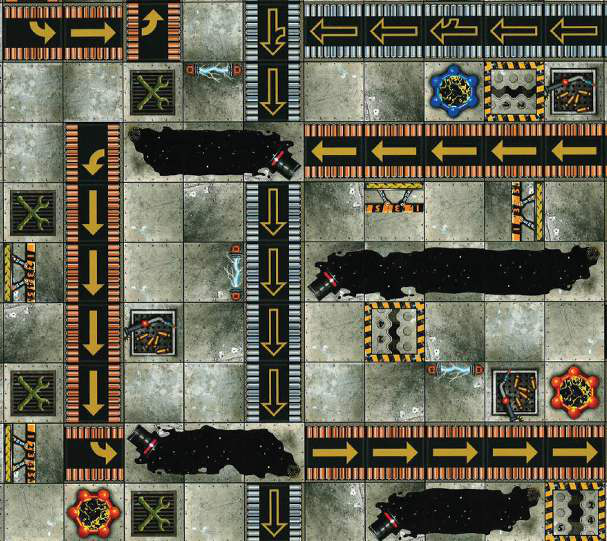
only get to use the ability of a piece they land on. This one-way nature of the board gives the players challenging decisions of whether to race ahead for a desirable space further along the track or to move slowly and get more actions but have to use only those spaces skipped by other players.
Sample Games
The Adventurers: The Temple of Chac (Blossier and Henry, 2009) Darter (Byrne and Conkey, 2004) Demon’s Run (Matheny, 1981) Gravwell: Escape from the 9th Dimension (Young, 2013) Niagara (Liesching, 2004) Primordial Soup (Matthäus and Nestel, 1997) Robo Rally (Garfield, 1994) Tutankhamen (Knizia, 1993) Yacht Race (Uncredited, 1960)
描述
棋子自动向特定方向移动,或者向特定方向移动更容易。
讨论
偏向(Bias)机制通常用于模拟风、水流、传送带和其他物理系统。通常有两种类型:自动(Automatic)和影响者(Influencers)。自动偏向机制以设定的方向移动棋子,通常在每回合结束时。一个例子是《Robo Rally》中的传送带,它自动移动所有在其上的机器人,并可能旋转它们。其他的还有《Niagara》和《The Adventurers: The Temple of Chac》中的河流,将河流上的所有棋子滑向瀑布,或者《Darter》中的磁铁或风扇。这在太空游戏中也通常被视为重力,例如《Demon’s Run》,移动那些太靠近黑洞的玩家(插图10.7)。这些效果通常通过版图上显示对棋子影响的箭头来向玩家指示。如果可移动元素导致该效果,则通常使用棋子上的图标。影响者机制使得向某些方向移动更容易。这在航海游戏中非常常见,但也可见于其他主题,如登山。在《Yacht Race》中,船只能移动的距离与风向直接相关。这种机制可以给原本毫无特色的地图增加纹理,如在航海或太空游戏中。当玩家对相关元素(移动《Darter》中的磁铁,或改变《Yacht Race》中的风向)有一定控制权时,
它可以为玩家提供非常有趣的战术可能性。例如,在《Niagara》中,玩家可以影响每回合河流的流速。使用这些机制需要小心,特别是当位置至关重要时的自动偏向。如果系统变得复杂,玩家很难想象他们在回合结束时会在哪里,特别是如果这与程序化移动(MOV-10)结合使用,如在《Robo Rally》中。该机制有更复杂的变化。一种是《Gravwell: Escape from the 9th Dimension》,其中的偏向点取决于玩家位置。玩家相对于离他们最近的船只移动,无论是在前面还是后面。在《Tutankhamen》中使用了相关的机制。玩家沿着轨道移动,只能向一个方向移动。他们可以移动任意远,但
插图10.7 《Robo Rally》的样本版图显示了两种类型的传送带。移动到红色传送带上的机器人沿箭头方向移动一格;蓝色传送带将其移动两格。一些传送带空间还会旋转机器人,如转弯箭头所示。
只能使用他们降落的棋子的能力。版图的这种单向性质让玩家面临具有挑战性的决定:是冲在前面争取轨道上更理想的空间,还是缓慢移动并获得更多行动,但只能使用其他玩家跳过的那些空间。
游戏范例
The Adventurers: The Temple of Chac (Blossier and Henry, 2009) - 《The Adventurers: The Temple of Chac》 Darter (Byrne and Conkey, 2004) - 《Darter》 Demon’s Run (Matheny, 1981) - 《Demon’s Run》 Gravwell: Escape from the 9th Dimension (Young, 2013) - 《引力边缘》 Niagara (Liesching, 2004) - 《尼亚加拉》 Primordial Soup (Matthäus and Nestel, 1997) - 《原始汤》 Robo Rally (Garfield, 1994) - 《机器人拉力赛》 Tutankhamen (Knizia, 1993) - 《图坦卡蒙》 Yacht Race (Uncredited, 1960) - 《Yacht Race》