Description
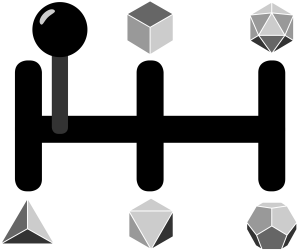
Different Dice are used to move depending on unit or game state.
Discussion
As an alternative to giving fixed Movement Points to units (MOV-04), this mechanism assigns a particular die or dice that are rolled to determine how far a unit may move. This introduces some randomness in movement rates but allows the player (and designer) to control the range. In Formula De, each gear is represented by a different die. Players roll the specific gear die to see how far they will move. These are special dice that have a specific min and max value—the D20 fifth gear die, for example, goes from 21 to 30. Battleball assigns a different die to each unit—D6s for the slow linesman and D20s for the speedy wide receivers. In this case, however, the dice are standard and go from 1 to 6 or 1 to 20 in these particular cases. This makes the wide receivers much more variable. In the dog-sled racing game Mush, dogs are represented by different dice depending on the type of weather they prefer. One of the advantages of this system is that there are very few rules overhead. Once the die is selected, you roll it to generate that number of Movement Points.
Sample Games
Battleball (Baker, 2003) Formula De (Lavauer and Randall, 1991) Mush (Moon, 1994)
描述
根据单位或游戏状态使用不同的骰子(Different Dice)进行移动。
讨论
作为给单位固定移动点数(MOV-04)的替代方案,此机制指定一个特定的骰子或骰子组来确定单位可以移动多远。这引入了移动速率的一些随机性,但允许玩家(及设计师)控制范围。在《方程式赛车》(Formula De)中,每个档位由不同的骰子表示。玩家掷特定的档位骰子来看看他们将移动多远。这些是特殊的骰子,具有特定的最小和最大值——例如,D20五档骰子从21到30。《Battleball》为每个单位分配不同的骰子——慢速线人使用D6,快速外接手使用D20。然而,在这种情况下,骰子是标准的,在这些特定情况下从1到6或1到20。这使得外接手更加多变。在狗拉雪橇竞速游戏《Mush》中,根据它们喜欢的天气类型,狗由不同的骰子表示。该系统的优点之一是规则开销非常小。一旦选择了骰子,你掷它来生成那个数量的移动点数。
游戏范例
Battleball (Baker, 2003) - 《Battleball》 Formula De (Lavauer and Randall, 1991) - 《方程式赛车》 Mush (Moon, 1994) - 《Mush》