Description
Movement occurs that is not visible to all players.
Discussion
Hidden Movement is closely tied to many of the mechanisms discussed in Chapter 6, “Uncertainty,” but there are specific considerations that are reviewed here. Scotland Yard is a classic example of a game with Hidden Movement. One player, Mr. X, is trying to evade the other players for a set number of turns. Hidden Movement games require the hidden players to track their location somehow, and in Scotland Yard, it is done by recording it on a pad. This method is commonly used in these games, as it also allows for the players to review the hidden players’ locations after the game is complete, both for the fun of seeing “close calls” as well as ensuring that the rules were followed. This last item deserves to be emphasized. By its nature, Hidden Movement requires actions to be taken without the knowledge of the other players. So, typically the rules relating to this activity should be as simple as possible. In Scotland Yard, Mr. X uses Point-to-Point movement (discussed in Tessellation MOV-01) to move around the map, using different forms of transportation. The connections between the points are colorcoded to match the transportation options, making it relatively simple to
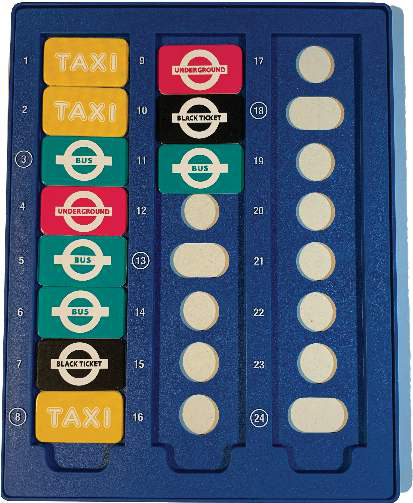
understand, and hopefully avoid mistakes. An error in a Hidden Movement game often cannot be found until after the game is over and can invalidate the entire experience (Illustration 10.11a). There are games that have more complex movements and rules in general in order to support a specific play experience. The Normandy Campaign is the first entry in the Double-Blind trilogy. In these war games, each player has a map of the play area and keeps it hidden from the other behind a screen. The front line is represented by a chain of tokens. Any movement of pieces behind the front line (friendly territory) is not revealed to the other player. If a player wishes to move into enemy territory, they announce the coordinates of the spaces they moving into, one at a time. If there are enemy forces in a space, the movement is stopped and combat between the invaders and defenders is resolved. Any spaces the invading armies traverse are taken over by the invading player, and the front line is adjusted to reflect the transfer of ownership. Illustration 10.11a Hidden movement in Scotland Yard is tracked with this component. A piece of a player is placed inside, and the Mr. X player writes their moves in the windows and covers it with the type of transportation that was used.
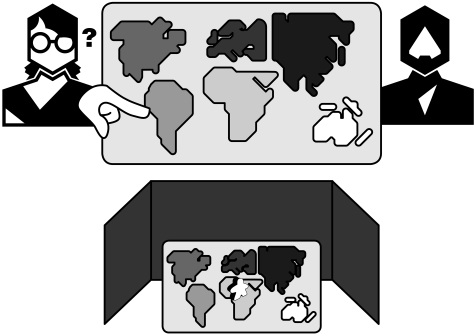
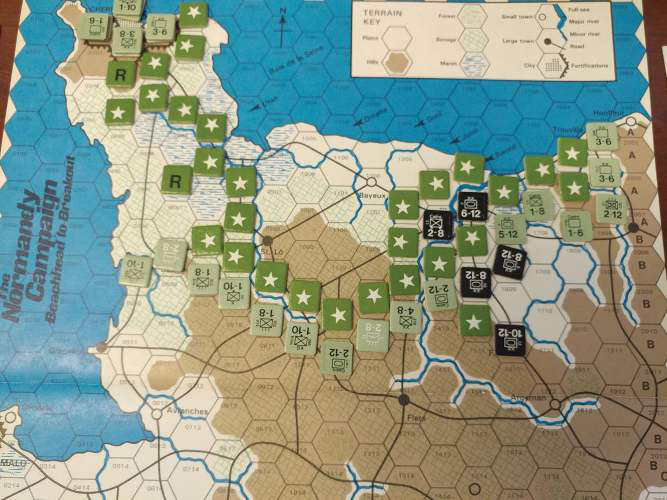
This procedure requires that both players be very familiar with the rules and relies on the honor system for following them (Illustration 10.11b). The game Flat Top simulates carrier battles in World War II, and both players use Hidden Movement on private boards to track the location of their naval task forces to try to find the enemy players launch search planes on the main board. However, since simply placing search planes launched from carriers directly onto the board would reveal the carrier locations, players are allowed to use Hidden Movement for search planes until they want to reveal them on the main board. Tey can’t search until they are revealed, but they can move to a different location far enough from their carrier to try to mislead the opponent about their origin point. Since deception and deduction are typically part of the Hidden Movement experience, most of these games have defined points or reasons when players must reveal their location. Scotland Yard requires the player to surface on certain turns. Specter Ops requires the hidden player to commit crimes at certain Illustration 10.11b The Axis map in The Normandy Campaign. The Allied front line is indicated by the green star counters, but the actual Allied units may be anywhere within that area. Photo by Board Game Geek user oi_you_nutter.
locations, which reveal their location, as does moving in Line of Sight of a hunter (ARC-08). Ghost Chase does not permit the ghost player to enter the same room twice, gradually reducing their possible options for movement. Another option for giving hints is used in Captain Sonar. In this game, each team announces what direction it is moving in (e.g., North or West). The other team records this information and, since subs cannot move through islands or off the map, can gradually figure out where the opponent is located. The Fury of Dracula gives time-delayed hints to the hunters using an Action Queue system (ACT-06). Dracula plays a card showing the location he is moving to, but that card is added to a queue. Only the last card in the queue may be looked at by the hunters, so they see where Dracula was a few turns ago but not where he currently is. This has the benefit of not requiring any note-taking by the player conducting the Hidden Movement and helps detect rule violations. Hidden movement games can take advantage of recording moves to force players to actually program movement in advance (Programmed Movement: MOV-10). In Mind MGMT, a one-vs-many game (STR-03), the single player begins the game by planning five turns of movement on a personal dry-erase board. Each turn they plan one more turn into the future. This combines future commitment for the hidden player with a “trail” system like The Fury of Dracula. In the two-player Duel in the Dark about the bombing raids on Germany during World War II, the British player plans all of their movement before the raid begins, after targets and weather are determined. This is done by placing a series of “compass cards” in a stack indicating the direction the raid moves. During the raid, the Germans may move freely and try to predict what the British path and target are. In Duel in the Dark, the player using hidden movement has little chance to react to the “visible” movement player, so the need for information hints is minimized. It shifts more into a pure deductive exercise (UNC-12). Pyramid of Pengqueen offers a unique approach to detecting hidden locations. Players place magnetized pieces on either side of a vertical center wall. When two pieces are on the same space, they repel and fall off of the wall. Another way to implement Hidden Movement is what we call the Anchor/ Distance mechanism. In this, the unit that is moving is revealed in a specific location. Ten each turn, or as a result of an action, it moves one further away from that space, increasing the Distance. However, the exact location is not recorded or determined in any way. At some point, the movement is completed or the unit is revealed. At that time, it is placed on the map a number of spaces away from the Anchor space determined by the Distance.
This system is used by War of the Ring. The Fellowship hides, and then each time it takes a Move action, the Distance is increased by one on a movement track, but the Fellowship token itself does not yet move, and remains on its last revealed location. The opponent, The Shadow Armies, may try to hunt and reveal the location of the Fellowship, or the Fellowship may declare its position voluntarily. When the Fellowship is revealed, the Free Peoples player moves its token on the map by as many spaces as the Distance shown on the movement track. The Distance is then reset to zero. If the Fellowship selects a path through certain regions, like an enemy-controlled stronghold, consequences like taking increased corruption or damage will follow. On a turn-by-turn basis, the Fellowship’s exact location is undetermined. Interactions with the Fellowship are tied to its last known location, but an interaction which reveals the Fellowship also forces a declaration of its last few turns of movement. One important consequence of this system is that paper tracking of the Fellowship is not required and the experience is far less susceptible to human error. In 4000 ad, fleets move by “warping” from one location to another. This is done by placing them into a plastic tray and recording where it starts. Ten each turn, it is advanced along the distance track, until the player decides to leave the warp. At this point, the fleet may be placed anywhere that is the current distance from the origin.
Sample Games
4000 ad (Doherty, 1972) Captain Sonar (Fraga and Lemonnier, 2016) Duel in the Dark (de Pedro, 2007) The Fury of Dracula (Hand, 1987) Ghost Chase (Haferkamp 2001) Mind MGMT: The Psychic Espionage “Game” (Cormier and Lim, 2021) The Normandy Campaign (Chadwick, 1983) Pyramid of Pengqueen (Merkle, 2008) Scotland Yard (Burggraf, Garrels, Hoermann, Ifland, Scheerer, and Schlegel, 1983) Specter Ops (Matsuuchi, 2015) Stop Tief (Doyle, 1979) War of the Ring (Di Meglio, Maggi, and Nepitello, 2004)
描述
发生所有玩家都看不到的移动。
讨论
隐藏移动(Hidden Movement)与第6章“不确定性”中讨论的许多机制密切相关,但这里回顾了一些具体的考虑因素。《苏格兰场》(Scotland Yard)是具有隐藏移动的经典游戏示例。一名玩家X先生试图在设定的回合数内逃避其他玩家。隐藏移动游戏要求隐藏玩家以某种方式跟踪他们的位置,在《苏格兰场》中,这是通过在记事本上记录来完成的。这种方法通常用于这些游戏中,因为它还允许在游戏完成后让玩家回顾隐藏玩家的位置,既是为了看到“险些被抓”的乐趣,也是确保遵守规则。最后这一项值得强调。就其性质而言,隐藏移动需要在其他玩家不知情的情况下采取行动。因此,通常与此活动相关的规则应尽可能简单。在《苏格兰场》中,X先生使用点对点移动(在镶嵌 MOV-01中讨论)在地图上移动,使用不同形式的交通工具。点与点之间的连接以颜色编码,以匹配交通选项,这使得它相对简单易
理解,并希望避免错误。隐藏移动游戏中的错误往往直到游戏结束后才能发现,并且会使整个体验无效(插图10.11a)。有些游戏通常具有更复杂的移动和规则,以支持特定的游戏体验。《The Normandy Campaign》是Double-Blind三部曲的第一部。在这些战争游戏中,每名玩家都有一个游戏区域的地图,并在屏幕后面向另一方隐藏。前线由一连串的代币表示。在前线后方(友方领土)的任何棋子移动都不会向另一名玩家透露。如果玩家希望进入敌方领土,他们一次宣布一个要进入的空间坐标。如果空间中有敌军,移动停止,并解决入侵者和防御者之间的战斗。入侵军队经过的任何空间都被入侵玩家接管,并调整前线以反映所有权的转移。插图10.11a 《苏格兰场》中的隐藏移动使用此组件进行跟踪。将玩家的一个棋子放在里面,X先生玩家在窗口中写下他们的动作,并用所使用的交通工具类型覆盖它。
此过程要求双方玩家都非常熟悉规则,并依靠荣誉系统来遵守规则(插图10.11b)。游戏《Flat Top》模拟二战中的航母战斗,双方玩家在私人版图上使用隐藏移动来跟踪其海军特遣部队的位置,并试图通过在主版图上发射搜索机来寻找敌人。然而,由于简单地将从航母发射的搜索机直接放在版图上会暴露航母位置,因此允许玩家在想要在主版图上显示之前对搜索机使用隐藏移动。在显示之前他们无法搜索,但他们可以移动到距离其航母足够远的不同位置,试图误导对手关于其原点。由于欺骗和推理通常是隐藏移动体验的一部分,大多数这些游戏都有定义的点或理由,此时玩家必须透露他们的位置。《苏格兰场》要求玩家在特定回合浮出水面。《Specter Ops》要求隐藏玩家在特定
插图10.11b 《The Normandy Campaign》中的轴心国地图。盟军前线由绿色星星指示物指示,但实际的盟军单位可能在该区域内的任何地方。照片由Board Game Geek用户oi_you_nutter提供。
位置犯罪,这会暴露他们的位置,就像在猎人的视线中移动一样(ARC-08)。《Ghost Chase》不允许幽灵玩家两次进入同一个房间,从而逐渐减少他们可能移动的选项。《Captain Sonar》使用了另一种给出提示的选项。在这个游戏中,每支队伍宣布其移动方向(例如,北或西)。另一支队伍记录此信息,由于潜艇不能穿过岛屿或移出地图,因此可以逐渐弄清楚对手的位置。《德古拉之怒》(The Fury of Dracula)使用行动队列系统(ACT-06)给猎人时间延迟的提示。德古拉打出一张显示他移动到的位置的牌,但这张牌被添加到一个队列中。猎人只能查看队列中的最后一张牌,因此他们看到德古拉几回合前在哪里,但不知道他目前在哪里。这具有不需要进行隐藏移动的玩家做任何笔记的好处,并有助于发现违规行为。隐藏移动游戏可以利用记录移动来迫使玩家实际预先编程移动(程序化移动:MOV-10)。在《Mind MGMT》这个一对多游戏(STR-03)中,单人玩家通过在个人干擦板上规划五个回合的移动开始游戏。每个回合他们再规划未来的一回合。这结合了隐藏玩家的未来承诺和像《德古拉之怒》那样的“踪迹”系统。在关于二战期间轰炸德国的双人游戏《Duel in the Dark》中,英国玩家在确定目标和天气后,在突袭开始前规划所有移动。这是通过将一系列指示突袭移动方向的“指南针卡”放在一堆中来完成的。在突袭期间,德国人可以自由行动并试图预测英国的路径和目标是什么。在《Duel in the Dark》中,使用隐藏移动的玩家几乎没有机会对“可见”移动玩家做出反应,因此对信息提示的需求被最小化。通过这种方式,它更多地转变为纯粹的演绎练习(UNC-12)。《Pyramid of Pengqueen》提供了一种检测隐藏位置的独特方法。玩家将磁化棋子放在垂直中心墙的两侧。当两个棋子在同一个空间时,它们会排斥并从墙上掉下来。实现隐藏移动的另一种方法是我们称之为锚点/距离的机制。在那个机制中,移动的单位在特定位置被揭示。然后在每回合,或者作为行动的结果,它从该空间向更远的地方移动一步,增加距离。然而,确切位置没有以任何方式记录或确定。在某个时刻,移动完成或单位被揭示。那时,它被放置在离由距离确定的锚点空间一定数量空间的地图上。
《魔戒圣战》(War of the Ring)使用了该系统。护戒远征队隐藏起来,然后每当它采取移动行动时,距离在移动轨道上增加一,但远征队标记本身尚未移动,并保留在其上次揭示的位置。对手,暗影大军,可能会试图寻找并揭示远征队的位置,或者远征队可能会自愿宣布其位置。当远征队被揭示时,自由人民玩家将地图上的标记移动由移动轨道上显示的距离那么多的空间。然后距离重置为零。如果远征队选择穿过某些区域的路径,如敌人控制的据点,随后会有增加腐败或伤害等后果。在逐个回合的基础上,远征队的确切位置是不确定的。与远征队的互动与其最后已知位置有关,但揭示远征队的互动也迫使其宣布其最后几个回合的移动。该系统的一个重要后果是不需要对远征队进行纸质跟踪,并且体验更不容易受到人为错误的影响。在《4000 AD》中,舰队通过从一个位置“折跃”到另一个位置来移动。这是通过将它们放入塑料托盘并记录其起始位置来完成的。然后在每回合,它沿着距离轨道前进,直到玩家决定离开折跃。此时,舰队可以放置在距离原点当前距离的任何地方。
游戏范例
4000 ad (Doherty, 1972) - 《4000 AD》 Captain Sonar (Fraga and Lemonnier, 2016) - 《声纳队长》 Duel in the Dark (de Pedro, 2007) - 《暗夜对决》 The Fury of Dracula (Hand, 1987) - 《德古拉之怒》 Ghost Chase (Haferkamp 2001) - 《Ghost Chase》 Mind MGMT: The Psychic Espionage “Game” (Cormier and Lim, 2021) - 《Mind MGMT》 The Normandy Campaign (Chadwick, 1983) - 《The Normandy Campaign》 Pyramid of Pengqueen (Merkle, 2008) - 《冰块金字塔》 Scotland Yard (Burggraf, Garrels, Hoermann, Ifland, Scheerer, and Schlegel, 1983) - 《苏格兰场》 Specter Ops (Matsuuchi, 2015) - 《Specter Ops》 Stop Tief (Doyle, 1979) - 《抓小偷》 War of the Ring (Di Meglio, Maggi, and Nepitello, 2004) - 《魔戒圣战》
Area Control
War-gaming is a thread that runs through much of board game design, and indeed, modeling conflicts through games remains a popular genre. At the center of games of conflict is the notion of controlling an area. How a game represents this idea is tied to the overall scope of the conflict depicted. Teater-level games that deal with continents and countries tend to be more binary and abstract about control, while individual and squadlevel games may not even define it, though the force projection capabilities of units will nonetheless enforce control over different parts of the board. Area control games are more common in the American design school, but over time, European designers have brought indirect conflict and rapid resolution concepts into the space. The term area majority is sometimes used in place of area control, and another term area influence is also used. There isn’t a reliable definition for any of these terms. But here’s one way to think of them: Area Influence is the highest-level category, which would cover all types of relationships between players, their tokens, and the specific areas they inhabit. Area Majority and Area Control would be two sub-branches of Area Influence. In practice, however, Area Majority and Area Control are the dominant mechanical forms we observe in games, and the distinction between the two is often ignored. Tus, we’ve chosen the name Area Control to stand for all the various mechanisms of control and influence that we’ll discuss. Many of the mechanisms discussed here are a subset of Chapter 10, “Movement.” However, their use is specialized and common enough to warrant a chapter of their own. DOI: 10.1201/9781003179184-11
区域控制 (Area Control)
战争游戏是贯穿大部分棋盘游戏设计的一条主线,确实,通过游戏模拟冲突仍然是一个流行的类型。冲突游戏的核心是控制区域的概念。游戏如何表达这一想法与所描述冲突的总体范围有关。处理大陆和国家的战区级游戏往往在控制方面更加二元和抽象,而个人和班级游戏甚至可能没有定义它,尽管单位的兵力投送能力仍将强制控制版图的不同部分。区域控制游戏在美国设计流派中更为常见,但随着时间的推移,欧洲设计师将间接冲突和快速解决概念带入了该领域。术语区域多数(area majority)有时用于代替区域控制,另一个术语区域影响力(area influence)也被使用。这些术语没有任何可靠的定义。但这里有一种思考它们的方式:区域影响力是最高级别的类别,它将涵盖玩家、他们的代币以及他们居住的特定区域之间的所有类型的关系。区域多数和区域控制将是区域影响力的两个子分支。然而,在实践中,区域多数和区域控制我们在游戏中观察到的主要机制形式,两者之间的区别经常被忽略。因此,我们选择了名称区域控制来代表我们将讨论的所有各种控制和影响机制。这里讨论的许多机制是第10章“移动”的子集。然而,它们的用途非常专业且普遍,足以值得单独一章。