Description
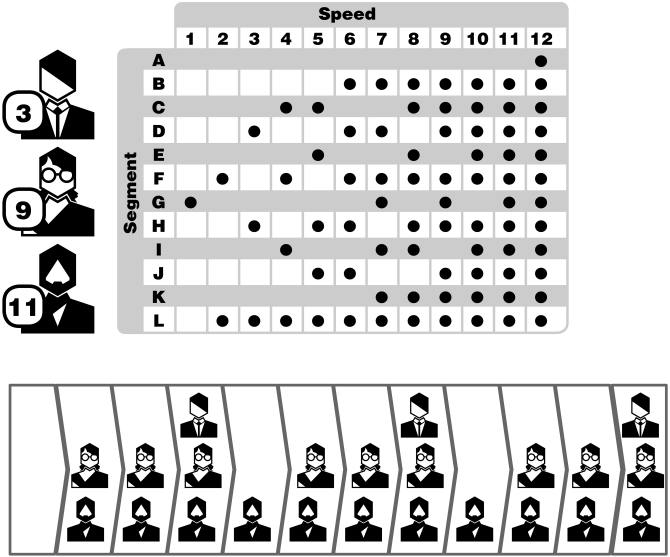
A turn is broken up into a series of small Impulses. Depending on their speed, units will be able to move in specific Impulses.
Discussion
Originally pioneered in Star Fleet Battles, this system simulates the simultaneous movement of player pieces. Rather than one player moving their full distance, and then the next, moves are interleaved. There is a chart that shows which Impulses a ship will move in for different speeds. When a ship becomes active, it moves a single hex. As an example, in Star Fleet Battles, ships may have speeds from 0 to 16, so there are 16 Impulses. A ship that is moving at speed 4 will move every fourth Impulse. A ship that is moving at speed 6 will move in Impulses 3, 6, 8, 11, 14, and 16.
This system increases realism by having ships gradually approach each other, rather than jump to a new location and fire from there. However, it does so at an increase in complexity and bookkeeping that requires one of the players to keep track of the progress of the turn and alert players to when particular ships need to move.
Sample Games
Attack Vector: Tactical (Burnside, Finley, and Valle, 2004) Car Wars (Irby and Jackson, 1981) Star Fleet Battles (Cole, 1979)
描述
一个回合被分成一系列小的脉冲(Impulse)。根据它们的速度,单位将能够在特定的脉冲中移动。
讨论
该系统最初在《星际舰队之战》(Star Fleet Battles)中首创,模拟玩家棋子的同时移动。不是一个个玩家移动全距离,然后再下一个,而是交错进行移动。有一个图表显示船在不同速度下将在哪些脉冲中移动。当船变得活跃时,它移动一个六角格。例如,在《星际舰队之战》中,船的速度可能从0到16,所以有16个脉冲。以速度4移动的船将每四个脉冲移动一次。以速度6移动的船将在脉冲3、6、8、11、14和16中移动。
该系统通过让船逐渐相互接近,而不是跳到一个新位置并从那里开火,从而增加了真实感。然而,这样做增加了复杂性和簿记工作,需要其中一名玩家跟踪回合的进度,并提醒玩家特定船只何时需要移动。
游戏范例
Attack Vector: Tactical (Burnside, Finley, and Valle, 2004) - 《Attack Vector: Tactical》 Car Wars (Irby and Jackson, 1981) - 《Car Wars》 Star Fleet Battles (Cole, 1979) - 《星际舰队之战》