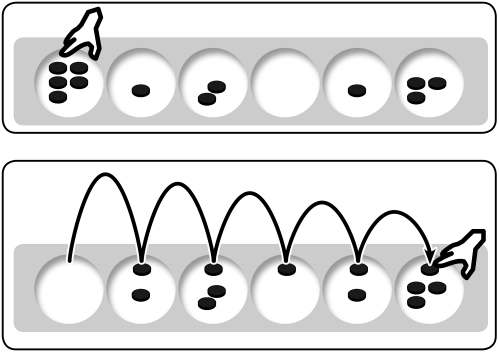
Description
Movement is based on the number of units at the starting location.
Discussion
This system arises from a family of games from Africa, most notably Mancala. In Mancala, the board is a series of pits organized essentially in a ring. Various numbers of playing pieces are in each pit. On their turn, a player selects a pit and removes all the pieces in that pit and places one in each successive pit in a single direction. If there are three pieces in a pit, for example, one each will be placed in each of the next three pits going around the ring. A common variation on this mechanism is that only one piece moves, but the distance it gets to move is exactly equal to the number of pieces in the space it starts in. In Finca, this system is used to move around a Rondel for action selection (ACT-10), and all pieces, regardless of owner, count toward the distance moved. Finca also has the twist that the strength of the action is based on the number of tokens in the destination space. In Downfall of Pompeii, players begin the game by placing their pawns into buildings in the city. After the first eruption, players can add pawns to a building equal to the number of pawns already in the building, and finally, after the second
eruption, players move pawns a number of spaces equal to the number of pawns on the originating space. In Teseus: The Dark Orbit, players move their pieces around a space station, again based on the number of pieces located in the starting area. However, they have the choice of going clockwise or counterclockwise. These systems have a lot of opportunity for clever play and are highly interactive as pieces from all players are commingled and directly impact the options available to each.
Sample Games
Downfall of Pompeii (Wrede, 2004) Finca (Sentker and zur Linde, 2009) Mancala (Unknown, 700) Teseus: The Dark Orbit (Oracz, 2013)
描述
移动基于起始位置的单位数量。
讨论
这个系统源于非洲的一系列游戏,最著名的是播棋(Mancala)。在播棋中,版图是一系列本质上组织成环的凹坑。每个凹坑中有不同数量的棋子。在他们的回合,玩家选择一个凹坑并取出该凹坑中的所有棋子,并在单个方向的每个连续凹坑中放置一个。例如,如果凹坑中有三个棋子,则将在环周围的接下来三个凹坑中各放置一个。这种机制的一个常见变体是只有一个棋子移动,但移动的距离完全等于它开始的空间中的棋子数量。在《Finca》中,该系统用于在轮盘上移动以进行行动选择(ACT-10),所有棋子,无论所有者是谁,都计入移动距离。《Finca》还有一个转折,即行动的强度基于目标空间中的代币数量。在《庞贝城的末日》(Downfall of Pompeii)中,玩家通过将棋子放入城市中的建筑物开始游戏。第一次喷发后,玩家可以向建筑物添加等于建筑物中已有棋子数量的棋子,最后,在第二次
喷发后,玩家移动棋子的空间数等于起始空间上的棋子数量。在《Teseus: The Dark Orbit》中,玩家在空间站周围移动他们的棋子,同样基于位于起始区域的棋子数量。然而,他们可以选择顺时针或逆时针走。这些系统有许多巧妙玩法的机会,并且高度互动,因为来自所有玩家的棋子混合在一起并直接影响每个人可用的选项。
游戏范例
Downfall of Pompeii (Wrede, 2004) - 《庞贝城的末日》 Finca (Sentker and zur Linde, 2009) - 《Finca》 Mancala (Unknown, 700) - 《播棋/曼卡拉》 Teseus: The Dark Orbit (Oracz, 2013) - 《忒修斯:黑暗轨道》