Description
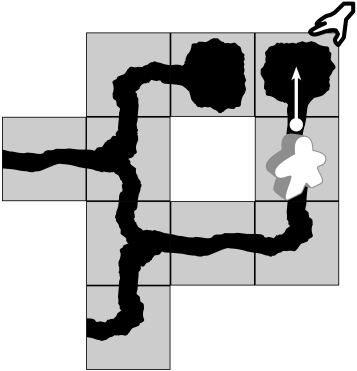
The map is added to as it is explored.
Discussion
This Map Addition mechanism is commonly used in exploration games, as players expose new areas of the map. There are two broad types of games in this category: Constrained, where the shape of the board is known and players must explore within those bounds, and Unconstrained, where players are free to explore as they wish (sometimes with some rules). There are also games where the map shape is defined by the scenario or mission but is hidden by the game mechanics, as in The 7th Continent, or known to only one player, as in Descent: Journeys in the Dark. This mechanism is often implemented with tiles and so is a subset of Tile Laying. Much of that discussion applies here. But there are some specific points for map building. If players can build in any direction, it may keep them somewhat separated as each explores their own area. If more interaction is desired, some incentive to move to the center needs to be included. The cooperative realtime game Escape: The Curse of the Temple implements this rather bluntly, by requiring players to gather on a single tile periodically. In the stress and
hurry of a real-time game, it can be challenging to avoid getting spread out. If using tiles, edges can be used to gate movement. For example, in Eclipse, tiles may be marked with a gate or be blank. If two gates match up on adjacent tiles, players may move between them. Later, a technology may be developed that permits movement even if only one gate is between two tiles. This allows for structure and movement restrictions even in the openness of space. The Map Addition mechanism can also be used to introduce uncertainty into an essentially linear track. In Mississippi Queen and The Mushroom Eaters, new portions of the track are revealed as they are moved onto. In Mississippi Queen, this acts as a type of Catch-The-Leader mechanism (VIC-18), as the leader may be out of position to take advantage of the newly revealed tile. Exploration can also be procedurally generated. In Source of the Nile, when exploring an empty hex, players roll on a series of tables to determine the base terrain type, rivers, and other features. The system cleverly incorporates adjacent spaces to make it more likely, for example, for a block of adjacent jungle spaces to emerge rather than a series of isolated jungle spaces.
Sample Games
The 7th Continent (Roudy and Sautter, 2017) Descent: Journeys in the Dark (Wilson, 2005) Dragon Island (Fitzgerald, 2017) Eclipse (Tahkokallio, 2011) Escape: The Curse of the Temple (Ostby, 2012) Mississippi Queen (Hodel, 1997) The Mushroom Eaters (Hayden, 2013) Source of the Nile (Maker and Wesley, 1978) Xia: Legends of a Drift System (Miller, 2014)
描述
地图在探索过程中被添加(Map Addition)。
讨论
这种地图添加机制常用于探索游戏,因为玩家暴露了地图的新区域。这类游戏大致分为两类:受限(Constrained),即版图的形状已知,玩家必须在这些界限内探索;以及非受限(Unconstrained),即玩家可以随心所欲地探索(有时带有一些规则)。也有一些游戏的地图形状由场景或任务定义,但被游戏机制隐藏,如《The 7th Continent》,或仅为一名玩家所知,如《Descent: Journeys in the Dark》。这种机制通常用板块实现,因此是板块放置的子集。大部分讨论都适用于此。但对于地图构建有一些具体的点。如果玩家可以在任何方向构建,这可能会使他们有些分离,因为每个人都在探索自己的区域。如果希望有更多互动,需要包含一些向中心移动的激励。合作实时游戏《Escape: The Curse of the Temple》相当直白地实现了这一点,要求玩家定期聚集在单个板块上。在实时游戏的压力和
匆忙中,避免分散开可能具有挑战性。如果使用板块,边缘可用于控制移动。例如,在《Eclipse》中,板块可能标记有门或空白。如果两个门在相邻板块上匹配,玩家可以在它们之间移动。后来,可能会开发出一种技术,即使两个板块之间只有一个门也允许移动。这允许即使在太空的开放性中也有结构和移动限制。地图添加机制也可用于将不确定性引入本质上是线性的轨道。在《Mississippi Queen》和《The Mushroom Eaters》中,轨道的新部分在移动到它们上面时被揭示。在《Mississippi Queen》中,这充当了一种追赶领先者机制(VIC-18),因为领导者可能位置不佳,无法利用新揭示的板块。探索也可以程序生成。在《尼罗河源头》(Source of the Nile)中,当探索一个空六角格时,玩家在一系列表格上掷骰子以确定基本地形类型、河流和其他特征。该系统巧妙地结合了相邻空间,使其更有可能,例如,出现一块相邻的丛林空间,而不是一系列孤立的丛林空间。
游戏范例
The 7th Continent (Roudy and Sautter, 2017) - 《第七大陆》 Descent: Journeys in the Dark (Wilson, 2005) - 《深入绝地:暗黑之旅》 Dragon Island (Fitzgerald, 2017) - 《Dragon Island》 Eclipse (Tahkokallio, 2011) - 《星蚀》 Escape: The Curse of the Temple (Ostby, 2012) - 《逃离神庙》 Mississippi Queen (Hodel, 1997) - 《密西西比皇后》 The Mushroom Eaters (Hayden, 2013) - 《蘑菇食客》 Source of the Nile (Maker and Wesley, 1978) - 《尼罗河源头》 Xia: Legends of a Drift System (Miller, 2014) - 《Xia: Legends of a Drift System》