Description
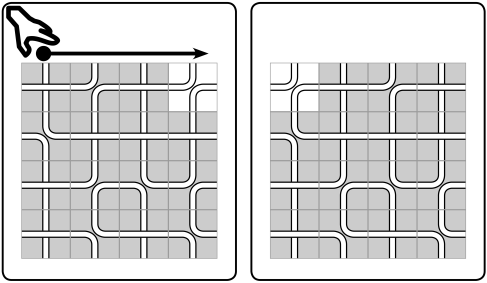
The map is modified during the course of the game through rotation or shifts.
Discussion
In this Map Deformation mechanism, the map is traditionally composed of a series of (typically square) tiles, composed of smaller spaces. Player tokens are located on these tiles. When the tiles are rotated or relocated, the player tokens are moved along with them. Because this can often radically change the game situation, this mechanism introduces a large dose of chaos into the proceedings. It can also make it difficult for certain players who may have spatial relation issues to visualize the result of the deformation. This is particularly true as tiles with more spaces on them are used. This mechanism can be implemented through means other than tiles. In Stay Alive players move sliders around the edge of the board to control where holes are located, possibly dropping marbles out of the game. In both Dune and Yedo, an entire section of the board is blocked each turn by the sandstorm and watchman, respectively. Because of the impact of Map Deformation, it is typically the centerpiece of the game and not a secondary mechanism.
Sample Games
Dune (Eberle, Kittredge, and Olatka, 1979) Dungeon Twister (Boelinger, 2004) Stay Alive (Barlow, 1965) Wiz-War (Jolly, 1983) Yedo (Ginste and Plancke, 2012)
描述
在游戏过程中通过旋转或移位修改地图。
讨论
在这个地图变形(Map Deformation)机制中,地图传统上由一系列(通常是方形)板块组成,由更小的空间组成。玩家代币位于这些板块上。当板块旋转或重新定位时,玩家代币随之移动。因为这通常会从根本上改变游戏情况,所以这种机制在过程中引入了大量的混乱。如果不具有良好的空间关系视力,某些玩家可能很难想象变形的结果。当使用更空间的板块时尤其如此。这种机制可以通过板块以外的方式实现。在《Stay Alive》中,玩家在版图边缘移动滑块以控制孔的位置,可能会将弹珠掉出游戏。在《沙丘》(Dune)和《Yedo》中,沙尘暴和守望者分别每回合阻塞版图的整个部分。由于地图变形的影响,它通常是游戏的核心而不是次要机制。
游戏范例
Dune (Eberle, Kittredge, and Olatka, 1979) - 《沙丘》 Dungeon Twister (Boelinger, 2004) - 《Dungeon Twister》 Stay Alive (Barlow, 1965) - 《Stay Alive》 Wiz-War (Jolly, 1983) - 《Wiz-War》 Yedo (Ginste and Plancke, 2012) - 《Yedo》