Description
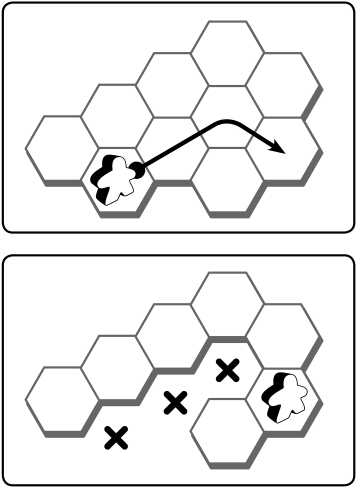
Over the course of the game, the map shrinks.
Discussion
Removing parts of the map can be psychologically interesting for the players, as they feel more constricted both in space and in options. We are exposed to this Map Reduction mechanism first as children through the game Musical Chairs. Isolation and Hey, That’s My Fish! are classic representatives of this mechanism. In both, players take a move and then remove a tile. In Isolation, it may be any tile on the board. In contrast, in Hey, That’s My Fish!, it must be the tile that the player began their turn on. In Sinking of the Titanic, the board is shrunk in a fixed fashion, rather than under player control, as the ship rotates beneath the water board and the board gradually becomes reduced more and more.
In some games, the board closing is something that happens toward the end of the game. In The Omega Virus, sectors of the board may suddenly be closed to the players completely as the game nears its timed conclusion. Also worth mentioning are the Survive: Escape from Atlantis series of games, where the board as a whole does not shrink, but safe tiles (land tiles in this case) are slowly removed, forcing players into shark-infested waters. Many other games don’t shrink the physical board; they simply reduce the options available to the players. Ticket to Ride and many other rails games naturally reduce the options available to players as more and more routes get claimed. To a substantial extent, the question of whether the board gets smaller or the options on it become fewer is mostly a matter of thematic consonance and what is practical given the physical components involved.
Sample Games
Hey, That’s My Fish! (Cornett and Jakeliunas, 2003) Isolation (Kienitz, 1972) The Omega Virus (Gray, 1992) Sinking of the Titanic (Uncredited, 1975) Survive: Escape from Atlantis (Courtland-Smith, 1982) Ticket to Ride (Moon, 2004)
描述
在游戏过程中,地图会缩小。
讨论
对于玩家来说,移除部分地图可能在心理上很有趣,因为他们感觉在空间和选项上都更加受限。我们小时候第一次通过游戏《抢椅子》(Musical Chairs)接触到了这种地图减少(Map Reduction)机制。《Isolation》和《嘿!我的鱼!》(Hey, That’s My Fish!)是该机制的经典代表。在这两个游戏中,玩家移动一步然后移除一个板块。在《Isolation》中,它可以是版图上的任何板块。相比之下,在《嘿!我的鱼!》中,它必须是玩家回合开始时所在的板块。在《Sinking of the Titanic》中,版图是以固定的方式缩小的,而不是在玩家的控制下,因为船在水下版图下方旋转,而且版图逐渐变得越来越小。
在某些游戏中,版图关闭是在游戏接近尾声时发生的事情。在《The Omega Virus》中,随着游戏接近其计时结束,版图的扇区可能会突然对玩家完全关闭。还值得一提的是《Survive: Escape from Atlantis》系列游戏,其中版图整体并没有缩小,而是安全板块(在这种情况下是陆地板块)被慢慢移除,迫使玩家进入充满鲨鱼的水域。许多其他游戏并不缩小物理版图;它们只是减少了玩家可用的选项。《车票之旅》(Ticket to Ride)和许多其他铁路游戏自然会减少玩家可用的选项,因为越来越多的路线被认领。在很大程度上,版图是否变小或其上的选项是否变少,主要是一个主题一致性的问题,以及考虑到所涉及的物理组件什么是实际的。
游戏范例
Hey, That’s My Fish! (Cornett and Jakeliunas, 2003) - 《嘿!我的鱼!》 Isolation (Kienitz, 1972) - 《Isolation》 The Omega Virus (Gray, 1992) - 《The Omega Virus》 Sinking of the Titanic (Uncredited, 1975) - 《Sinking of the Titanic》 Survive: Escape from Atlantis (Courtland-Smith, 1982) - 《逃离亚特兰蒂斯》 Ticket to Ride (Moon, 2004) - 《车票之旅》