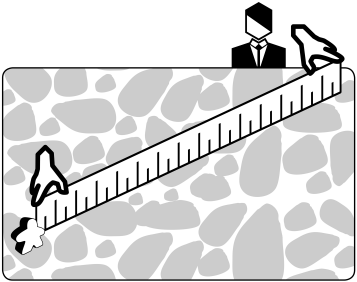
Description
Pieces may be moved up to a certain distance, measured by a ruler.
Discussion
In this Measurement system, there is no grid or other tessellation breaking up the map. Pieces are free to move any amount up to their movement limit, expressed in inches, centimeters, or using a game-supply ruler. This system is typically seen in miniatures games, which are played directly on a tabletop. Because of the analog nature of Measurement, these systems have several unique issues they need to deal with. First, attack, like movement, is also expressed in the Measurement units. The designer needs to decide whether to allow for Measurement at any time to determine the range or only after attacks or moves have been declared. Not allowing premeasurement gives an edge to players that are better at estimating ranges but tends to make for a lighter experience as sophisticated plans and strategies may fall apart because a charge falls a fraction of a centimeter short. Most modern games allow for premeasurement, although this does slow things down (Illustration 10.3). This is compounded by the second issue, that there is always some imprecision in moving and Measurement. These systems require players to communicate about the intent of moves and to act in a reasonable fashion. Finally, unlike Movement Points systems (MOV-04), the measuring can be challenging with different terrain types. Does movement in difficult terrain count as moving “farther” than in other terrains? How are those
Measurements handled? These considerations make games more complex. These downsides are offset by games that feel more cinematic and realistic due to the open-ended nature of the scenery, movement, and combat.
Sample Games
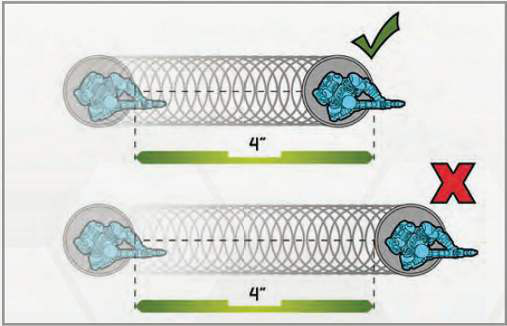
Dropzone Commander (Lewis, 2012) Infinity (Rodriguez, 2005) Warhammer Age of Sigmar (Uncredited, 2015) Illustration 10.3 The measurement diagram from the Infinity rules. They specify that movement measurements are made from the front of the unit base at the start to the front at the destination.
描述
棋子可以移动一定的距离,用尺子测量。
讨论
在这个测量(Measurement)系统中,没有网格或其他镶嵌将地图分开。棋子可以自由移动直到其移动限制的任何数量,用英寸、厘米或游戏提供的尺子表示。这种系统通常见于直接在桌面上玩的微缩模型游戏。由于测量的模拟性质,这些系统有几个独特的问题需要处理。首先,攻击,就像移动一样,也用测量单位表示。设计师需要决定是允许随时进行测量以确定范围,还是仅在宣布攻击或移动后才允许。不允许预先测量给那些更善于估计范围的玩家带来了优势,但倾向于带来更轻松的体验,因为复杂的计划和策略可能会因为冲锋差了几分之一厘米而崩溃。大多数现代游戏允许预先测量,但这确实会减慢速度(插图10.3)。第二个问题使情况变得更加复杂,即在移动和测量中总会有一些不精确。这些系统要求玩家就移动意图进行沟通并采取合理的行动。最后,与移动点数系统(MOV-04)不同,对于不同的地形类型,测量可能具有挑战性。在困难地形中的移动是否算作比在其他地形中移动“更远”?这些
测量是如何处理的?这些考虑因素使游戏变得更加复杂。这些缺点被由于场景、移动和战斗的开放性而感觉更电影化和现实的游戏所抵消。
游戏范例
Dropzone Commander (Lewis, 2012) - 《Dropzone Commander》 Infinity (Rodriguez, 2005) - 《无限》 Warhammer Age of Sigmar (Uncredited, 2015) - 《战锤:西格玛时代》 插图10.3 《无限》规则中的测量图。它们规定移动测量是从起始处的单位基座前部到目的地的前部。