Description
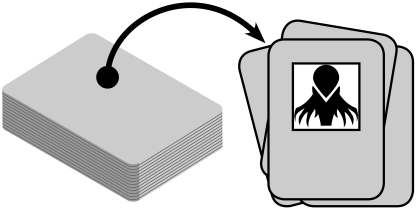
Players Move Trough a Deck of cards.
Discussion
This mechanism gives players the feeling of movement by forcing them to work through a deck to get to the bottom or some goal card. In Chainsaw Warrior, for example, the deck thematically represents the house players are exploring, with cards representing rooms or encounters, and players take “move” actions to delve deeper. This mechanism is also used in Incan Gold, where players flip cards to move deeper into the temple. Adopting this metaphor allows designers to give players a sense of forward momentum while keeping the game compact, eliminating the need for a board or large map. It also makes it easier to randomize. The Gating and Unlocking mechanism (ACT-15) is good to use here to tier difficulty.
Sample Games
Chainsaw Warrior (Hand, 1987) Incan Gold (Faidutti and Moon, 2005) Maiden’s Quest (Shannon, 2018) One Deck Dungeon (Cieslik, 2016)
描述
玩家穿过一副牌库(Move Through a Deck of cards)。
讨论
这种机制通过强迫玩家通过一副牌来到达底部或某张目标卡,给玩家一种移动的感觉。例如,在《Chainsaw Warrior》中,牌库在主题上代表玩家正在探索的房子,卡牌代表房间或遭遇,玩家采取“移动”行动来深入探索。这种机制也用于《印加宝藏》(Incan Gold),玩家翻卡以深入神庙。采用这种隐喻允许设计师在不需要版图或大地图的情况下,让玩家有一种向前推进的感觉,同时保持游戏紧凑。这也使随机化变得更容易。在此处使用门控和解锁机制(ACT-15)来分层难度是不错的选择。
游戏范例
Chainsaw Warrior (Hand, 1987) - 《Chainsaw Warrior》 Incan Gold (Faidutti and Moon, 2005) - 《印加宝藏》 Maiden’s Quest (Shannon, 2018) - 《Maiden’s Quest》 One Deck Dungeon (Cieslik, 2016) - 《地下城》