Description
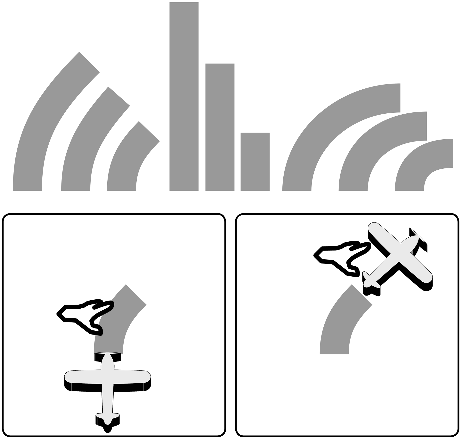
A defined Movement Template is used to determine where a piece moves to.
Discussion
First pioneered in Wings of War, this system has been widely used since, most notably in the Star Wars: X-Wing Miniatures Game. Each turn, players simultaneously select which Movement Template will be used by each of their units. For example, it may be a Short Straight, a Gradual Left, or a Sharp Right. Moves are revealed, and the templates are used to determine where each piece will end. Because of the use of the templates, this mechanism is best thematically integrated with pieces that need to keep moving, such as airplanes (Illustration 10.9a). These games are similar to Programmed Movement (MOV-10), except that only one move is programmed, as opposed to the 3–5 that are common in traditional Programmed Movement games. These systems also typically
do not have a board or spaces to regulate movement but are played directly on a tabletop. While this introduces some of the analog issues discussed in Measurement, the use of the templates keeps things better constrained. However, rules for collisions also need to be developed. The use of templates also allows for unit differentiation by defining which templates may be available to them. Lazer Ryderz introduces a variation on the system by incorporating an Action Retrieval system (ACT-03) for when players are allowed to reuse certain templates (Illustration 10.9b). A related system, included here for brevity, is Diskwars, where the units are discs. Tey are moved by flipping a certain number of times. The diameter of the disc and the number of times it may be flipped define the speed. In essence, the discs themselves are serving as the Movement Templates.
Sample Games
Diskwars (Gelle, Hardy, Jolly, and Petersen, 1999) Lazer Ryderz (Amato and Kline, 2017) Star Wars: X-Wing Miniatures Game (Little, 2012) Wings of War (Angiolini and Paglia, 2004) Illustration 10.9a A movement template in X-Wing. There is an indent on the side of the plastic base that allows the template to be placed accurately. The rear of the unit is then moved to the end of the template.
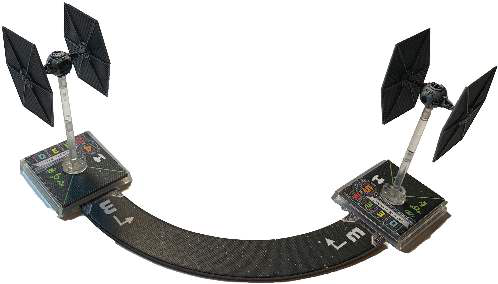
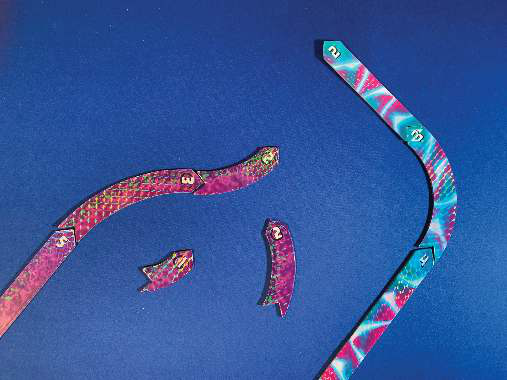
Illustration 10.9b In Lazer Ryderz, players move by placing templates but older templates stay on the table for a few turns. This both limits where a player can move, as certain templates may be unavailable, and also creates obstacles on the table as templates cannot be crossed. Two separate templates are shown for a better sense of scale.
描述
使用定义的移动模板(Movement Template)来确定棋子移动到的位置。
讨论
该系统最初在《Wings of War》中首创,此后被广泛使用,最著名的是《星球大战:X翼战机》(Star Wars: X-Wing Miniatures Game)。每回合,玩家同时选择每个单位将使用哪个移动模板。例如,它可能是短直线、缓左转或急右转。移动被揭示,并使用模板确定每个棋子的终点。由于使用了模板,这种机制最好在主题上与需要保持移动的棋子集成,例如飞机(插图10.9a)。这些游戏类似于程序化移动(MOV-10),不同之处在于只编程了一个移动,而不是传统程序化移动游戏中常见的3-5个。这些系统也通常
没有版图或空间来调节移动,而是直接在桌面上玩。虽然这引入了在测量中讨论的一些模拟问题,但模板的使用使事情得到了更好的约束。然而,还需要制定碰撞规则。模板的使用还允许通过定义哪些模板可供它们使用来区分单位。《Lazer Ryderz》通过结合行动取回系统(ACT-03)引入了该系统的变体,用于玩家何时被允许重用某些模板(插图10.9b)。为了简洁起见,这里包括一个相关系统是《Diskwars》,其中的单位是圆盘。它们通过翻转一定次数来移动。圆盘的直径和可以翻转的次数定义了速度。本质上,圆盘本身充当移动模板。
游戏范例
Diskwars (Gelle, Hardy, Jolly, and Petersen, 1999) - 《Diskwars》 Lazer Ryderz (Amato and Kline, 2017) - 《Lazer Ryderz》 Star Wars: X-Wing Miniatures Game (Little, 2012) - 《星球大战:X翼战机》 Wings of War (Angiolini and Paglia, 2004) - 《战争之翼》 插图10.9a 《X翼战机》中的移动模板。塑料底座侧面有一个凹痕,允许准确放置模板。然后将单位的后部移动到模板的末端。
插图10.9b 在《Lazer Ryderz》中,玩家通过放置模板来移动,但较旧的模板会在桌子上停留几回合。这既限制了玩家可以移动的地方,因为某些模板可能不可用,也 在桌子上制造了障碍,因为模板不能被穿过。显示两个单独的模板以获得更好的比例感。