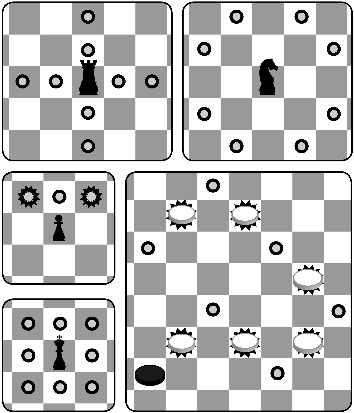
Description
Pieces move in a specific pattern relative to the board grid.
Discussion
This Pattern Movement mechanism gives pieces specific ways that they can move relative to a grid. There are three basic styles: 1 Fixed Target Spaces: This is similar to the way that knights move in Chess. There are a few specified target squares, and the piece may be moved to any of them. Tey may or may not be able to jump over spaces that are blocked by friendly or enemy pieces. These moves do not need to be reversible. While a Chess knight may return to the square it came from, a pawn may not move backward. In Shogi the Gold, for example, may move diagonally forward but not diagonally backward (although it may move straight backward). 2 Any Distance in a Direction: The Queen in Chess would be an example of this movement style. Pieces may move any number of spaces in a given direction until blocked by another piece. Sometimes, the
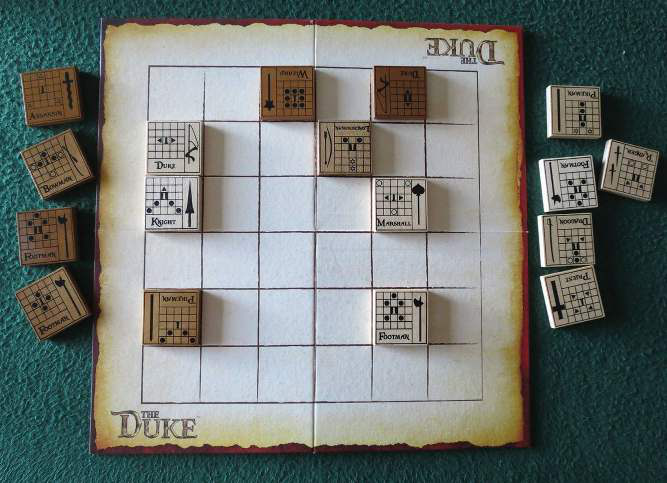
directions are fixed relative to the board, so pieces cannot return to where they came from. The Lance in Shogi, for example, may move any distance forward but may never move backward until it is promoted. 3 Jumping: Jumping over pieces may be a requirement for moving or may be used to capture. Sometimes jumps can be chained, as in Draughts (Checkers) and Chinese Checkers, which can lead to dynamic and dramatic play. Games with Pattern Movement often have a Promotion mechanism, where pieces that reach the end of the board (or close to the end, as in Shogi) are converted into a more powerful version of the piece. Navia Dratp has pieces that promote by spending a currency to upgrade them. It is earned by moving and capturing, and different pieces cost different amounts to upgrade, which gives a great tool for balancing. A different take on Promotion is shown by The Duke, where pieces are tiles with different movement patterns on either side. When a piece is moved, it is flipped over to its other side (Illustration 10.1). Illustration 10.1 Pieces in The Duke have their movement pattern printed on them. After moving, they are flipped over to show a different pattern. Photo by Dan Thurot.
Movement Patterns can be difficult to learn if there is a different pattern for each piece and it is not part of the piece, as in Chess or Shogi. However, some modern games, such as the aforementioned Navia Dratp and The Duke, print the movement pattern directly onto the piece, which makes it much smoother for newer players to learn and allows for even more different styles of pieces. Nevertheless, games like The Duke do present players with the challenge of remembering the movement pattern on the reverse side of each piece. Player references can help alleviate these issues.
Sample Games
Checkers (Unknown) Chess (Unknown, ∼1200) Chinese Checkers (Monks, 1892) The Duke (Holcomb and Mclaughlin, 2013) Navia Dratp (Yamazaki, 2004) Shogi (Unknown)
描述
棋子相对于版图网格以特定模式移动(Pattern Movement)。
讨论
这种模式移动机制赋予棋子以特定方式相对于网格移动。有三种基本风格:
- 固定目标空间(Fixed Target Spaces):这类似于象棋中马的移动方式。有几个指定的目标方格,棋子可以移动到其中任何一个。它们可能能够也可能不能跳过被友方或敌方棋子阻挡的空间。这些移动不需要是可逆的。虽然国际象棋骑士可以回到它来的方格,但兵不能向后移动。例如,在将棋中,金将可以向斜前方移动,但不能向斜后方移动(尽管它可以笔直向后移动)。
- 在某个方向上的任何距离(Any Distance in a Direction):国际象棋中的皇后就是这种移动风格的一个例子。棋子可以在给定方向上移动任意数量的空间,直到被另一个棋子阻挡。有时,
方向是相对于版图固定的,所以棋子不能回到原来的地方。例如,将棋中的香车可以向前移动任意距离,但在晋升之前永远不能向后移动。3. 跳跃(Jumping):跳过棋子可能是移动的要求,也可能用于捕获。有时跳跃可以连锁,如在国际跳棋(Checkers)和中国跳棋(Chinese Checkers)中,这可能导致动态和戏剧性的游戏。具有模式移动的游戏通常具有晋升机制,到达版图末端(或接近末端,如在将棋中)的棋子被转换为该棋子的更强大版本。《Navia Dratp》的棋子通过花费货币来升级晋升。它是通过移动和捕获获得的,不同的棋子升级成本不同,这提供了一个很好的平衡工具。《The Duke》展示了对晋升的不同看法,其中棋子是两侧有不同移动模式的板块。当移动棋子时,它会被翻转到另一侧(插图10.1)。
插图10.1 《The Duke》中的棋子印有移动模式。移动后,它们被翻转以显示不同的模式。照片由Dan Thurot拍摄。
如果每个棋子有不同的模式并且不是棋子的一部分,如在国际象棋或将棋中,移动模式可能很难学习。然而,一些现代游戏,如前面提到的《Navia Dratp》和《The Duke》,直接在棋子上打印移动模式,这使得新玩家学习更加顺畅,并允许更多不同风格的棋子。尽管如此,像《The Duke》这样的游戏确实给玩家带来了记住每个棋子反面移动模式的挑战。玩家参考可以帮助缓解这些问题。
游戏范例
Checkers (Unknown) - 《国际跳棋》 Chess (Unknown, ∼1200) - 《国际象棋》 Chinese Checkers (Monks, 1892) - 《中国跳棋》 The Duke (Holcomb and Mclaughlin, 2013) - 《公爵棋》 Navia Dratp (Yamazaki, 2004) - 《Navia Dratp》 Shogi (Unknown) - 《将棋》