Description
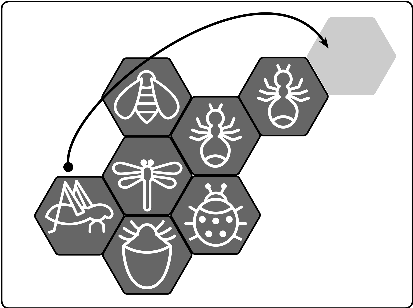
The Pieces themselves compose the Map.
Discussion
These games blur the line between Units and Map, as the map is composed of the individual units themselves. Because of this, these games are typically played directly on the table surface without a board. The two exemplar games for this mechanism, Hive and Vortex, use hexagonal tiles for units. Hexagons are a natural choice for this mechanism, as it gives more options for pieces to move. Typically, pieces must be adjacent to other pieces, so there is one single connected block of units. Pieces are added to the other edge or moved around the outside. Pieces that are surrounded by others are usually locked in place, with only those on the outside of the block able to reposition. Units may have intrinsic abilities (as in Hive) or gain special abilities based on adjacent tiles (Vortex). Because all the pieces, both friendly and enemy, are in a connected block, these games are typically highly interactive, tactical, and quick.
Sample Games
Hive (Yianni, 2001) Maelstrom (Hardy, Jolly, and Petersen, 2001) Vortex (Hardy, Jolly, and Petersen, 2001)
描述
棋子本身构成了地图(Pieces as Map)。
讨论
这些游戏模糊了单位和地图之间的界限,因为地图由单个单位本身组成。正因为如此,这些游戏通常直接在没有版图的桌面上玩。这种机制的两个模范游戏《Hive》和《Vortex》使用六角形板块作为单位。六角形是这种机制的自然选择,因为它给棋子移动提供了更多选择。通常,棋子必须与其他棋子相邻,因此有一个单一的连接单位块。棋子被添加到其他边缘或在外部移动。被其他棋子包围的棋子通常被锁定在原地,只有那些在块外部的棋子能够重新定位。单位可能具有内在能力(如在《Hive》中)或基于相邻板块获得特殊能力(《Vortex》)。因为所有棋子,无论是友方还是敌方,都在一个连接的块中,这些游戏通常是高度互动、战术性和快速的。
游戏范例
Hive (Yianni, 2001) - 《昆虫棋/蜂巢》 Maelstrom (Hardy, Jolly, and Petersen, 2001) - 《Maelstrom》 Vortex (Hardy, Jolly, and Petersen, 2001) - 《Vortex》