Description
Players simultaneously program their movement and then reveal and execute it.
Discussion
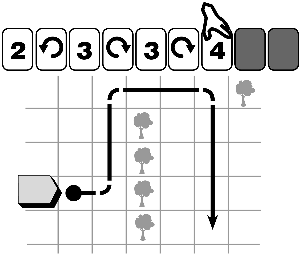
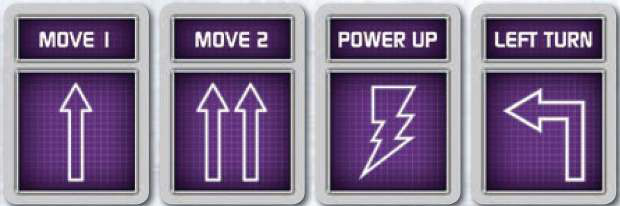
This is a subset of Action Queues (ACT-06), so the considerations there apply. However, there are some specifics relating to movement to cover here. First is the Right-Left issue. Programmed Movement games often have turning as one of the orders. Robo Rally is an example. This can often be difficult for players to visualize and can result in turning the wrong way. It can be beneficial to have the turn cards labeled as Clockwise and Counterclockwise, rather than Right or Left, as these may be simpler for players to visualize, but the issue remains. To avoid this, some Programmed Movement games either have a generic Turn action, allowing the players to choose facing at that time, or allow free rotations. The Dragon & Flagon is an example (Illustration 10.4). Another is how challenging the spatial puzzle will be and how that fits into the game theme. Robo Rally creates a complex space for players to navigate by constraining them in two ways. First, players draw a hand of nine cards and must select five to be programmed. It is frequent that players do not have the exact cards they need to get where they would like to go, so that forces them to evaluate a variety of alternatives. In addition, there are features on the board like conveyor belts, pits, and pushers that, although deterministic, make it even more challenging to picture the
result of a sequence of cards. There is also bumping—if players move into the same space as another robot, they push it out of the square, which can have a huge effect on where that robot ends up. Ten, if robots take damage, they may have cards “locked” into place, making coming up with a plan even more challenging. All of these elements foster a feeling of chaos, which is the goal of Robo Rally, which players tend to either love or hate. Space Cadets uses a similar system, with cards being drawn and placed in sequence to plot movement. But it gives a little more control to players, as there are fewer obstacles on the board, and ships pass through each other or may occupy the same space. Players also have more control, as they can slow down, reducing the number of cards played or allocating more of the Energy resource to Helm, allowing for more cards to be drawn. Another lever for the designer is the number of cards to be placed in the queue. This materially impacts the complexity of planning. While Robo Rally has players plot five cards, duck! duck! Go only has them plot one, befitting its intended younger audience. Volt: Robot Battle Arena has players place a die on a chart indicating the direction they want to move, with the die face indicating the distance. There is no facing—robots can move or shoot in any direction chosen. This puts the emphasis in Volt: Robot Battle Arena on guessing what the opponents will do, rather than on how to control your own robot. Programmed Movement can also be used as part of a Hidden Movement game (MOV-24). Illustration 10.4 A sample queue in Robo Rally. The cards are executed in sequence from left to right, relying on the player to be able to visualize the action.
Sample Games
The Dragon & Flagon (Engelstein, Engelstein, and Engelstein, 2016) duck! duck! Go! (Nunn, 2008) Robo Rally (Garfield, 1994) Space Cadets (Engelstein, Engelstein, and Engelstein, 2012) Twin Tin Bots (Keyaerts, 2013) Volt: Robot Battle Arena (Matsuuchi, 2014)
描述
玩家同时编程他们的移动,然后揭示并执行它。
讨论
这是行动队列(ACT-06)的一个子集,因此那里的考虑因素适用。然而,这里有一些与移动相关的细节需要涵盖。首先是左右问题。程序化移动(Programmed Movement)游戏通常将转向作为指令之一。《Robo Rally》就是一个例子。这通常很难让玩家想象,并且可能导致转向错误的方向。将转向卡标记为顺时针和逆时针,而不是右或左,可能是有益的,因为这些可能更容易让玩家想象,但问题仍然存在。为了避免这种情况,一些程序化移动游戏要么有一个通用的转向动作,允许玩家在那时选择面向,要么允许自由旋转。《The Dragon & Flagon》就是一个例子(插图10.4)。另一个是空间谜题将有多大的挑战性,以及它如何适应游戏主题。《Robo Rally》通过以两种方式限制玩家,为玩家创造了一个复杂的空间来导航。首先,玩家抓一手九张牌,必须选择五张进行编程。玩家经常没有确切的牌去他们想去的地方,迫使他们评估各种替代方案。此外,版图上有传送带、坑和推手等特征,虽然是确定性的,但使想象
一系列卡片的结果更具挑战性。还有碰撞——如果玩家移动到与另一个机器人相同的空间,他们会将其推出方格,这会对该机器人的最终位置产生巨大影响。然后,如果机器人受到伤害,哪怕是有卡片“锁定”到位,也会使制定计划更具挑战性。所有这些元素都培养了一种混乱的感觉,这是《Robo Rally》的目标,玩家往往要么喜欢要么讨厌它。《Space Cadets》使用类似的系统,抽取卡片并按顺序放置以绘制移动。但它给了玩家更多的控制权,因为版图上的障碍物较少,船只穿过彼此或可能占据同一空间。玩家也有更多的控制权,因为他们可以减速,减少使用的卡片数量或分配更多的能量资源给舵,从而允许抽取更多的卡片。设计师的另一个杠杆是放置在队列中的卡片数量。这实质上影响了规划的复杂性。虽然《Robo Rally》让玩家策划五张牌,但《duck! duck! Go》只让他们策划一张,这符合其预期的年轻受众。《Volt: Robot Battle Arena》让玩家将骰子放在指示他们想要移动方向的图表上,骰子面指示距离。没有面向——机器人可以朝选择的任何方向移动或射击。这将《Volt: Robot Battle Arena》的重点放在猜测对手会做什么上,而不是如何控制自己的机器人。程序化移动也可以用作隐藏移动游戏的一部分(MOV-24)。插图10.4 《Robo Rally》中的样本队列。卡片按顺序从左到右执行,依靠玩家能够想象动作。
游戏范例
The Dragon & Flagon (Engelstein, Engelstein, and Engelstein, 2016) - 《龙与地下城》/《酒馆乱斗》 duck! duck! Go! (Nunn, 2008) - 《小黄鸭快跑》 Robo Rally (Garfield, 1994) - 《机器人拉力赛》 Space Cadets (Engelstein, Engelstein, and Engelstein, 2012) - 《太空学员》 Twin Tin Bots (Keyaerts, 2013) - 《双宝机器人》 Volt: Robot Battle Arena (Matsuuchi, 2014) - 《Volt: Robot Battle Arena》