Description
The precise location of units is not tracked. Only their Relative Position is important.
Discussion
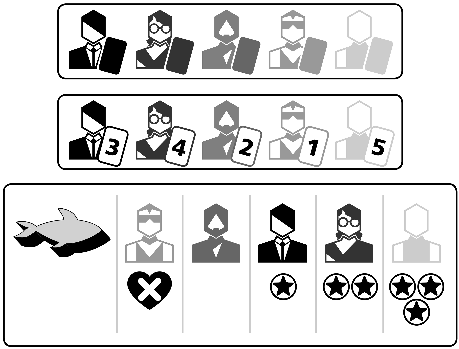
The standard use case for this mechanism is in racing games that track relative order but not specific position. For example, in Formula Motor Racing, the cars for the players are simply in sequence from first place to last. Players take actions to try to move further up toward the front of the line and be in the first place when the game ends. The distance between first and second place is always the same. There is no further representation of distance or gaps between cars. Similarly, in Get Bit!, players are swimmers trying to escape from a shark and only their relative position is tracked. The shark attacks the player last in line (Illustration 10.5). This system has the benefit of simplicity and focuses on specific aspects of racing. It also eliminates the need for a board, track, or lanes, and the rules and space overhead that go with that. It also keeps the games competitive, as it is literally impossible for a car to get too far into the lead to catch or drop too far behind the leader. Everything is constrained.
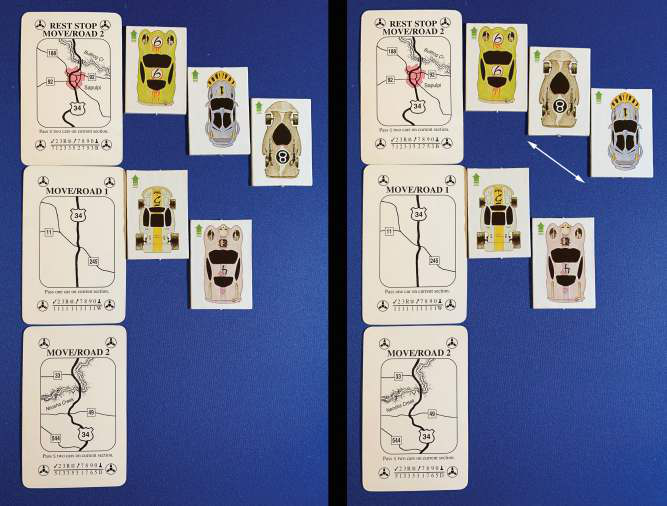
Roadkill is a hybrid version of this system, which has a series of location cards that players race through. Not all players need to be on the same location card but those that are placed in a ranked line. The air combat game Ace of Aces uses an innovative book system, where each page shows the view out of the player’s cockpit. The positions are determined by a relative movement system, as players select moves secretly and simultaneously, and the planes are shifted relative to each other, with each player remaining the center of their own play space. Another type of Relative system is used in Up Front. This card-based tactical combat game has squads that move toward or away from other squads. Teir location is represented by an abstract concept called Relative Range, which goes from 1 (far away) to 5 (right on top of each other). Abstracting movement in this way allows Up Front to focus on other tactical elements of the battle. Illustration 10.5 In Roadkill, players move along a track formed of cards. On each card, players are placed in relative order. In the image on the left, Car #8 is in last place on the top card. If it passes Car #1, it moves up in order, as shown in the right.
Racing or movement does not need to be the central metaphor for use of this mechanism. In Guillotine, players manipulate a line of people, with the character at the head of the line needing to put their head on the chopping block.
Sample Games
Ace of Aces: Handy Rotary Series (Leonardi, 1980) Formula Motor Racing (Knizia, 1995) Galaxy Trucker (Chvátil, 2007) Get Bit! (Chalker, 2007) Guillotine (Peterson, 1998) Roadkill (Greenwood and Verssen, 1993) Up Front (Allen, 1983)
描述
不跟踪单位的精确位置。只有它们的相对位置(Relative Position)很重要。
讨论
这种机制的标准用例是在跟踪相对顺序但不跟踪具体位置的赛车游戏中。例如,在《Formula Motor Racing》中,玩家的赛车只是简单地从第一名到最后一名排列。玩家采取行动试图向队列前方移动,并在游戏结束时处于第一名。第一名和第二名之间的距离总是相同的。没有进一步表示距离或赛车之间的差距。同样,在《Get Bit!》中,玩家是试图通过游泳逃离鲨鱼的游泳者,只跟踪他们的相对位置。鲨鱼攻击排在最后的玩家(插图10.5)。该系统的优点是简单,侧重于赛车的特定方面。它还没必要使用版图、轨道或车道,以及随之而来的规则和空间开销。它还保持了游戏的竞争性,因为赛车几乎不可能领先太远而无法赶上,或落后太远而掉队。一切都受到限制。
《Roadkill》是这个系统的混合版本,它有一系列位置卡,玩家在其中竞速。并非所有玩家都需要在同一张位置卡上,但那些在同一张卡上的玩家排成一列。空战游戏《Ace of Aces》使用创新的书本系统,每页显示玩家驾驶舱外的视图。位置由相对移动系统确定,因为玩家秘密且同时选择移动,飞机相对于彼此移动,每个玩家保持在自己游戏空间的中心。《Up Front》中使用了另一种类型的相对系统。这是一款基于卡牌的战术战斗游戏,其中的小队向其他小队移动或远离。它们的位置由一个称为相对射程的抽象概念表示,范围从1(很远)到5(就在彼此之上)。以这种方式抽象移动允许《Up Front》专注于战斗的其他战术元素。插图10.5 在《Roadkill》中,玩家沿着由卡牌形成的轨道移动。在每张卡牌上,玩家按相对顺序放置。在左图中,8号车位于顶牌的最后一位。如果它超过1号车,它会按顺序向上移动,如右图所示。
竞速或移动不需要成为使用此机制的核心隐喻。在《Guillotine》中,玩家操纵一排人,排在最前面的人需要把头放在断头台上。
游戏范例
Ace of Aces: Handy Rotary Series (Leonardi, 1980) - 《王牌对决》 Formula Motor Racing (Knizia, 1995) - 《方程式赛车》 Galaxy Trucker (Chvátil, 2007) - 《银河卡车司机》 Get Bit! (Chalker, 2007) - 《Get Bit!》 Guillotine (Peterson, 1998) - 《Guillotine》 Roadkill (Greenwood and Verssen, 1993) - 《Roadkill》 Up Front (Allen, 1983) - 《Up Front》