Description
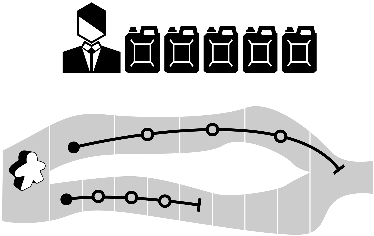
Players expend a Resource to Move.
Discussion
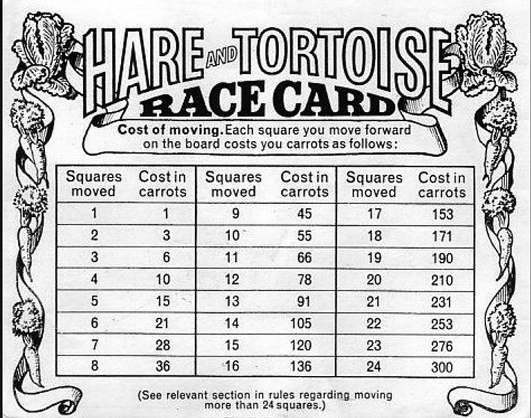
Games where players are moving a limited number of pieces (typically one) may give them a resource that needs to be expended to move. This can take the form of a card with a numeric value, as in Ave Caesar or Ben Hur, or it can be a currency such as fuel or something more abstract. In Hare & Tortoise, players need to spend carrots to move and can acquire them through various actions (Illustration 10.2). The resource may also have to be expended to change velocity. This is most commonly seen in space games, such as Attack Vector: Tactical, where fuel modifies velocities. However, it can also apply to traditional racing games, like Mississippi Queen, where players are racing steamships on the Mississippi River. In Mississippi Queen, players may normally increase or decrease their speed by one. If they wish to accelerate or decelerate at a higher rate, they must expend coal, which is a limited resource. Scotland Yard gives players a limited number of tickets of different types— Subway or Bus, for example—one of which must be used each turn depending on the type of transportation taken. If the detectives exhaust their tickets before catching Mr. X, they lose the game. Giving players a resource that they need to manage is one way to mitigate the common issues with random Roll-and-Move games (MOV-02), as it increases player choice.
Sample Games
Attack Vector: Tactical (Burnside, Finley, and Valle, 2004) Ave Caesar (Riedesser, 1989) Ben Hur (du Poel, 1987) Elfenland (Moon, 1998) Hare & Tortoise (Parlett, 1973) Mississippi Queen (Hodel, 1997) Mush (Moon, 1994) Scotland Yard (Burggraf, Garrels, Hoermann, Ifland, Scheerer, and Schlegel, 1983) Illustration 10.2 The movement chart in Hare and Tortoise, which uses a triangular cost system. Moving 4 spaces costs 10 carrots, while moving 8 spaces costs 36 carrots.
描述
玩家消耗资源来移动(Resource to Move)。
讨论
玩家移动有限数量棋子(通常为一个)的游戏可能会给他们一种需要消耗才能移动的资源。这可以采取具有数值的卡牌形式,如在《Ave Caesar》或《Ben Hur》中,或者它可以是诸如燃料或更抽象的东西之类的货币。在《龟兔赛跑》(Hare & Tortoise)中,玩家需要花费胡萝卜来移动,并可以通过各种行动获得它们(插图10.2)。资源也可能必须消耗以改变速度。这最常见于太空游戏中,例如《Attack Vector: Tactical》,其中燃料会改变速度。然而,它也可以应用于传统的竞速游戏,如《Mississippi Queen》,玩家在密西西比河上驾驶汽船比赛。在《Mississippi Queen》中,玩家通常可以增加或减少一格速度。如果他们希望以更高的速度加速或减速,他们必须消耗煤炭,这是一种有限的资源。《苏格兰场》(Scotland Yard)给玩家有限数量的不同类型的票——例如地铁或公共汽车——取决于乘坐的交通工具类型,每回合必须使用其中一种。如果侦探在抓到X先生之前用完了他们的票,他们就输了。给玩家一种他们需要管理的资源是缓解随机掷骰移动游戏(MOV-02)常见问题的一种方法,因为它增加了玩家的选择。
游戏范例
Attack Vector: Tactical (Burnside, Finley, and Valle, 2004) - 《Attack Vector: Tactical》 Ave Caesar (Riedesser, 1989) - 《Ave Caesar》 Ben Hur (du Poel, 1987) - 《Ben Hur》 Elfenland (Moon, 1998) - 《精灵国度》 Hare & Tortoise (Parlett, 1973) - 《龟兔赛跑》 Mississippi Queen (Hodel, 1997) - 《密西西比皇后》 Mush (Moon, 1994) - 《Mush》 Scotland Yard (Burggraf, Garrels, Hoermann, Ifland, Scheerer, and Schlegel, 1983) - 《苏格兰场》 插图10.2 《龟兔赛跑》中的移动图表,使用三角成本系统。移动4格花费10根胡萝卜,而移动8格花费36根胡萝卜。