Description
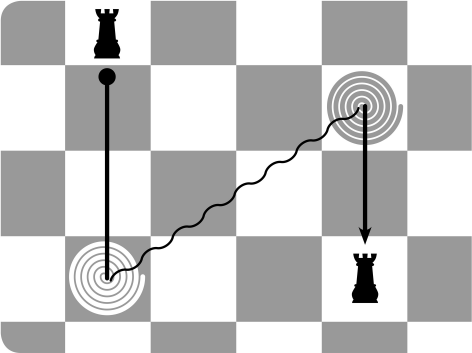
A shorter or quicker route exists that may not always be available.
Discussion
Shortcuts are a way for designers to warp the geometry of the board, to give players other options. For example, in Clue, players may move directly between the diagonal corners of the board. This system reduces travel time, which is not a core feature of Clue. Sometimes, shortcuts are only usable by certain characters or with certain equipment. This is commonly used in dungeon-crawl-type games, through the Secret Passage trope. Characters may need to use a skill to detect and be able to use them or need a special key. Some games will have alternate paths that are shorter but more treacherous. This is a way to present tactical options to players in what is traditionally a basic Roll-and-Move format (MOV-02).
Sample Games
Clue (Pratt, 1949) Dungeoneer (Denmark, 2003)
描述
存在一条可能并不总是可用的更短或更快的路线。
讨论
捷径(Shortcuts)是设计师扭曲版图几何结构以给玩家其他选择的一种方式。例如,在《妙探寻凶》(Clue/Cluedo)中,玩家可以直接在版图的对角之间移动。这个系统减少了旅行时间,这不是《妙探寻凶》的核心特征。有时,捷径只能由某些角色或使用某些装备使用。这常用于地下城爬行类型的游戏中,通过秘密通道的桥段。角色可能需要使用技能来检测并能够使用它们,或者需要一把特殊的钥匙。有些游戏会有更短但更危险的替代路径。这是一种在传统的掷骰移动格式(MOV-02)中向玩家展示战术选择的方法。
游戏范例
Clue (Pratt, 1949) - 《妙探寻凶》 Dungeoneer (Denmark, 2003) - 《Dungeoneer》