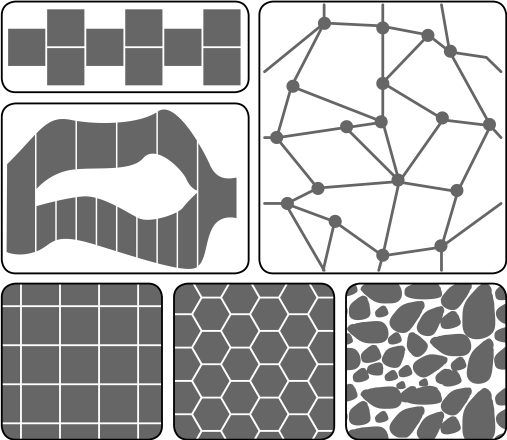
Description
The playing field is divided into spaces to regulate movement.
Discussion
There are several ways to subdivide boards, all of which are covered in this section. The most basic is a one-dimensional division. This is often called a track, and it is commonly used in Race games, Roll-and-Move games, and others. There are several variations on the standard track. First, there may be alternate paths that branch off of the main path. These can be a shortcut that reduces the distance needed to travel or a path that gives bonuses or other information, as in Careers, where each potential career choice has its own path. Second, certain spaces, or collections of spaces, may be divided into sub-spaces in the width of the track. This is typically used in racing games to create lanes, allowing multiple players to occupy the same space, and to create “inside” and “outside” lanes. The number of lane spaces can be reduced,
sometimes even down to one, to create bottlenecks that create challenges for players. This is used to great effect in Ave Caesar and Downforce, where vehicles move a set number of spaces based on cards. Forcing players to waste a good card because they cannot get through a bottleneck is a key strategy. Boards can also be laid out in two dimensions, either with a regular pattern or with irregular shapes. The most common regular patterns are squares (as in Chess) and hexagons, used in many war games, such as PanzerBlitz. Triangles may also be used but are uncommon as they limit options for adjacency and tend to look busy. If squares are used, the designer needs to decide if pieces may move diagonally. From a distance standpoint, a diagonal move is approximately 50% further than an orthogonal move, which needs to be compensated for in games striving for realism. Hexagonal Tessellations do not have this issue, and all natural moves are the same distance. This is why they are commonly used for war games and others require realistic movement. Note that a square grid with each row shifted 50%, making a brick pattern, is isomorphic to a hex grid (and easier to prototype, particularly when creating tiles—even rectangular cards can be used for this purpose). Some games need to model three-dimensional space, typically those that take place in space, in the air, or under the sea. A common approach is a dashboard or log sheet for each vehicle that tracks the altitude. This system is used in Richtofen’s War and Air Force. Some, like Attack Vector: Tactical, have tokens placed next to or beneath pieces to indicate height above or below the playing surface. Others, like Chopper Strike and Sub Search, physically create multiple levels of the play area by vertically stacking boards, separated by supports. These are physically striking and easy for players to interpret but need to limit the number of levels due to cost, the physical size of the board, and ease of reaching in between levels to reach pieces. Irregular patterns are called Area Maps. Diplomacy is an example. There are several design considerations for Area Maps. First, if they regulate movement, the areas should be approximately the same size, or at least “movement equivalent.” For example, a mountainous region may be divided into smaller, more numerous spaces so it takes more moves to traverse. If possible, regions should not touch at a corner, and they should only touch along an edge. Area maps are isomorphic to point-to-point movement, where boxes or circles are connected by lines. Sometimes point-to-point maps can be preferable, as they clearly show connections, and connection information (like
rivers or borders) may be more evident. Point-to-point maps are also common in space games, where the connection between stars is shown. Some maps are a combination of two-dimensional point-to-point and onedimensional tracks. For example, Trains and Stations has tracks in between cities that players must build along. If a region contains important information, like terrain type or resources, the graphics should be visible and distinct even if pieces are present.
Sample Games
Tracks Ave Caeser (Riedesser, 1989) Careers (Brown, 1955) Downforce (Daviau, Jacobson, and Kramer, 2017) Monopoly (Darrow and Magie, 1933) Snakes & Ladders (Unknown, ∼200 bce) Sorry! (Haskell, Jr. and Storey, 1929)
Squares Chess (Unknown, ∼1200) Checkers (Unknown) Go (Unknown, 2200 bce)
Hexagons Blitzkrieg (Pinsky and Shaw, 1965) PanzerBlitz (Dunnigan, 1970) Squad Leader (Hill, 1977) Lords of Creation (Wallace, 1993)
Tree-Dimensional Attack Vector: Tactical (Burnside, Finley, and Valle, 2004) Chopper Strike (Uncredited, 1976) Richtofen’s War (Reed, 1972) Sub Search (Uncredited, 1973)
Area Diplomacy (Calhamer, 1959) El Grande (Kramer and Ulrich, 1995) Risk (Lamorisse and Levin, 1959)
Point-to-Point A House Divided (Chadwick and Emrich, 1981) Pirate and Traveller (Sanderson, 1908) Twilight Struggle (Gupta and Matthews, 2005)
Combination Master of the Galaxy (Bokarev and Seleznev, 2018) Trains and Stations (Lang, 2013) World in Flames (Pinder and Rowland, 1985)
描述
游戏场地被分成空间以调节移动。
讨论
有几种细分版图的方法,本节涵盖了所有这些方法。最基本的是一维划分。这通常称为轨道(track),常用于竞速游戏、掷骰移动游戏和其他游戏。标准轨道有几种变体。首先,可能有从主路径分支出来的替代路径。这些可以是可以减少所需行程距离的捷径,或者是提供奖金或其他信息的路径,如在《Careers》中,每个潜在的职业选择都有自己的路径。其次,某些空间,或空间集合,可以在轨道的宽度上划分为子空间。这通常用于赛车游戏以创建车道,允许多个玩家占据相同的空间,并创建“内”和“外”车道。车道空间的数量可以减少,
有时甚至减少到现在的一个,以制造瓶颈给玩家带来挑战。这在《Ave Caesar》和《Downforce》中效果显著,车辆根据卡牌移动设定的空间数。强迫玩家浪费一张好牌,因为他们无法通过瓶颈,是一个关键策略。版图也可以在二维中布局,要么具有规则模式,要么具有不规则形状。最常见的规则模式是正方形(如在国际象棋中)和六边形,用于许多战争游戏,如《PanzerBlitz》。三角形也可以使用,但不常见,因为它们限制了邻接选项并且往往看起来很乱。如果使用正方形,设计师需要决定棋子是否可以对角线移动。从距离的角度来看,对角线移动比正交移动大约远50%,这需要在力求真实的游戏中进行补偿。六边形镶嵌(Hexagonal Tessellations)没有此问题,所有自然移动都是相同的距离。这就是为什么它们通常用于战争游戏和其他要求逼真移动的游戏。请注意,每行偏移50%的正方形网格,形成砖块图案,与六角形网格同构(并且更容易制作原型,特别是在创建板块时——甚至矩形卡牌也可以用于此目的)。有些游戏需要模拟三维空间,通常是那些发生在太空、空中或海底的游戏。一种常见的方法是为每辆车使用仪表板或记录表来跟踪高度。该系统用于《Richtofen’s War》和《Air Force》。有些游戏,如《Attack Vector: Tactical》,在棋子旁边或下方放置代币来指示游戏表面上方或下方的高度。其他游戏,如《Chopper Strike》和《Sub Search》,通过垂直堆叠版图,由支撑物隔开,实际上创造了游戏区域的多个层级。这些在物理上很引人注目,易于玩家解释,但由于成本、版图的物理尺寸以及便于在层级之间接触棋子,需要限制层级的数量。不规则模式被称为区域地图。例如《外交》(Diplomacy)。区域地图有几个设计考虑因素。首先,如果它们调节移动,区域的大小应该大致相同,或者至少是“移动等效”的。例如,山区可能被划分为更小、更多的空间,因此需要更多的移动才能穿越。如果可能,区域不应在角落接触,它们应该只沿边缘接触。区域地图与点对点移动同构,其中方框或圆圈由线连接。有时点对点地图可能更可取,因为它们清楚地显示连接,并且连接信息(如
河流或边界)可能更明显。点对点地图在太空游戏中也很常见,其中显示了星星之间的连接。有些地图是二维点对点和一维轨道的组合。例如,《Trains and Stations》在城市之间有玩家必须沿其建设的轨道。如果区域包含重要信息,如地形类型或资源,即使存在棋子,图形也应该是可见和清晰的。
游戏范例
轨道(Tracks) Ave Caeser (Riedesser, 1989) - 《Ave Caesar》 Careers (Brown, 1955) - 《Careers》 Downforce (Daviau, Jacobson, and Kramer, 2017) - 《Downforce》 Monopoly (Darrow and Magie, 1933) - 《大富翁》 Snakes & Ladders (Unknown, ∼200 bce) - 《蛇梯棋》 Sorry! (Haskell, Jr. and Storey, 1929) - 《Sorry!》
正方形(Squares) Chess (Unknown, ∼1200) - 《国际象棋》 Checkers (Unknown) - 《国际跳棋》 Go (Unknown, 2200 bce) - 《围棋》
六边形(Hexagons) Blitzkrieg (Pinsky and Shaw, 1965) - 《Blitzkrieg》 PanzerBlitz (Dunnigan, 1970) - 《装甲闪击战》 Squad Leader (Hill, 1977) - 《班长》 Lords of Creation (Wallace, 1993) - 《Lords of Creation》
三维(Three-Dimensional) Attack Vector: Tactical (Burnside, Finley, and Valle, 2004) - 《Attack Vector: Tactical》 Chopper Strike (Uncredited, 1976) - 《Chopper Strike》 Richtofen’s War (Reed, 1972) - 《Richtofen’s War》 Sub Search (Uncredited, 1973) - 《Sub Search》
区域(Area) Diplomacy (Calhamer, 1959) - 《外交》 El Grande (Kramer and Ulrich, 1995) - 《大王》 Risk (Lamorisse and Levin, 1959) - 《Risk》
点对点(Point-to-Point) A House Divided (Chadwick and Emrich, 1981) - 《A House Divided》 Pirate and Traveller (Sanderson, 1908) - 《Pirate and Traveller》 Twilight Struggle (Gupta and Matthews, 2005) - 《冷战热斗》
组合(Combination) Master of the Galaxy (Bokarev and Seleznev, 2018) - 《银河主宰》 Trains and Stations (Lang, 2013) - 《Trains and Stations》 World in Flames (Pinder and Rowland, 1985) - 《World in Flames》