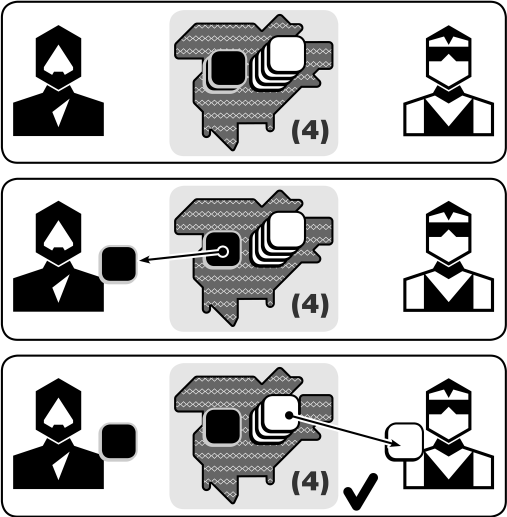
Description
The player with fewer units removes one. Ten players alternate removing units until reaching a set number, one player is out of units, or some other stopping mechanism.
Discussion
The system of Alternate Removal was first introduced in the 1980 game Civilization. Conflict in Civilization only needs to be resolved if the total number of tokens in an area exceeds its carrying capacity (representing the fertility of the particular area), which ranges from one to five. If the total quantity exceeds this, the Alternating Removal process is initiated. Tokens are removed, starting with the player with the fewest until the total number of tokens no longer exceeds the carrying capacity. If players have equal numbers of tokens, the tied players each remove a token at the same time.
This system has a variety of intriguing features. First, it is strictly deterministic. It is a determinative process with no hidden information. This is rare among conflict resolution mechanisms. Second, coexistence in an area is allowed and common. Many games with conflict or battles for areas only permit a single player to ultimately occupy an area or control it in the case of Area Majority games (ARC-02). This gives more flexibility for players to negotiate and settle borders. Finally, it gives the design hooks for special abilities later in the game. For example, if only one player in a Conflict has Metal Working, they are always the last to remove a token. Inis uses a similar removal system, except that players have the option of removing a unit or discarding a card. In addition, players have the option, after taking a casualty, to withdraw from the battle rather than pursuing the conflict. Notably, this doesn’t trigger a retreat from the disputed territory.
Sample Games
Civilization (Tresham, 1980) Inis (Martinez, 2016)
描述
单位较少的玩家移除一个单位。然后玩家交替移除单位,直到达到设定的数量、一名玩家没有单位或某种其他停止机制。
讨论
交替移除(Alternate Removal)系统最早是在1980年的游戏《文明》(Civilization)中引入的。在《文明》中,只有当一个区域内的代币总数超过其承载能力(代表特定区域的肥沃程度,范围从一到五)时,才需要解决冲突。如果总数超过此值,则启动交替移除过程。从拥有最少代币的玩家开始移除代币,直到代币总数不再超过承载能力。如果玩家拥有相同数量的代币,则平局玩家同时各移除一个代币。
该系统具有各种有趣的特征。首先,它是严格确定性的。这是一个没有隐藏信息的确定性过程。这在冲突解决机制中很少见。其次,允许且常见在一个区域共存。许多有冲突或争夺区域的游戏只允许一名玩家最终占据一个区域或在区域多数游戏(ARC-02)的情况下控制它。这给了玩家更多的灵活性来谈判和划定边界。最后,它为游戏后期的特殊能力提供了设计挂钩。例如,如果冲突中只有一名玩家拥有金属加工技术,他们总是最后一个移除代币的人。《Inis》使用类似的移除系统,除了玩家可以选择移除一个单位或弃一张牌。此外,玩家在受到伤亡后,可以选择撤出战斗而不是继续冲突。值得注意的是,这不会触发从争议领土撤退。
游戏范例
Civilization (Tresham, 1980) - 《文明》 Inis (Martinez, 2016) - 《因尼斯》