Description
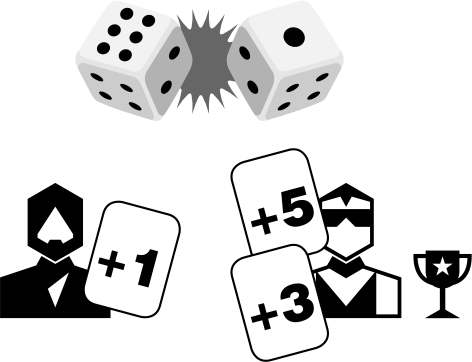
Each player simultaneously or sequentially plays one or more cards. These modify the base outcome of a conflict and allow various special abilities to apply.
Discussion
This resolution system places more control in the hands of the players. In its simplest form, the player plays a number card to be added to the base results, as in Cosmic Encounter. However, this can be taken in a wide variety of directions to make combat more tactical. Kemet resolves the conflict by giving players a strength based on the number of units in the battle. The players then each select a single Combat Card that modifies the outcome. It has three values: strength bonus, shield value, and damage caused. The strength bonus is added to the unit strength to determine the victory, while the shield value and damage bonuses determine how many opposing units are killed. Units are only removed based on those values, not winning or losing the battle. Players may know they are most likely to lose and, therefore, choose a Combat Card with little strength bonus but high damage value. This way, they destroy as many units as possible, possibly setting up for a counterattack, or even a Pyrrhic victory, should they succeed in eliminating all the attacking forces. This type of counterplay leads to a lot of Yomi (UNC-01), as players try to outguess their opponent’s intent.
Kemet also has players exhaust Combat Cards that they use, plus one additional card, in each battle. When all cards are exhausted, they are recovered, similar to an Action Retrieval system (ACT-03). This gives players more decisions to make and gives savvy players the opportunity to track which Combat Cards may still be in play for their opponents. A variety of other games allow players to play cards that modify the battle in more extreme ways. Starship Samurai allows each player to include one battle card, the effects of which may range from a simple strength addition to the ability to redeploy units into or out of the battle, changing the situation drastically. Magic: The Gathering and other collectible card games use cardbased Interrupts (TRN-17) to allow for a wide variety of different effects. Card systems can get quite complex. We the People has players draw a hand of tactics cards to resolve battles, the size of which is based on a variety of factors, including strength. Players then alternate playing or matching an opponent play. The first player who is not able to match the opponent loses the battle, so the player with more cards will typically win, but not always, and seizing the ability to lead the card play becomes a critical tactic. In Starcraft: The Board Game, players have a small hand of cards with abilities that trigger based on the units involved in the battle. As in We the People, players alternate card play to gain an advantage. Starcraft allows players to purchase upgraded tech cards to shuffle into their combat decks, but there is no guarantee they will be available, leading to opportunities for bluffing (UNC-01). The disadvantage of the more sophisticated card-based systems is that they slow down play quite a bit as battles are resolved. In a two-player game, this may not be an issue, but it is a consideration with higher player counts. Nonetheless, these systems can offer enormous design opportunities, and the ability to model a wide range of thematic moments and stratagems, as a play of War of the Ring will demonstrate.
Sample Games
Cosmic Encounter (Eberle, Kittredge, Norton, and Olatka, 1977) Hannibal (Bauza, 2010) Kemet (Bariot and Montiage, 2012) Magic: The Gathering (Garfield, 1993) Starcraft: The Board Game (Konieczka and Petersen, 2007) Starship Samurai (Vega, 2018) War of the Ring (Di Meglio, Maggi, and Nepitello, 2004) We the People (Herman, 1993)
描述
每个玩家同时或按顺序打出一张或多张牌。这些会修改冲突的基本结果,并允许应用各种特殊能力。
讨论
这种解决系统将更多的控制权交给了玩家。在其最简单的形式中,玩家打出一张数字卡添加到基本结果中,如在《Cosmic Encounter》中。然而,这可以朝各种方向发展,使战斗更具战术性。《Kemet》通过根据战斗中的单位数量赋予玩家力量来解决冲突。然后玩家各选择一张战斗卡来修改结果。它有三个值:力量加成、护盾值和造成的伤害。力量加成被添加到单位力量中以确定胜利,而护盾值和伤害加成决定了有多少敌方单位被杀死。单位仅根据这些值移除,而不是赢得或输掉战斗。玩家可能知道他们极有可能输掉,因此选择一张力量加成小但伤害值高的战斗卡。通过这种方式,他们摧毁尽可能多的单位,可能为反击做准备,甚至如果他们成功消灭了所有进攻部队,就会获得皮洛士式的胜利(惨胜)。这种类型的反制会导致很多Yomi(博弈,UNC-01),因为玩家试图猜透对手的意图。
《Kemet》还让玩家在每次战斗中耗尽他们使用的战斗卡,外加一张额外的卡。当所有卡都被耗尽时,它们会被恢复,类似于行动取回系统(ACT-03)。这给玩家提供了更多决策,并给精明的玩家提供了跟踪哪些战斗卡可能仍在对手手中的机会。各种其他游戏允许玩家打出以更极端方式修改战斗的卡牌。《Starship Samurai》允许每位玩家包含一张战斗卡,其效果可能从简单的力量增加到将单位重新部署进出战斗的能力,从而极大地改变局势。《万智牌》和其他集换式卡牌游戏使用基于卡牌的中断(TRN-17)来允许各种不同的效果。卡牌系统可能会变得相当复杂。《We the People》让玩家抽取一手战术卡来解决战斗,其大小基于包括力量在内的各种因素。然后玩家交替出牌或匹配对手的出牌。第一个无法匹配对手的玩家输掉战斗,所以拥有更多卡牌的玩家通常会获胜,但不总是如此,抓住主导出牌的能力成为关键战术。在《星际争霸:棋盘游戏》(Starcraft: The Board Game)中,玩家有一小手基于参与战斗的单位触发能力的卡牌。正如在《We the People》中一样,玩家交替出牌以获得优势。《星际争霸》允许玩家购买升级的技术卡洗入他们的战斗牌组,但不能保证它们可用,从而导致虚张声势(UNC-01)的机会。更复杂的基于卡牌的系统的缺点是,随着战斗的解决,它们会大大减慢游戏速度。在双人游戏中,这可能不是问题,但在玩家人数较多时这是一个考虑因素。尽管如此,这些系统可以提供巨大的设计机会,以及模拟各种主题时刻和策略的能力,正如《魔戒圣战》(War of the Ring)的玩法所展示的那样。
游戏范例
Cosmic Encounter (Eberle, Kittredge, Norton, and Olatka, 1977) - 《星际遭遇战》 Hannibal (Bauza, 2010) - 《汉尼拔》 Kemet (Bariot and Montiage, 2012) - 《Kemet》 Magic: The Gathering (Garfield, 1993) - 《万智牌》 Starcraft: The Board Game (Konieczka and Petersen, 2007) - 《星际争霸:棋盘游戏》 Starship Samurai (Vega, 2018) - 《Starship Samurai》 War of the Ring (Di Meglio, Maggi, and Nepitello, 2004) - 《魔戒圣战》 We the People (Herman, 1993) - 《We the People》