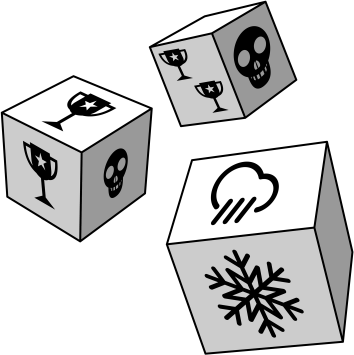
Description
The player rolls dice, and any die showing the target icon is a success.
Discussion
This mechanism is typically a subset of High Number (RES-01) or Stat Check (RES-02), as the number of successes ultimately reduces to one of these. However, we are listing this as a separate mechanism due to some subtleties in the implementation and player interaction. The use of Die Icons has several advantages over traditional dice with numbers on the sides. First, using an icon makes it simpler for players to interpret the result, if they are properly chosen. Counting icons is inherently simpler from a cognitive perspective than adding numbers or checking to see if numbers on dice exceed certain values. This ease increases as the number of dice rolled increases and is particularly true if the target value may vary depending on the game situation. In this case, icons are easier to parse at a glance, especially if they are thematic. For example, contrast Warhammer with Memoir ’44. In Warhammer, a player may roll 4 dice for an attack, looking for a 5 or higher for a success (a 5+, in the parlance). After rolling, the player needs to look at the dice, remembering the target number. Memoir ’44, like Warhammer, bases
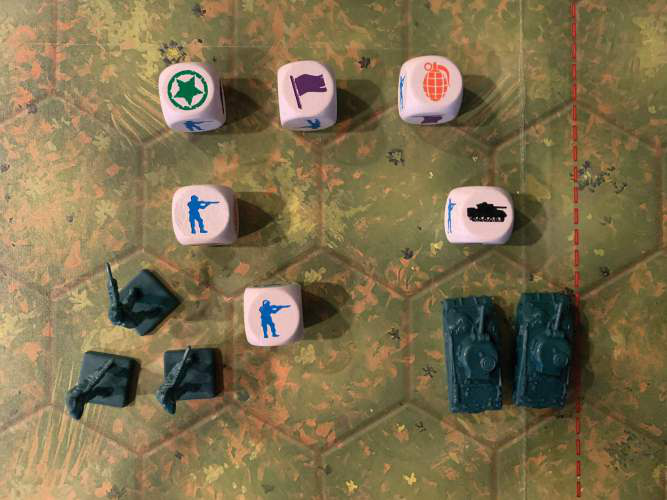
the number of dice rolled on the type of the attacking unit. The icon that counts as a hit is based on what is being targeted. When attacking an Infantry, each Infantry symbol counts as a hit. When attacking Armor, each Armor symbol counts as a hit. In addition, the grenade icon always counts as an additional hit. Since there are two infantry icons, one armor icon, and one grenade icon on a die, an attack on infantry is equivalent to a 4+ and an attack on armor a 5+. But the player does not need to have a chart of those numbers or track them in any way. It is intuitively obvious to look for the icons of what you are attacking and just count them up. Advanced players can understand the symbol distribution, but it is not necessary. The die does the heavy lifting. The distribution of icons also gives the designer fine-grained control over possible combat outcomes and allows for multiple effects to be determined. The Memoir ’44 dice also include a Retreat icon, which applies in conjunction with the removal effects, allowing for a wide variety of outcomes (Illustration 4.2). Illustration 4.2 The dice from Memoir ’44 are used to resolve battles and are resolved relative to the target. Infantry icons eliminate an infantry, Tank icons eliminate a tank, and the Hand Grenade eliminates either. Flags force a retreat, and the star icons are used for special effects.
A disadvantage of icons is that it is very difficult to deal with modifiers or other ways to modify attacks based on, for example, terrain or different quality forces. Some games, like Descent, deal with this by having dice of different qualities, relating to the power and skill of the character, weapon, armor, or other equipment. The dice can be segregated into types like attack, defense, knockback, special, and others, again allowing the designer fine-grained control over possible outcomes while making it simple for the player to interpret. Tey just need to see what color dice need to be rolled and then read off the icons to see the results. Eclipse is a hybrid of this system, with three colors of dice representing different powers—yellow (the weakest), orange, and red. However, Eclipse does not use icons on the dice. Standard numeric pips are used but with non-standard distributions to model the varying power levels. At the extreme end, Dragon Dice has custom dice for every single unit in the game. The same effect can be represented by different icons for different units. For example, Move icons may be boot prints for one creature and hoof prints for another. Although it increases thematic immersion, having so many icons can make it difficult for players to quickly parse results. It can also create production challenges, and indeed, Quarriors!, the game that launched the concept of collectible dice games, struggled to find a publisher because of the manufacturing challenge the game presented. While they are most commonly used on dice, icons can be placed on cards to be flipped for resolution as well. Similar considerations apply, except that it is rare to have draws from multiple different decks the same way games like Descent: Journeys in the Dark have players roll different dice.
Sample Games
Command & Colors (Borg, 2006) Descent: Journeys in the Dark (Wilson, 2005) Dragon Dice (Smith, 1995) Eclipse (Tahkokallio, 2011) Memoir ’44 (Borg, 2004) Quarriors! (Elliott and Lang, 2011)
描述
玩家掷骰子,任何显示目标图标的骰子都是成功。
讨论
这种机制通常是高数值(RES-01)或属性检定(RES-02)的子集,因为成功的数量最终归结为其中之一。然而,由于实施和玩家互动中的一些微妙之处,我们将此作为单独的机制列出。与侧面有数字的传统骰子相比,使用骰子图标(Die Icons)有几个优点。首先,如果选择得当,使用图标可以让玩家更简单地解释结果。从认知的角度来看,计算图标本质上比加数字或检查骰子上的数字是否超过某些值更简单。这种容易程度随着掷骰数量的增加而增加,特别是在目标值可能根据游戏情况而变化的情况下。在这种情况下,图标更容易一眼看出,特别是如果它们是主题性的。例如,对比《战锤》(Warhammer)和《Memoir ’44》。在《战锤》中,玩家可能会为了攻击掷4个骰子,寻求5或更高的成功(用行话说是5+)。掷骰后,玩家需要看骰子,记住目标数字。《Memoir ’44》像《战锤》一样,基于
攻击单位的类型来确定掷骰数量。算作命中的图标基于被攻击的目标。攻击步兵时,每个步兵符号算作一次命中。攻击装甲时,每个装甲符号算作一次命中。此外,手榴弹图标总是算作一次额外的命中。由于骰子上有两个步兵图标、一个装甲图标和一个手榴弹图标,因此对步兵的攻击等同于4+,对装甲的攻击等同于5+。但是玩家不需要有一张这些数字的图表或以任何方式跟踪它们。寻找你正在攻击的图标并把它们数起来是很直观的。高级玩家可以理解符号分布,但这并不是必须的。骰子承担了繁重的工作。图标的分布还赋予设计师对可能战斗结果的细粒度控制,并允许确定多种效果。《Memoir ’44》骰子还包括撤退图标,它与移除效果结合使用,允许各种各样的结果(插图4.2)。插图4.2 《Memoir ’44》中的骰子用于解决战斗,并相对于目标进行解决。步兵图标消除一个步兵,坦克图标消除一个坦克,手榴弹消除两者中任意一个。旗帜强制撤退,星形图标用于特殊效果。
图标的一个缺点是很难处理修正值或其他基于地形或不同质量部队修改攻击的方式。一些游戏,如《深入绝地》(Descent),通过拥有不同质量的骰子来解决这个问题,这些骰子与角色、武器、盔甲或其他装备的力量和技能有关。骰子可以分为攻击、防御、击退、特殊等类型,这再次允许设计师对可能的结果进行细粒度控制,同时也让玩家简单解释。他们只需要看需要掷什么颜色的骰子,然后读出图标看结果。《星蚀》(Eclipse)是该系统的混合体,有三种颜色的骰子代表不同的力量——黄色(最弱)、橙色和红色。然而,《星蚀》不在骰子上使用图标。使用标准数字圆点,但分布非标准,以模拟不同的力量水平。在极端情况下,《Dragon Dice》为游戏中的每个单位定制骰子。同样的效果可以用不同单位的不同图标来表示。例如,移动图标可能对一种生物是靴印,对另一种生物是蹄印。虽然这增加了主题沉浸感,但拥有这么多图标会让玩家很难快速解析结果。这也可能带来生产挑战,事实上,推出了可收集骰子游戏概念的游戏《Quarriors!》曾因游戏带来的制造挑战而难以找到发行商。虽然它们最常用于骰子,但图标也可以放在卡牌上翻转以进行解决。类似的考虑适用,除了很少有像《深入绝地:暗黑之旅》那样让玩家掷不同骰子那样从多个不同牌堆中抽牌。
游戏范例
Command & Colors (Borg, 2006) - 《指挥与军旗》 Descent: Journeys in the Dark (Wilson, 2005) - 《深入绝地:暗黑之旅》 Dragon Dice (Smith, 1995) - 《龙骰》 Eclipse (Tahkokallio, 2011) - 《星蚀》 Memoir ’44 (Borg, 2004) - 《大战回忆录》 Quarriors! (Elliott and Lang, 2011) - 《Quarriors!》