Description
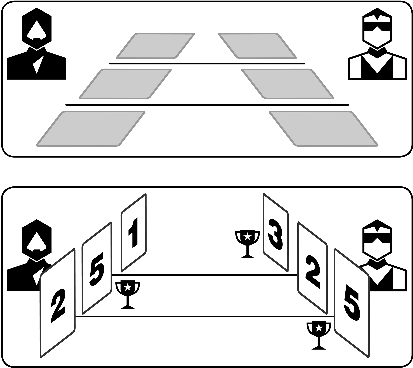
The players select how many of their forces they will commit to the battle to different categories. The players then reveal their assignments and resolve.
Discussion
This is a meta-mechanic that builds on other Resolution means. Typically, players will reveal their strengths in different categories, with the High Number gaining the benefit (RES-01). If the allocation portion of this mechanism is done secretly, it is a Sealed Bid Auction, so considerations noted in that section (AUC-05) apply here. In one of the earlier implementers of this system, Dune and its successor, Rex: Final Days of an Empire, have players allocating to just two categories: in the battle or out of the battle. Units that a player commits to a battle will be lost. In addition, all units from the loser are eliminated. This system makes the players evaluate whether to give themselves a higher chance to win by committing larger forces or preserve as much of their force as possible by committing fewer forces. Dune augments the mechanism by allowing the players to also commit leaders and bonus cards along with forces. This uncertainty is critical for this
system to work so that the player with the larger force cannot just bid one more than the size of the smaller (Illustration 4.5). A modified form of this system has the loser only losing part of its force, not the full force. This makes the decision of Force Commitment for the larger side more challenging, as it introduces more Yomi (UNC-01) by giving a broader possible strength range of the commitment of the smaller force. Cry Havoc and Rising Sun give more options to players for Force allocation. In Cry Havoc, players may allocate forces to take control of the area being fought over, cause casualties, or take prisoners. Control and Prisoners are executed by the player with the most forces in that region, while Cause Casualties is executed by all players who have units there. Tactics cards can also be played to affect the battle in various ways. Rising Sun has a similar system to Cry Havoc, except with slightly different assignment options (the ability to sacrifice your own units for victory points, for example). Also, while Rising Sun uses the same simultaneous secret assignment of forces, Cry Havoc has the Attacker allocate first, followed by the Defender. Secret assignment emphasizes the guessing nature and leads to a lighter, more random feel, while sequential assignment removes luck but Illustration 4.5 The Combat Wheel in Dune. Players select the strength they are committing to the battle and may also add a leader disk and cards. This is held in the hand and then simultaneously revealed.
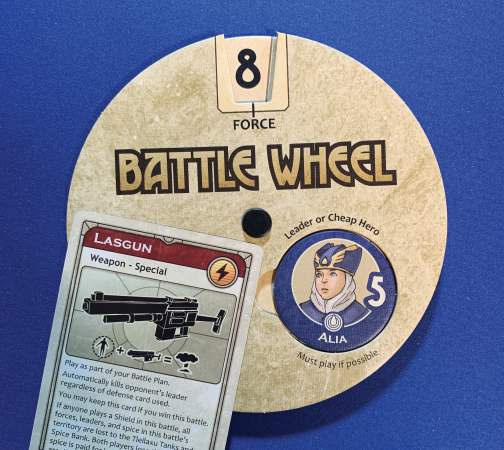
may give an advantage to the side that places last (the Defender, in the case of Cry Havoc). These types of systems give the players a lot of flexibility in the goals they want to achieve in a battle. Are they trying to hold ground? Cause losses? Earn points? The player can use the options to pursue a variety of strategies.
Sample Games
Cry Havoc (Rodiek, Oracz, and Walczak, 2016) Dune (Eberle, Kittredge, and Olatka, 1979) Rex: Final Days of an Empire (Eberle, Goodenoungh, Kitteredge, Konieczka, Olatka, and Petersen, 2012) Rising Sun (Lang, 2018) Scythe (Stegmaier, 2016)
描述
玩家选择他们将致力于战斗不同类别的部队数量。然后玩家揭示他们的分配并解决。
讨论
这是一个建立在其他解决手段之上的元机制。通常,玩家会揭示他们在不同类别中的力量,高数值获得利益(RES-01)。如果该机制的分配部分是秘密进行的,那就是密封式拍卖,因此在该部分(AUC-05)中指出的考虑因素适用于此。在该系统的早期实施者之一《沙丘》(Dune)及其继任者《Rex: Final Days of an Empire》中,玩家只分配到两个类别:在战斗中或在战斗外。玩家投入战斗的单位将会丢失。此外,输家的所有单位都被消除。该系统让玩家评估是通过投入更多兵力给自己更高的获胜机会,还是通过投入更少兵力来尽可能保留兵力。《沙丘》通过允许玩家除了兵力外还投入领袖和奖励卡来增强该机制。这种不确定性对这个
系统的运作至关重要,这样拥有较大兵力的玩家就不能只比拥有较小兵力的玩家多出价一个(插图4.5)。该系统的一种修改形式是输家只失去部分兵力,而不是全部兵力。这使得较大一方的兵力投入(Force Commitment)决策更具挑战性,因为它通过给出较小兵力投入的更广泛的可能力量范围引入了更多的Yomi(博弈,UNC-01)。《Cry Havoc》和《Rising Sun》为玩家提供了更多的兵力分配选项。在《Cry Havoc》中,玩家可以分配兵力来控制争夺的区域、造成伤亡或俘虏俘虏。控制和俘虏由该区域兵力最多的玩家执行,而造成伤亡由所有在那里的玩家执行。战术卡也可以用来以各种方式影响战斗。《Rising Sun》有一个类似于《Cry Havoc》的系统,只是分配选项略有不同(例如牺牲自己的单位来获得胜利点数的能力)。此外,虽然《Rising Sun》使用相同的同秘分配兵力,但《Cry Havoc》让攻击者先分配,然后是防御者。秘密分配强调猜测性质,导致更轻松、更随机的感觉,而顺序分配消除了运气,但
插图4.5 《沙丘》中的战斗轮。玩家选择他们投入战斗的力量,还可以添加领袖圆盘和卡牌。这被握在手中,然后同时揭示。
可能会给最后放置的一方(在《Cry Havoc》的情况下是防御者)带来优势。这些类型的系统给了玩家在战斗中想要实现的目标很大的灵活性。他们试图坚守阵地吗?造成损失?赚取点数?玩家可以使用这些选项来追求各种策略。
游戏范例
Cry Havoc (Rodiek, Oracz, and Walczak, 2016) - 《Cry Havoc》 Dune (Eberle, Kittredge, and Olatka, 1979) - 《沙丘》 Rex: Final Days of an Empire (Eberle, Goodenoungh, Kitteredge, Konieczka, Olatka, and Petersen, 2012) - 《瑞克斯:帝国末日》 Rising Sun (Lang, 2018) - 《旭日战魂》 Scythe (Stegmaier, 2016) - 《镰刀战争》