Description
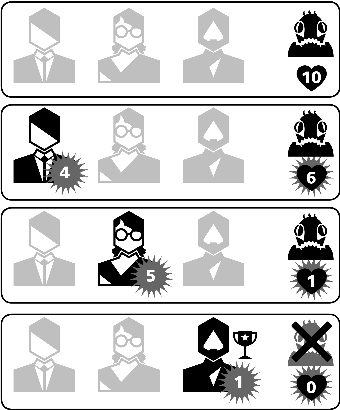
Players contribute toward completing a task, but only the player who finally completes it gets a benefit.
Discussion
This Kill Steal mechanism originated in video games, which is where the term came from. In tabletop games, it is most frequently seen in combat games, where the player scoring the last hit to kill a creature gains the experience, treasure, or another reward. In Cutthroat Caverns, players are trying to defeat creatures to reach and defeat the final boss and win the game. If all players are killed, they all lose, but if at least one survives, the player with the most points wins. See Semi-Co-Op (STR-05) for more details about this type of game structure. But while all players collectively battle creatures, only the player that lands the final hit that kills it gains the points. This adds a lot of interesting dynamics as players maneuver to land that final blow. Similarly, in the purely competitive games Dungeon Run, Wildlands, and Space Freaks, as players attack, if monsters or other players are not defeated, the damage they suffer carries over. Whichever player actually reduces the target’s health to zero gains the reward.
This mechanism is easy for players to understand and work with, but it makes things more contentious and raises the stakes, as if you are performing an attack that should defeat an enemy, but you get unlucky and it doesn’t, other players can swoop in for the kill and your efforts are for naught. Some conflict games, like Adrenaline, avoid Kill Stealing by giving points to all players who contributed to defeating that opponent but at the expense of additional bookkeeping to track who caused what damage. This mechanism is not limited to combat. It has been used in an economic game like Valparaiso, where players construct buildings in districts, but the player who constructs the final house gets a bonus, or in an abstract like 6 Nimmt, where players place cards into rows based on their number, and the person who plays the sixth card takes the whole row (although taking rows is a bad thing, so perhaps this is better classified as a Reverse Kill Steal). There are echoes of this mechanism in Gating and Unlocking (ACT-15), as many games have tracks that players advance on, but the first player to reach a certain space gets a one-time bonus.
Sample Games
6 Nimmt (Kramer, 1994) Cutthroat Caverns (Covert, 2007) Dungeon Run (Bistro, 2011) Space Freaks (Jantunen and Wikström, 2017) Valparaiso (Malz and Malz, 2018) Wildlands (Wallace, 2018)
描述
玩家为完成一项任务做出贡献,但只有最终完成任务的玩家才能获得利益(Kill Steal)。
讨论
这种抢人头(Kill Steal)机制起源于电子游戏,这也是该术语的来源。在桌面游戏中,它最常出现在战斗游戏中,造成最后一击杀死生物的玩家获得经验、宝藏或其他奖励。在《Cutthroat Caverns》中,玩家试图击败生物以达到并击败最终BOSS并赢得游戏。如果所有玩家都被杀死,他们都会输,但如果至少有一人幸存,得分最高的玩家获胜。有关此类游戏结构的更多详细信息,请参阅半合作(STR-05)。虽然所有玩家通过战斗攻击生物,但只有造成杀死它的最后一击的玩家才能获得积分。当玩家操纵以造成最后一击时,这增加了很多有趣的动态。同样,在纯粹的竞争性游戏《Dungeon Run》、《Wildlands》和《Space Freaks》中,随着玩家攻击,如果怪物或其他玩家没有被击败,他们遭受的伤害会保留。无论哪个玩家实际上将目标的生命值降至零,都会获得奖励。
这个机制很容易让玩家理解和使用,但是让事情变得更具争议性并提高了赌注,好像你在进行一次应该击败敌人的攻击,但你运气不好,它没有死,其他玩家可以猛扑过来杀戮,你的努力就白费了。一些冲突游戏,如《Adrenaline》,通过给所有为击败该对手做出贡献的玩家加分来避免抢人头,但这需要额外的簿记来跟踪谁造成了什么伤害。这种机制不限于战斗。它已被用于像《Valparaiso》这样的经济游戏中,玩家在各区建造建筑物,但建造最后一栋房子的玩家获得奖金,或者在像《6 Nimmt》这样的抽象游戏中,玩家根据数字将卡牌放入行中,打出第六张牌的人拿走整行(尽管拿走行是一件坏事,所以这也许可以更好地归类为反向抢人头)。在门控和解锁(ACT-15)中有这种机制的回声,因为许多游戏有玩家前进的轨道,但第一个到达特定空间的玩家获得一次性奖励。
游戏范例
6 Nimmt (Kramer, 1994) - 《谁是牛头王》 Cutthroat Caverns (Covert, 2007) - 《Cutthroat Caverns》 Dungeon Run (Bistro, 2011) - 《Dungeon Run》 Space Freaks (Jantunen and Wikström, 2017) - 《Space Freaks》 Valparaiso (Malz and Malz, 2018) - 《Valparaiso》 Wildlands (Wallace, 2018) - 《Wildlands》