Description
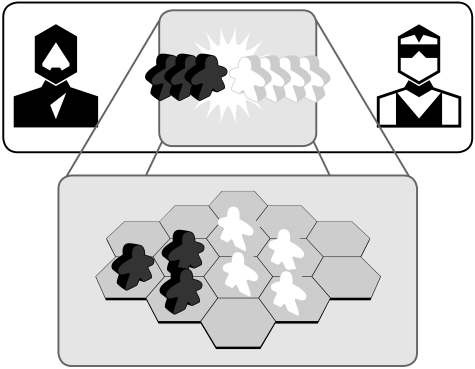
When a conflict is initiated, pieces are moved to a separate board for resolution.
Discussion
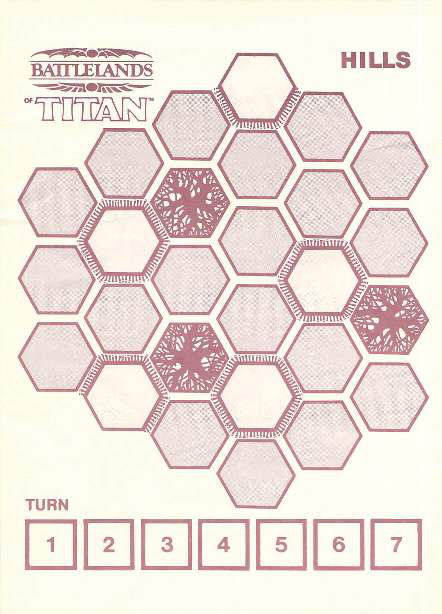
This is a meta-mechanic, as it is a way of organizing conflict, and relies on one of the other methods discussed here to actually resolve individual attacks. One of the earliest examples of the Minimap mechanism is the 1962 game Bismarck. In this naval game, players secretly move task forces around a search board. When they discover each other, task forces are moved to the Battle Board, where the conflict is actually resolved (through a Stat Check mechanism in Bismarck’s case). It is like “zooming in” on the battle to get more tactical. Video games like Master of Orion and Heroes of Might and Magic implement a similar system. The Battle Board was later extended in Titan, where players move groups of monsters (Legions) around a master board. When two opposing Legions meet in the same space, they are transferred to a battle board to actually fight the battle. Titan is notable in that it has a different battle board for each type of terrain, and the side the defender sets up on depends on the direction from
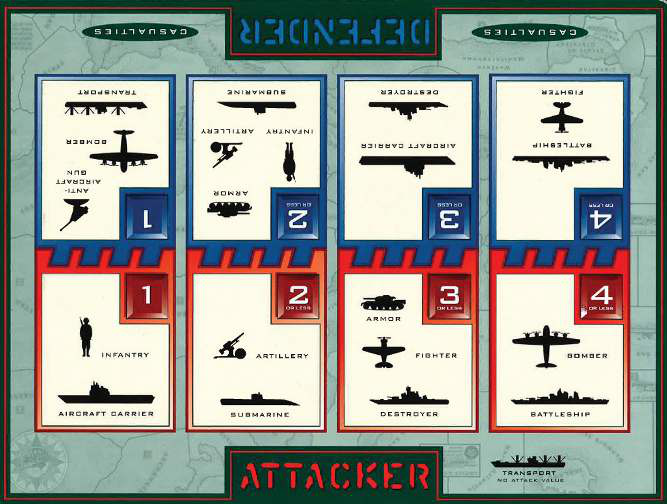
which the attacker entered the space. This makes battles extremely variable and tactical (Illustrations 4.4a and 4.4b). A variation on this can be seen in Buck Rogers: Battle for the 25th Century, which has both a solar system map and separate maps for each planet, co-located on the board. Unlike Titan, which has many, many Jungle spaces, all Illustration 4.4a When a battle takes place in a Hills space in Titan, the battle is conducted on this separate board. Each board has different combinations of terrain. This board features Hill spaces that confer a combat advantage to occupiers and Forest spaces that are impassable. A much simpler version of this mechanism is used in Axis & Allies, which uses a Battle Board not to give tactical options to the players, but as a player-aid to help organize and keep track of the strength of units, what they need to roll to hit, and which units are still able to fire. This is more of a graphic design technique than a mechanism. A similar system is seen in many Force Commitment games (ARC-06).
of which resolve on the Jungle board, here the planet maps are very specific to the planets in the solar system and act as a place for units on the planet to be located and for ground battles to be resolved.
Sample Games
Axis & Allies (Harris, Jr., 1981) Bismarck (Roberts and Shaw, 1962) Buck Rogers: Battle for the 25th Century (Grubb, 1988) Titan (McAllister and Trampier, 1980) Illustration 4.4b The battle board in Axis & Allies: Europe. The boxes are used to organize units by combat strength and track casualties. It obviates the need for players to memorize the combat strength of all the different units.
描述
当冲突发起时,棋子被移动到一个单独的版图进行解决。
讨论
这是一种元机制,因为它是一种组织冲突的方式,并依赖于这里讨论的其他方法之一来实际解决单独的攻击。小地图(Minimap)机制的最早例子之一是1962年的游戏《俾斯麦号》(Bismarck)。在这款海军游戏中,玩家秘密地在搜索版图周围移动特遣部队。当他们发现对方时,特遣部队被移动到战斗版图,通过那里实际解决冲突(在《俾斯麦号》的情况下通过属性检定机制)。这就像“放大”战斗以获得更多战术。像《猎户座之王》(Master of Orion)和《魔法门之英雄无敌》(Heroes of Might and Magic)这样的电子游戏实现了类似的系统。战斗版图后来在《泰坦》(Titan)中得到扩展,玩家在主版图周围移动怪物群(军团)。当两个对立的军团在同一个空间相遇时,它们被转移到战斗版图上实际进行战斗。《泰坦》值得注意的是,每种地形都有不同类型的战斗版图,防御者设置的一侧取决于
攻击者进入该空间的方向。这使得战斗极其多变和战术化(插图4.4a和4.4b)。这种变化可以在《Buck Rogers: Battle for the 25th Century》中看到,它既有太阳系地图,也有每个行星的单独地图,位于版图上的同一位置。与《泰坦》有许多丛林空间不同,所有
插图4.4a 当在《泰坦》中的山丘空间发生战斗时,战斗在这个单独的版图上进行。每个版图都有不同的地形组合。该版图具有赋予占领者战斗优势的山丘空间和无法通行的森林空间。这种机制的一个简单得多的版本用于《轴心国与同盟国》(Axis & Allies),它使用战斗版图并不是为了给玩家提供战术选择,而是作为玩家辅助,帮助组织和跟踪单位的力量、他们命中需要掷出的点数,以及哪些单位仍然能够开火。这更多的是一种平面设计技术,而不是一种机制。类似的系统在许多兵力投入游戏(ARC-06)中也能看到。
都在丛林版图上解决,这里的行星地图非常特定于太阳系中的行星,并充当行星上单位定位和地面战斗解决的地方。
游戏范例
Axis & Allies (Harris, Jr., 1981) - 《轴心国与同盟国》 Bismarck (Roberts and Shaw, 1962) - 《俾斯麦号》 Buck Rogers: Battle for the 25th Century (Grubb, 1988) - 《Buck Rogers: Battle for the 25th Century》 Titan (McAllister and Trampier, 1980) - 《泰坦》 插图4.4b 《Axis & Allies: Europe》中的战斗版图。方框用于按战斗力组织单位并跟踪伤亡。它避免了玩家记住所有不同单位战斗力的需要。