Description
Actions, resources, or resolutions are shared between neighbors.
Discussion
The concept “scope” generally means the range of impact an action has among players. The two most common scopes are global scope—impacting everyone—and personal scope—impacting only yourself. Neighbor Scope is a specific type of scope that has particular considerations and uses. Before we dive into these details, two game examples will clarify what this term means. In 7 Wonders, there are two Neighbor Scope systems. When placing cards, players may use a resource that their neighbor produces by giving them two coins. And when the military is resolved, each player compares their strength only to their immediate neighbor to see if they take a victory or defeat token. In Between Two Cities, each player builds two cities—one to their left and the other to their right. Teir cities are shared by the neighbors on either side. Each round, players draft tiles and place them into their shared cities. At the
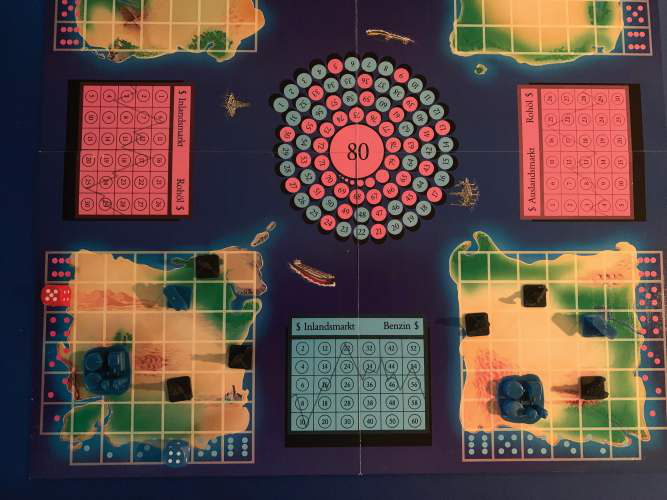
end of the game, each city is scored, and each player scores points equal to their lowest-scoring city (a form of Highest-Lowest scoring—see VIC-20). Players work with their neighbors to make each city as good as possible but are incentivized to emphasize improving their lower-scoring city. Neighbor scope has a number of positive features. The most important is that by restricting the interactions a player needs to worry about, it is easier to scale the game to higher player counts. This is evident in 7 Wonders, which comfortably goes to seven players. If you could potentially get resources from any other player or attack them, it would slow the game down quite a lot as players have more options to consider. Limiting the scope limits the number of possibilities that need to be considered and presents a smaller decision space to players. Similarly, the neighbor scope of Between Two Cities allows for negotiation and player discussion but in a controlled way. This makes it more comfortable for players who don’t like open negotiation games and also reduces the time required for negotiations—always a potential issue with these types of games (see ECO-18 Negotiation). The downside of this mechanism is that, particularly at larger player counts, players often do not need to interact, even socially, with players other than neighbors, particularly players that are across the table from them, the farthest players from them positionally. Players may go an entire game and not know how those players are doing, what their strategies are, or good or bad players they are making. Since they are only interacting with their immediate neighbors, that is who they are focusing on. Ten, when the game ends, they find out how other people did, which often comes as a surprise. Players at far distances impact them only indirectly, if at all. While this may make sense from a simulation standpoint or from allowing the game to scale smoothly, it does make for a certain type of social experience that is more fragmented and doesn’t create a group “story” per se. There are many other expressions of neighbor scope. One is the standard card draft (CAR-06 Card Drafting), where players select a card from their hand and pass the rest to their left. You most immediately impact your “downstream” neighbor as, depending on the game, you may be able to judge what people are collecting and potentially block them from gaining a set or combo. A unique implementation can be found in Crude: The Oil Game. Each player builds facilities on a 6×6 grid. At the start of a player’s turn, they roll two dice, and one activates a row in the grid and the other a column.
Any facilities found in these produce resources. However, the row die also activates the same row in the right-hand neighbor’s grid, and the column die activates the matching column in the left-hand neighbor (Illustration 4.8). Another is in party games. The classic game “telephone,” where players whisper a message down a chain of people, is an example. Another is Telestrations, where players alternately draw or describe a picture based on what they are given by their neighbor. Both examples underscore how this allows games to scale to a large group while keeping the action understandable and focused. The concept of scope can be applied in other ways as well. Some multi-player games will extend neighbor scope by including effects that impact the player directly across from you, or a player two to your left or right. Again, the objective is to restrict the decision space. To a certain extent, the Destiny system in Cosmic Encounter also applies a scope limitation. At the start of each turn, a player draws a card or disk Illustration 4.8 In Crude, the active player rolls two dice and activates buildings in that row and column. The dice also activate the buildings of the active player’s neighbors. In this example, the red die in the lower left would activate the red “5” row in the right-hand neighbor’s grid.
(depending on game version) from a pile, and it directs which player they must attack. The targets aren’t limited to neighbors, of course, but the system does limit the interaction to two players only. Toughtful consideration of action scope allows the designer to control complexity, decision space, and player interaction.
Sample Games
7 Wonders (Bauza, 2010) Between Two Castles of Mad King Ludwig (O’Malley and Rosset 2018) Between Two Cities (O’Malley, Pedersen, Rosset, 2015) Crude: The Oil Game (St. Laurent, 1974) Kodama Forest (Iglesias and Riley, 2020) Telephone (Unknown) Telestrations (Uncredited, 2009) [Published version of public domain Eat Poop You Cat]
Game End and Victory
Two characteristics that separate games from other activities are having a goal and a defined end-game point. Even in a role-playing game (RPG), which may not have a formal end-game point, a campaign or narrative arc reaches a climax, and though the characters may continue on to the next adventure, goals still exist. Achieving goals, or achieving them better than other players, defines who wins the game. Goals and end-game points are frequently inter-twined in games, so we are exploring them together in this chapter. The first section primarily features ways of determining the winner, and the second section contains triggers for ending the game. We conclude this chapter by looking at several ancillary considerations for these topics. The first few mechanisms detail different aspects of Victory Points (VPs). Giving points to players is a straightforward way to determine who wins a game. Indeed, any victory system can be expressed as VPs. For example, Snakes & Ladders, which is a Race game (VIC-07), could be treated as having points. Rather than reaching square 100, players have points based on the square they are on. The first player to get 100 points (exactly) is the winner and ends the game. This is a trivial example, but designers should be on the lookout for other ways to define victory that better meet the theme of the game. For example, in many business or economic games, the victory goes to the player with the most money or the one who surpasses a monetary threshold. Many games allow players to collect points from several different activities. Tousands of years ago, Go allowed the players to score points by both surrounding territories and capturing enemy stones. Having multiple ways to gain points gives players multiple strategic approaches and allows players to judge the relative values of actions. DOI: 10.1201/9781003179184-5
描述
行动、资源或解决在邻居之间共享。
讨论
“范围”这一概念通常意味着行动在玩家中产生影响的范围。最常见的两个范围是全局范围——影响每个人——和个人范围——只影响你自己。邻居范围(Neighbor Scope)是一种特殊类型的范围,具有特定的考虑因素和用途。在我们深入研究这些细节之前,两个游戏示例将阐明该术语的含义。在《七大奇迹》(7 Wonders)中,有两个邻居范围系统。放置卡牌时,玩家可以使用邻居生产的资源,方法是给他们两个硬币。而在解决军事冲突时,每个玩家只与他们的直接邻居比较力量,看他们是否获得胜利或失败标记。在《双城之间》(Between Two Cities)中,每个玩家建造两个城市——一个在左边,另一个在右边。他们的城市由两边的邻居共享。每一轮,玩家轮抽板块并将它们放入他们的共享城市中。在
游戏结束时,每个城市都会计分,每个玩家获得的分数等于得分最低的城市的分数(一种最高-最低评分形式——见VIC-20)。玩家与邻居合作,使每个城市尽可能好,但也受到激励,重点改善得分较低的城市。邻居范围有许多积极特征。最重要的是,通过限制玩家需要担心的互动,更容易将游戏扩展到更高的玩家人数。这在《七大奇迹》中很明显,它可以舒适地容纳七名玩家。如果你可能从任何其他玩家那里获得资源或攻击他们,那会让游戏慢很多,因为玩家有更多的选项要考虑。限制范围限制了需要考虑的可能性数量,并向玩家展示了更小的决策空间。同样,《双城之间》的邻居范围允许协商和玩家讨论,但以受控的方式进行。这使得不喜欢公开谈判游戏的玩家更舒服,也减少了谈判所需的时间——这一直是此类游戏的潜在问题(见ECO-18谈判)。这种机制的缺点是,特别是在玩家人数较多时,玩家通常不需要与其他玩家互动,即使是社交上的,尤其是坐在桌子对面的玩家,他们在位置上离他们最远。玩家可能会玩一整场游戏,却不知道那些玩家做得如何,他们的策略是什么,或者他们是好玩家还是坏玩家。由于他们只与直接邻居互动,这就是他们关注的对象。然后,当游戏结束时,他们会发现其他人做得如何,这往往是个惊喜。远距离的玩家即使有影响,也只是间接影响。虽然从模拟的角度或从允许游戏平滑扩展的角度来看这可能有意义,但这确实会带来某种类型的社交体验,这种体验更加碎片化,并且本身不会创造一个群体的“故事”。邻居范围还有许多其他表现形式。一种是标准的卡牌轮抽(CAR-06卡牌轮抽),玩家从手牌中选择一张牌,然后将剩下的传给左边的人。你最直接地影响你的“下游”邻居,因为根据游戏的不同,你也许能够判断人们在收集什么,并可能阻止他们获得一套或组合。《Crude: The Oil Game》中有一个独特的实现。每个玩家在6x6的网格上建造设施。在玩家回合开始时,他们掷两个骰子,一个激活网格中的一行,另一个激活一列。
在这些中发现的任何设施都会生产资源。然而,行骰子也会激活右手邻居网格中的同一行,列骰子也会激活左手邻居网格中的匹配列(插图4.8)。另一种是在派对游戏中。经典的“电话传话”游戏,玩家在一群人中耳语传递信息,就是一个例子。另一个是《传情画意》(Telestrations),玩家根据邻居给他们的东西轮流画画或描述图片。这两个例子都强调了这如何允许游戏扩展到一大群人,同时保持动作易于理解和集中。范围的概念也可以以其他方式应用。一些多人游戏将通过包括直接影响你对面玩家,或者你左边或右边第二个玩家的效果来扩展邻居范围。同样,目标是限制决策空间。在某种程度上,《Cosmic Encounter》中的命运系统也应用了范围限制。在每回合开始时,玩家从一堆牌中抽出一张卡牌或圆盘
插图4.8 在《Crude》中,当前玩家掷两个骰子并激活该行和列中的建筑物。骰子还会激活当前玩家邻居的建筑物。在此示例中,左下角的红色骰子将激活右手邻居网格中的红色“5”行。
(取决于游戏版本),它指示他们必须攻击哪个玩家。当然,目标并不限于邻居,但该系统确实将互动限制在两名玩家之间。对行动范围的深思熟虑允许设计师控制复杂性、决策空间和玩家互动。
游戏范例
7 Wonders (Bauza, 2010) - 《七大奇迹》 Between Two Castles of Mad King Ludwig (O’Malley and Rosset 2018) - 《疯王城堡》 Between Two Cities (O’Malley, Pedersen, Rosset, 2015) - 《双城之间》 Crude: The Oil Game (St. Laurent, 1974) - 《Crude: The Oil Game》 Kodama Forest (Iglesias and Riley, 2020) - 《Kodama Forest》 Telephone (Unknown) - 《电话传话》 Telestrations (Uncredited, 2009) [Published version of public domain Eat Poop You Cat] - 《传情画意》
游戏结束与胜利 (Game End and Victory)
将游戏与其他活动区分开来的两个特征是拥有目标和定义的结束游戏的点。即使在角色扮演游戏(RPG)中,可能没有正式的结束游戏的点,战役或叙事弧线也会达到高潮,虽然角色可能会继续下一次冒险,但目标仍然存在。实现目标,或比其他玩家更好地实现目标,定义了谁赢得游戏。目标和结束游戏的点在游戏中经常交织在一起,因此我们在本章中一起探讨它们。第一部分主要介绍确定赢家的方法,第二部分包含结束游戏的触发器。我们通过查看这些主题的几个辅助考虑因素来结束本章。前几个机制详细介绍了胜利点数(VPs)的不同方面。给玩家分数是确定谁赢得游戏的直接方法。实际上,任何胜利系统都可以表示为VPs。例如,《蛇梯棋》(Snakes & Ladders),这是一个竞速游戏(VIC-07),可以被视为拥有点数。玩家拥有的点数基于他们所在的方格,而不是到达100方格。第一个获得100分(正好)的玩家是赢家并结束游戏。这是一个微不足道的例子,但设计师应该留意其他定义胜利的方法,以更好地符合游戏的主题。例如,在许多商业或经济游戏中,胜利归于拥有最多钱的玩家或超过货币门槛的玩家。许多游戏允许玩家从几种不同的活动中收集点数。几千年前,围棋允许玩家通过包围领土和捕获敌人棋子来得分。拥有多种获得点数的方式为玩家提供了多种战略方法,并允许玩家判断行动的相对价值。