Description
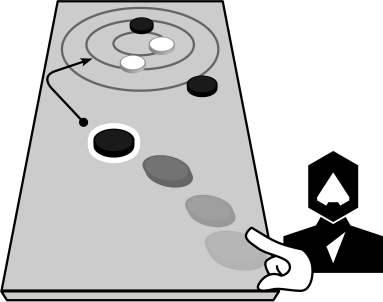
A Physical Action needs to be performed by one or more players to determine the outcome of the action.
Discussion
Adding a physical element for resolving player actions makes for an intuitive, tense, and exciting play experience by adding Performance Uncertainty (Chapter 6). Physical Action resolution is somewhat skill-based but also acts as a randomizer. However, its use does give a game a lighter, toyetic feel, as players interact with the game pieces. In a highly strategic game, this can lead to a disconnect, as the strategy is undercut by what can feel like a highly variable resolution mechanism. It also can make players that are poor at performing the activity feel like they are at a disadvantage throughout the game, and it is not something that they can compensate for, leading to a negative experience. The most common implementation of Physical Action is flicking, which is covered in its own entry, RES-24. Games with balance and stacking elements are also common and are covered in RES-25. While flicking is a popular implementation of a physical resolution mechanism, there are many alternatives. Flip Ships has a form of flicking, with a ship being placed on a platform and flipped off of it. Dungeon Fighter has players bounce a die off the table surface to land on a target.
Wallenstein introduced the Cube Tower. This is a tower with internal ledges. Players resolve a conflict by taking a specific number of cubes of different colors (the attacking and defending cubes, for example), and throw them into the tower. The cubes that emerge at the bottom determine the out-come. Cubes that get stuck inside are left behind and may emerge in future conflicts. If a player knows he or she has many cubes stuck in the tower, he or she may be more inclined to initiate conflicts, for example. Other games have objects being removed, like Ker-Plunk and Don’t Break the Ice. There are also games that combine removal with stacking, including Jenga and Villa Paletti. Finally, there are a variety of outlier physical mechanics, including throwing darts in Dart Wars, distinguishing items by feel in Space Cadets, eggremoval in Gulo Gulo, the pie launcher of Pie Face, finger gymnastics of Climb!, and popping balloons in Kamasutra. A comprehensive listing of these is beyond the scope of this book. Another variation on the physical resolution is Speed Matching. Cards are flipped up, and players need to see if two match, and either slap the cards or grab a totem. Games that incorporate this type of system include Jungle Speed and Scan. The inclusion of physical action can give players an opportunity to feint and induce a mistaken grab by other players, leading to a penalty in some games. Jungle Speed incorporates this tactic. Introducing a physical action gives the designer a chance to add physical handicaps to mix up the challenges and make them harder. It also ups the “zaniness” factor, giving games a lighter feel. Dungeon Fighter has players act with their non-dominant hands, eyes closed, and various other physical challenges.
Sample Games
Animal Upon Animal (Miltenberger, 2005) Ascending Empires (Cooper, 2011) Bausack (Zoch, 1987) Catacombs (Amos, Kelsey, and West, 2010) Climb! (Michaud, 2008) Dart Wars (Reymond, 2006) Diskwars (Gelle, Hardy, Jolly, and Petersen, 1999) Don’t Break the Ice (Uncredited, 1965) Dungeon Fighter (Buonfino, Silva, and Sorrentino, 2011)
Flick ’em Up (Beaujannot and Monpertuis, 2015) Flip Ships (Klenko, 2017) Gulo Gulo (Granau, Kramer, and Raggan, 2003) Jenga (Scott, 1983) Jungle Speed (Vuarchex and Yakovenko, 1997) Junk Art (stacking) (Cormier and Lim, 2016) Kamasutra (Faidutti, 2000) Ker-Plunk (Goldfarb and Soriano, 1967) Meeple Circus (Millet, 2017) Pie Face (Uncredited, 1964) Scan (Glass, 1970) Seal Team Flix (Ruth and Tomas, 2018) Space Cadets (Engelstein, Engelstein, and Engelstein, 2012) Villa Paletti (Payne, 2001) Wallenstein (Henn, 2002)
描述
需要由一名或多名玩家执行物理动作(Physical Action)才能确定动作的结果。
讨论
增加物理元素来解决玩家行动,通过增加表现不确定性(Performance Uncertainty,第6章),使游戏体验直观、紧张和刺激。物理动作解决在一定程度上基于技能,但也充当随机发生器。然而,随着玩家与游戏棋子的互动,它的使用确实给游戏带来了一种更轻松、更像玩具的感觉。在高度战略性的游戏中,这可能会导致脱节,因为策略会被感觉像是一个高度可变的解决机制所削弱。这也可能使不擅长进行该活动的玩家感到他们在整个游戏中处于劣势,而且这不是他们可以弥补的,从而导致负面体验。物理动作最常见的实现是弹指,这在单独的条目RES-24中涵盖。具有平衡和堆叠元素的游戏也很常见,并在RES-25中涵盖。虽然弹指是物理解决机制的流行实现,但也存在许多替代方案。《Flip Ships》有一种弹指形式,船被放置在平台上并从平台上翻转下来。《Dungeon Fighter》让玩家将骰子从桌面上反弹以落在目标上。
《Wallenstein》引入了方块塔(Cube Tower)。这是一个内部有壁架的塔。玩家通过拿取特定数量的不同颜色的方块(例如攻击方块和防御方块)并将它们扔进塔中来解决冲突。底部出现的方块决定了结果。卡在里面的方块被留下,并可能在未来的冲突中出现。例如,如果玩家知道他或她有许多方块卡在塔里,他或她可能更倾向于发起冲突。其他游戏有移除物体,如《Ker-Plunk》和《Don’t Break the Ice》。也有结合移除和堆叠的游戏,包括《Jenga》和《Villa Paletti》。最后,还有各种异常的物理机制,包括在《Dart Wars》中扔飞镖,在《Space Cadets》中凭感觉分辨物品,在《Gulo Gulo》中移除鸡蛋,《Pie Face》的馅饼发射器,《Climb!》的手指体操,以及在《Kamasutra》中戳破气球。这些的全面列表超出了本书的范围。物理解决的另一种变体是速度匹配。卡牌翻开,玩家需要查看两张是否匹配,并且要么拍打卡牌,要么抓住图腾。包含此类系统的游戏包括《Jungle Speed》和《Scan》。物理动作的加入可以让玩家有机会佯攻并诱使其他玩家错误抓取,从而在某些游戏中导致惩罚。《Jungle Speed》结合了这一战术。引入物理动做为设计师提供了增加物理障碍来混合挑战并增加难度的机会。它也提高了“滑稽”因素,给游戏一种更轻松的感觉。《Dungeon Fighter》让玩家用非惯用手、闭眼和各种其他物理挑战来行动。
游戏范例
Animal Upon Animal (Miltenberger, 2005) - 《动物叠叠高》 Ascending Empires (Cooper, 2011) - 《Ascending Empires》 Bausack (Zoch, 1987) - 《巴贝奇》 Catacombs (Amos, Kelsey, and West, 2010) - 《Catacombs》 Climb! (Michaud, 2008) - 《Climb!》 Dart Wars (Reymond, 2006) - 《Dart Wars》 Diskwars (Gelle, Hardy, Jolly, and Petersen, 1999) - 《Diskwars》 Don’t Break the Ice (Uncredited, 1965) - 《敲冰块》 Dungeon Fighter (Buonfino, Silva, and Sorrentino, 2011) - 《Dungeon Fighter》
Flick ’em Up (Beaujannot and Monpertuis, 2015) - 《Flick ’em Up》 Flip Ships (Klenko, 2017) - 《Flip Ships》 Gulo Gulo (Granau, Kramer, and Raggan, 2003) - 《Gulo Gulo》 Jenga (Scott, 1983) - 《叠叠乐》 Jungle Speed (Vuarchex and Yakovenko, 1997) - 《图腾快手》 Junk Art (stacking) (Cormier and Lim, 2016) - 《垃圾艺术》 Kamasutra (Faidutti, 2000) - 《Kamasutra》 Ker-Plunk (Goldfarb and Soriano, 1967) - 《Ker-Plunk》 Meeple Circus (Millet, 2017) - 《米宝马戏团》 Pie Face (Uncredited, 1964) - 《Pie Face》 Scan (Glass, 1970) - 《Scan》 Seal Team Flix (Ruth and Tomas, 2018) - 《海豹突击队》 Space Cadets (Engelstein, Engelstein, and Engelstein, 2012) - 《太空学员》 Villa Paletti (Payne, 2001) - 《Villa Paletti》 Wallenstein (Henn, 2002) - 《Wallenstein》